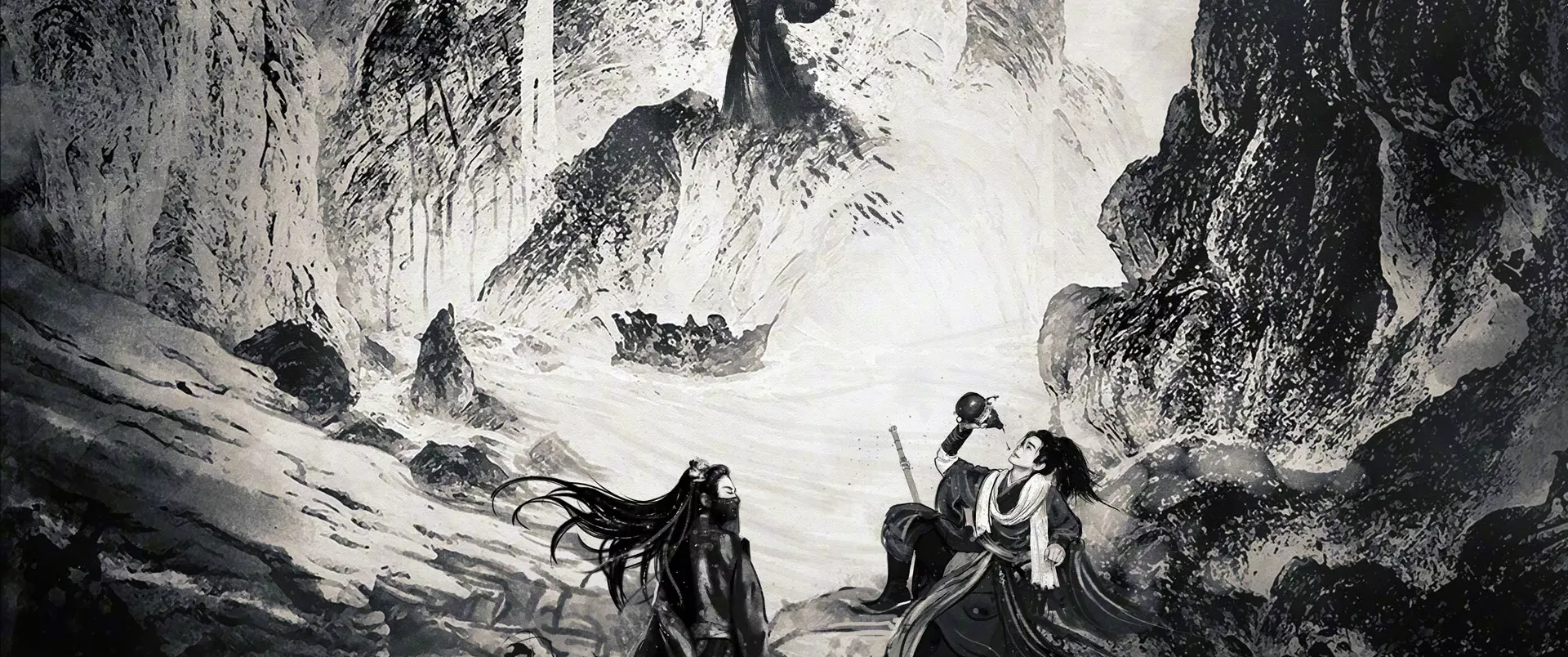
Linghu Chong (simplified: 令狐冲, traditional: 令狐沖, pinyin: Lìnghú Chōng, jyutping: Ling4 wu4 Cung1)1 was the 25-year-old senior disciple of the Huashan School who embodied the spirit of individual freedom that opposed the rigid hierarchies and power struggles of the orthodox jianghu.2 Despite his love of wine and apparent carelessness, Linghu Chong possessed an unwavering moral compass and exceptional martial arts talent, eventually mastering the legendary Nine Jians of Dugu and becoming a formidable swordsman of his generation.
Biography
Early life
Linghu Chong was orphaned in early childhood. At the age of ten, Yue Buqun, the leader of Huashan School, and his wife Ning Zhongze took him in and treated him as their own son. Yue Lingshan was then three. He often carried her out to pick wild fruit and catch rabbits, and he was groomed to become the school’s next leader. As the eldest disciple, he held the position of eldest shixiong3 among the Mount Hua students and bore responsibility for guiding his junior fellow disciples, including shidi4 such as Lao Denuo, Liang Fa, Shi Daizi, Gao Genming, Lu Dayou, Tao Jun, and Ying Bailuo.
From childhood, Linghu Chong developed a deep bond with Yue Lingshan, whom he considered both his younger shimei and potential romantic partner. His carefree nature and frequent drinking habits often earned him disapproval from Yue Buqun, who valued propriety and orthodox behaviour above all else. Despite his casual attitude toward rules, Linghu Chong demonstrated exceptional natural talent in swordsmanship and genuine loyalty to his school and shifu5.
Punishment and the meeting with Feng Qingyang
Linghu Chong’s friendship with the notorious bandit Tian Boguang began when he rescued the Northern Hengshan School nun Yilin from the lecher’s advances. To protect Yilin’s reputation, he gave a false name, claiming to be the older disciple Lao Denuo, and made up the saying that to see a nun was to lose every gamble, until Tian Boguang let her go. On Mount Heng he also stood against Fei Bin for Liu Zhengfeng and Qu Yang, and took the score of Laughing in the Wind from them before they died. Yue Buqun then confined him on Jade Maiden Peak, at Mount Hua’s Cliff of Contemplation. In the cliff he found chambers of martial arts left by earlier generations.
There he met Feng Qingyang, a master of the Huashan sword faction who had withdrawn from the jianghu. Feng Qingyang first spent a single night teaching him enough to beat Tian Boguang, then taught him the whole of the Nine Jians of Dugu, and told him not to reveal where the master was. During that study the two grew as close as grandfather and grandson. Because Linghu Chong kept the secret, Yue Buqun came to suspect that the sudden advance came from stealing the Lin family’s Evil-Warding Swordplay.
When the exiled sword faction came back to Mount Hua, Cheng Buyou’s palm caught Linghu Chong full in the chest. Later, barely able to stand, he still defeated Feng Buping with the Nine Jians of Dugu, using no neili at all. A Taishan Daoist watching said the qi faction’s disciple had the better swordplay and the sword faction’s elder the stronger neili, as if the two factions had changed places. With the same sword he then blinded fifteen masked men sent by Zuo Lengchan.
The Five Mountains merger
Zuo Lengchan of the Songshan School tried to force the Five Mountains Sword Schools into one school under himself. Linghu Chong’s opposition put him at odds with Yue Buqun, who wanted the merger for his own ends.
Luoyang, Shaolin, and Plum Manor
The Six Immortals of the Peach Valley (桃谷六仙) forced six streams of zhenqi into him, and Never Abstain two more. Even the Killing Doctor Ping Yizhi could do nothing with the result. The score of Laughing in the Wind that Linghu Chong carried was taken for the Evil-Warding Sword Manual. In Luoyang, at the house of Lin Pingzhi’s maternal grandfather, he looked for someone who could read music, and so met the Elder of the Green Bamboo and Ren Yingying. He took Yingying for an aged granny. She taught him the qin and listened to him. For her sake, members of the Sun Moon Holy Order and other heroes gathered at Five Hegemons Ridge. For a time on the road he passed as Feng Erzhong,6 and later in the uniform of the officer Wu Tiande.7
At Shaolin he woke to learn that Yue Buqun had expelled him for keeping company with the school’s enemies. Abbot Fangzheng would have taken him as a lay disciple and taught him the Tendon-Transmuting Sutra. He refused to change schools, and left still injured. On the road he found Xiang Wentian surrounded, fought beside him, and the two became sworn brothers.
Xiang Wentian took him to Plum Manor and wagered treasures of the qin, of chess, of calligraphy and of painting that no one there could beat Linghu Chong with a sword. Linghu Chong won five bouts. The hosts then sent him into a dungeon to meet a prisoner surnamed Ren. Xiang Wentian used the visit to put Ren Woxing in Linghu Chong’s place. Locked in, Linghu Chong learnt the Greater Star-Absorbing Technique that Ren Woxing had carved on the wall. The injury healed, and his neili advanced. He refused Ren Woxing’s invitation to join the order.
Hengshan, Blackwood Cliff, and Songshan
Mo Da told him that Ren Yingying was held at Shaolin, because she had offered her own life in exchange for his. He went with men of the order to fetch her, and found Dingxian, ambushed and dying. He accepted the Northern Hengshan School from her, and so became its zhangmen.8 The party was then trapped in the monastery, and escaped by a hidden passage. He went back in secret. There Yue Buqun tried to draw him with the Chongling Sword Technique, and hinted that Yue Lingshan might marry him if he lost on purpose. He would not leave Ren Yingying, Xiang Wentian and Ren Woxing behind, and he defeated Yue without having planned to.
On Blackwood Cliff, Linghu Chong, Xiang Wentian and Ren Woxing could not finish Dongfang Bubai between them. Ren Yingying seized Yang Lianting, and Linghu Chong killed Dongfang Bubai in that opening. Ren Woxing, restored as leader, offered him Yingying’s hand, and withheld a cure for the Star-Absorbing Technique’s after-effects unless he joined the order. Linghu Chong saw no difference between Ren Woxing and Dongfang Bubai, and refused.
He led the Northern Hengshan School to Mount Song to stop the merger. Yue Lingshan wounded him in the contest. Yue Buqun, who had the reputation of a junzi,9 blinded Zuo Lengchan with the Evil-Warding Swordplay, for which he had castrated himself, and became leader of the alliance.
Deaths, the cave, and withdrawal
Yue Lingshan and Lin Pingzhi went to take revenge on Yu Canghai and Mu Gaofeng. Lin Pingzhi was blinded on that journey, and Linghu Chong and Ren Yingying kept watch along the road. Lin Pingzhi later killed Yue Lingshan. As she died, Linghu Chong promised to look after the man who had killed her. His shimu10 Ning Zhongze took her own life. He came to see that Yue Lingshan had admired her father from childhood, and that the gentle Lin Pingzhi stood closer to that pattern than he did. He also learnt that Yue Buqun had killed Dingxian.
At the gathering Yue Buqun staged in the cave on the Cliff of Contemplation, Linghu Chong killed Zuo Lengchan with the Nine Jians of Dugu. He severed the bone and tendons of Lin Pingzhi’s right arm, stabbed both his legs, and then cut the tendons of the left arm, and had several Northern Hengshan nuns seize him at the cave mouth. He kept the promise made to Yue Lingshan. Three years later, Ren Yingying said he had shut Lin Pingzhi in the black cell under Plum Manor, with food and clothes, so that no one could harm him, and that this was care for the rest of his life. Yue Buqun caught Linghu Chong and Ren Yingying in a net as they came out of the cave. Yilin killed him and freed them.
Ren Woxing brought the order to Mount Hua to destroy the Five Mountains schools, spared Hengshan for a month, and again demanded that Linghu Chong join. He refused. A month later the order reached Mount Heng under Ren Yingying. Ren Woxing had died because he could not contain the zhenqi the Star-Absorbing Technique had drawn in. Linghu Chong and Ren Yingying settled the quarrel between the orthodox schools and the order, and exchanged betrothal gifts. She passed the order’s leadership to Xiang Wentian. After three years of mourning they married. Abbot Fangzheng, laying aside the barrier between the schools, taught Linghu Chong the Tendon-Transmuting Sutra while pretending the formula came from Feng Qingyang. Yingying was the one who told him what he had learnt, and the after-effects cleared. He passed the Northern Hengshan leadership to Yiqing. On Mount Hua, Ren Yingying said she had never thought she would end up tied to a great monkey like him (大马猴 – dà mǎhóu). The two put away their swords and left the jianghu as wandering xia.11
Personality and traits
Physical appearance
Linghu Chong was described as having a square face (长方脸蛋) with distinct features, sword-like eyebrows (剑眉), and thin lips (薄唇) that gave him a resolute and handsome appearance. His tall stature and confident bearing marked him as a natural leader, though his casual demeanour often masked his martial prowess from those who did not know him well. Even when unconscious from injury, his distinctive facial features made him immediately recognisable to those who knew him.
Personality and traits
Linghu Chong embodied the archetype of the free-spirited hero who valued personal authenticity over social expectations. His love of wine was legendary throughout the jianghu, often leading to humorous situations but never compromising his moral principles when serious matters arose. Despite his casual demeanour, he possessed an intuitive understanding of right and wrong that guided his actions consistently throughout his adventures.
His loyalty ran deep, particularly toward those he considered genuine friends regardless of their factional affiliations. This trait frequently put him at odds with orthodox expectations but ultimately proved more reliable than institutional loyalty, as demonstrated by his shifu’s betrayal of traditional values. He maintained a childlike sense of humour and playfulness even in dangerous situations, often diffusing tension through jokes and unconventional behaviour. When challenged with the question “What thing are you?” (你是什么东西?), he famously retorted “Then what north-south are you?” (那你是什么南北?), demonstrating his quick wit and refusal to be intimidated.
Values and principles
Unlike many martial artists who sought power or recognition, Linghu Chong consistently chose freedom over authority and authenticity over appearance. He refused prestigious positions and rejected opportunities for advancement that would have required him to compromise his principles or restrict his independence. This included declining offers to join the Shaolin Monastery and refusing to use his position as Northern Hengshan’s leader for personal gain.
His approach to martial arts reflected his character—he excelled not through rigid training regimens but through natural talent and an understanding of fundamental principles. The Nine Jians of Dugu suited him perfectly because it emphasised adaptation and improvisation over memorised patterns, mirroring his philosophy of life.
Martial arts abilities
Huashan Swordplay
As a Huashan disciple, Linghu Chong mastered the school’s traditional sword techniques taught by Yue Buqun and Ning Zhongze. These included classic forms such as White Clouds Emerging from Mountain Peaks (白云出岫), Phoenix Comes with Grace (有凤来仪), Immortal Hangs Upside Down (天绅倒悬), White Rainbow Pierces the Sun (白虹贯日), Ancient Pine Welcomes Guests (苍松迎客), Golden Goose Soars Across Sky (金雁横空), Endless Falling Leaves (无边落木), Green Mountains Faintly Visible (青山隐隐), and Ancient Cypress Forest (古柏森森). He also learnt the unique technique “Peerless and Unmatched, Lady Ning’s Sword” (无双无对、宁氏一剑) from his [shimu]10 Ning Zhongze, as well as the Taiyue Three Green Peaks (太岳三青峰) technique.
Violet Dawn Power
Linghu Chong also trained in Huashan’s signature qi cultivation method, the Violet Dawn Power12 (紫霞神功), an orthodox neigong method emphasising refinement and spiritual cultivation. Though his casual attitude toward practice initially limited his progress, his natural constitution and pure intentions allowed him to make steady advances in this foundational art.
Chongling Sword Technique
Together with Yue Lingshan, beside Jade Maiden Peak, Linghu Chong made the Chongling Sword Technique13 (冲灵剑法). The name joins his 冲 with her 灵. His gift was much the greater, and he liked to leave set forms behind, so nine-tenths of the sword was his. Their attainment was still shallow. The forms had little that was formidable, and they were of no use against an enemy, but the two practised them in private until they were familiar, and the set carried the pledge of their early attachment. At the contest on Mount Song they used Green Plums like Beans (青梅如豆), Willow Leaves like Brows (柳叶似眉), First Meeting in the Mist (雾中初见), Sudden Meeting after Rain (雨后乍逢), and Live and Die Together (同生共死).14
Greater Star-Absorbing Technique
A significant turning point came when Linghu Chong inadvertently learnt the dangerous Greater Star-Absorbing Technique15 (吸星大法) while imprisoned in Plum Manor. This forbidden art, derived from the Xiaoyao School’s Northern Darkness Divine Technique and Ding Chunqiu’s Power Transformation Technique, allowed him to absorb the neili of others and convert it into his own neili. The practitioner had to maintain their dantian (丹田 – dāntián) in a state like “a deep valley, always like a deep box” to successfully execute this dangerous method.
Tendon-Transmuting Sutra
He refused the Tendon-Transmuting Sutra16 (易筋经) when Abbot Fangzheng first offered it at Shaolin. After the Greater Star-Absorbing Technique began to turn against him, Fangzheng taught him an internal formula while pretending it was a message from Feng Qingyang. Ren Yingying later told him that the formula was the Tendon-Transmuting Sutra. This Shaolin method, attributed to Bodhidharma, is described as drawing the body’s channels into one circuit and binding the spirit of the five organs, so that qi arises within and the blood is nourished from without. Once it is understood, an ordinary art can be driven by it to a different order of effect.
Nine Jians of Dugu
The Nine Jians of Dugu became Linghu Chong’s defining martial art. Feng Qingyang taught it to him on the Cliff of Contemplation. The nine stances, from the General Sword Stance to the Breaking Qi Stance, are set out under Nine Jians of Dugu. He used them against Tian Boguang, Ren Woxing, Dongfang Bubai, Yue Buqun and Zuo Lengchan. The sword, created by Dugu Qiubai, finds the gap in an opponent’s form. There is no fixed attack. It follows what the user intends once the gap is seen. He never fully mastered the Breaking Palm Stance or the Breaking Qi Stance. Feng Qingyang told him he would need twenty more years of hard practice to contend with the best, and Linghu Chong took that to mean the Breaking Palm Stance above all.
Five Mountains Sword Techniques
During his confinement on the Cliff of Contemplation, Linghu Chong found stone carvings of the five schools’ sword techniques, with the breaks in them, left by the Ten Elders of the Sun Moon Holy Order. He studied the carvings for several months. The lost forms were more complete than the versions the five schools still practised. He later taught the lost Hengshan sword to the Northern Hengshan disciples.
Relationships
Linghu Chong’s relationship with his adoptive family formed the emotional core of his character development. His bond with Yue Buqun began as that of a devoted son to a respected father figure, but gradually deteriorated as Yue’s true nature became apparent. The painful realisation that his beloved shifu had become corrupted by ambition represented Linghu Chong’s loss of innocence regarding authority figures.
His bond with Yue Lingshan began in childhood, as shixiong and shimei and as sweethearts. After Lin Pingzhi entered the school, and while Linghu Chong was on the cliff, she drew closer to Lin Pingzhi. When someone took liberties with her, Linghu Chong killed nine men in succession. He would not have her harmed. Her death at Lin Pingzhi’s hands, and the promise he made her as she died, stayed with him. He said afterwards that she had admired her father from childhood, and that the gentle Lin Pingzhi was closer to the man she wanted than he was.
Master-disciple relationships
The contrast between Linghu Chong’s relationships with his two masters illustrated different approaches to martial arts instruction. Yue Buqun’s teaching emphasised discipline and orthodoxy but concealed selfish motives, while Feng Qingyang’s brief instruction focused on principles and character rather than specific techniques.
Feng Qingyang recognised Linghu Chong’s pure nature and natural talent, providing him with martial arts techniques that matched his temperament. The elderly master’s teachings emphasised understanding over memorisation, perfectly suiting his student’s intuitive approach to learning and life.
Romantic relationships
Ren Yingying taught him the qin, listened to him, and carried him, injured, to Shaolin, offering her own life for a cure. He came to love her, and still thought of Yue Lingshan after the marriage, without setting Yingying aside. Yilin loved him and never hid it. Her father, Never Abstain, and her mother, Mute Granny, each pressed him to marry her. He refused. Yilin would not injure him for it, and the two kept the affection of brother and sister.
Friendships and rivalries
Throughout his adventures, Linghu Chong formed friendships across factional lines, demonstrating his ability to judge people by their actions rather than their affiliations. His sworn brotherhood with Xiang Wentian, a member of the Sun Moon Holy Cult, exemplified this approach to relationships. He also developed close friendships with various jianghu figures including Zu Qianqiu, Lao Touzi, Lan Fenghuang, Ji Wushi, Huang Boliu, and the Six Immortals of the Peach Valley, demonstrating his natural ability to befriend people regardless of their orthodox or unorthodox affiliations.
Behind the scenes
Linghu Chong represents Jin Yong’s exploration of individual freedom versus institutional authority during the Cultural Revolution era. Though the author denied direct political allegory, the character’s rejection of orthodox hierarchies and embrace of personal authenticity resonated with readers experiencing similar tensions in their own society.
Literary significance
The character broke new ground in wuxia fiction by presenting a protagonist who ultimately rejected power and conventional success in favour of personal freedom. Unlike traditional heroes who sought to reform corrupt systems from within, Linghu Chong chose complete withdrawal from political structures, embodying a different model of heroism.
His martial arts journey also departed from conventional patterns. Rather than steadily accumulating power through dedicated training, he achieved greatness through understanding fundamental principles and maintaining moral purity. This approach aligned with Daoist philosophical concepts that emphasised naturalness over forced effort.
Cultural impact
Linghu Chong’s popularity helped establish a new archetype in Chinese popular culture—the reluctant hero who valued authenticity over authority. His approach to life, combining carefree enjoyment with unwavering moral principles, offered an alternative to both rigid conformity and selfish rebellion.
The character embodied the ideal of the chivalrous swordsman who maintained his principles while navigating the often treacherous waters of jianghu politics. His journey from a carefree disciple to a mature martial artist reflected the novel’s themes of growth, loyalty, and the complexity of human relationships. Jin Yong himself described Linghu Chong as not a great hero, but, like Tao Yuanming, someone who pursues freedom and individual liberation. In the afterword he added that Linghu Chong’s love for his shimei and for Ren Yingying was itself unfree, so that he ended inside love’s yoke, and that he may have been free only in Yilin’s unrequited love.17
In The Deer and the Cauldron, the Shaolin monk Chengguan looks back on Dugu Qiubai and on Linghu Chong as men of an earlier age who were unmatched because they overcame every stance by having none.17
Ni Kuang called Linghu Chong’s character the most lovable Jin Yong wrote: more at ease than Yang Guo, and with more presence than Wei Xiaobao. The Dictionary of Chinese Wuxia Fiction (中国武侠小说鉴赏辞典) set the small faults against the large fidelity, put the loyalty beside Guo Jing, the pride beside the one-armed Yang Guo, the wildness beside Duan Yu, and the unruliness as a forerunner of Wei Xiaobao, and found the moving part in his readiness to help the desperate without counting his own life. Chen Mo called him a representative figure of the quick, unruled Chinese mind, set against the part of the tradition that presses that freedom down.17
Portrayals
Linghu Chong has been portrayed by numerous actors in film and television adaptations of Laughing in the Wind:
Television series
- 1984 series – Chow Yun-fat
- 1985 series – Bryan Leung
- 1996 series – Jackie Lui
- 2000 series – Richie Jen
- 2000 Singapore series – Steve Ma
- 2001 series – Li Yapeng
- 2013 series – Wallace Huo
- 2018 series New Laughing in the Wind (新笑傲江湖) – Ding Guansen (丁冠森)
Film adaptations
- 1978 film The Proud Youth – Wong Yue
- 1990 film The Swordsman – Sam Hui
- 1992 film Swordsman II – Jet Li
Chow Yun-fat’s portrayal in the 1984 television series is widely regarded as the definitive interpretation of the character, capturing both Linghu Chong’s carefree spirit and underlying depth. His performance helped establish many of the character traits that subsequent adaptations would reference and became the standard against which other portrayals were measured. At the launch of the 2001 series, Jin Yong said that of the actors who had played Linghu Chong, Jet Li was the closest in looks and temperament, and Li Yapeng the next.17
See also
- Laughing in the Wind characters
- Huashan School
- Ren Yingying – his wife
- Nine Jians of Dugu – the sword Feng Qingyang taught him
- Northern Hengshan School – the school he led, then passed to Yiqing
Follow the archive routes
- Read: Continue with Laughing in the Wind or browse the translation archive.
- Explore: Follow the Laughing in the Wind character pages and faction pages.
- Understand: Start with wuxia and jianghu for the genre and social-world context.
- Watch: Follow wuxia adaptations for the screen route.
- Write: Study story elements in wuxia fiction for craft grounded in the novels.
External links
- Linghu Chong on Wikipedia
- Linghu Chong (Chinese) on Chinese Wikipedia
- Linghu Chong (Chinese) on Baidu Baike
Footnotes
-
冲 – chōng. Written with the ice radical, and here meaning empty, set against 盈 (yíng, full) in Ren Yingying’s name. Distinct from 沖, the water radical. See Chinese Wikipedia. ↩
-
江湖 – jiānghú. Literally rivers and lakes. The itinerant world beyond settled society and official reach, holding not only martial artists but the trades that travel with them, including pedlars, physicians, fortune-tellers, entertainers, boatmen, beggars, outlaws and the like. See Wuxia Wiki. ↩
-
师兄 – shīxiōng. Male senior. Both apprenticed to the same shifu. Shī means teacher. Xiōng means older brother. See Wuxia Wiki. ↩
-
师弟 – shīdì. Male junior. Both apprenticed to the same shifu. Shī means teacher. Dì means younger brother. See Wuxia Wiki. ↩
-
师父 – shīfù. Teacher responsible for technical instruction and moral guidance. Shī means teacher. Fù means father. See Wuxia Wiki. ↩
-
Laughing in the Wind, Chapter 20. ↩
-
Laughing in the Wind, Chapter 22. ↩
-
掌门 – zhǎngmén. Literally the one who holds the gate. The head of a martial arts school or order, holding its authority and its transmission. Zhǎng means to take charge of or preside over. Mén means gate, and by extension the school itself. See Wuxia Wiki. ↩
-
君子 – jūnzǐ. Gentleman. A person of moral refinement and ethical conduct in Confucian philosophy. ↩
-
师母 – shīmǔ. The wife of one’s shifu, holding a matriarchal role within the school. Shī means teacher. Mǔ means mother. See Wuxia Wiki. ↩ ↩2
-
侠 – xiá. A person adept in the martial arts who acts with chivalry and upholds the right. See Wuxia Wiki. ↩
-
紫霞神功 – Zǐxiá Shéngōng. Violet Dawn Power. Huashan School’s signature qi cultivation method. See Violet Dawn Power. ↩
-
冲灵剑法 – Chōnglíng Jiànfǎ. Chongling Sword Technique. A sword technique made by Linghu Chong and Yue Lingshan beside Jade Maiden Peak. See Chongling Sword Technique. ↩
-
The first two names come from Ouyang Xiu’s ci to the tune Ruan Lang Gui (阮郎归): 南园春半踏青时,风和闻马嘶。青梅如豆柳如眉,日长蝴蝶飞。 See Chinese Wikipedia. ↩
-
吸星大法 – Xīxīng Dàfǎ. Greater Star-Absorbing Technique. A powerful technique that allows the practitioner to absorb others’ neili. See Greater Star-Absorbing Technique. ↩
-
易筋经 – Yìjīn Jīng. Tendon-Transmuting Sutra. A Shaolin internal method. Fangzheng passed it to Linghu Chong under Feng Qingyang’s name. See Tendon-Transmuting Sutra. ↩
-
令狐冲 on Chinese Wikipedia, which quotes Jin Yong’s afterword, the later novel, Ni Kuang, the Dictionary of Chinese Wuxia Fiction, and Chen Mo. ↩ ↩2 ↩3 ↩4