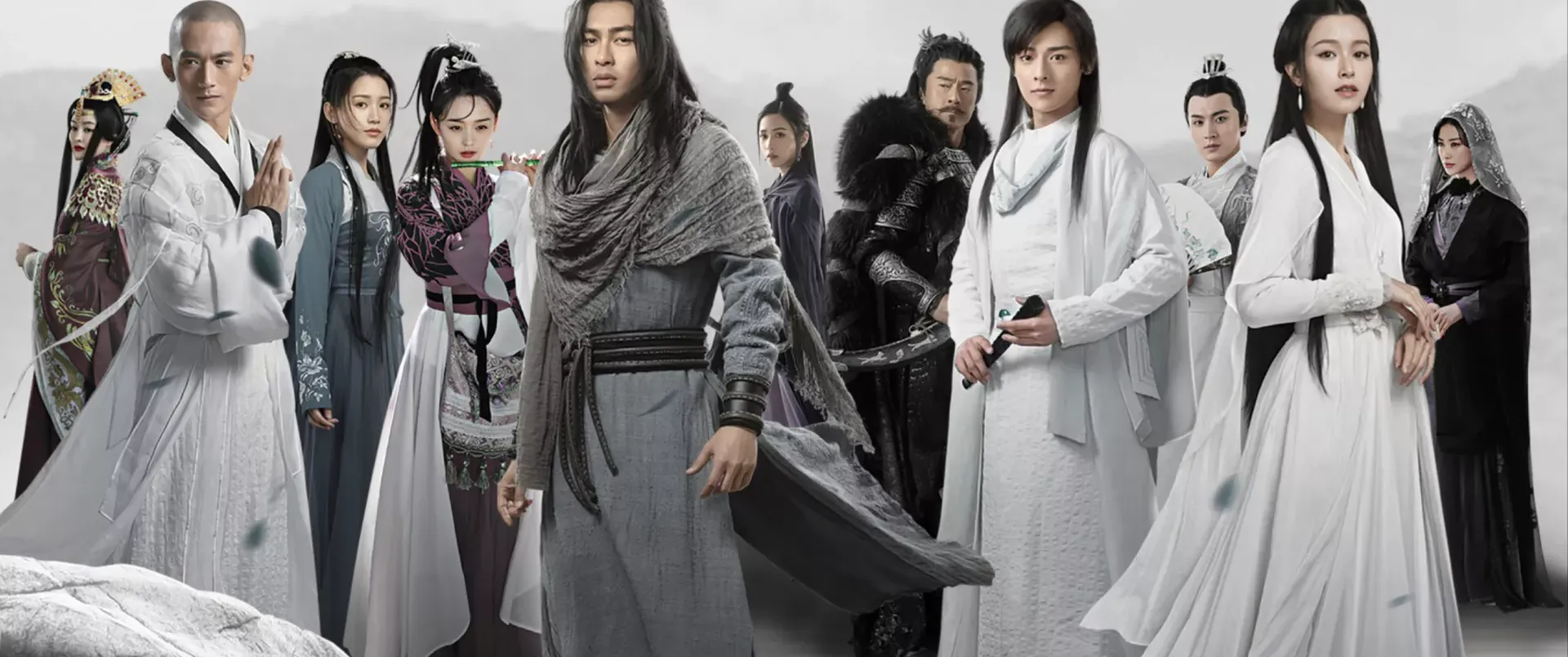
Shaolin Order (simplified: 少林派, traditional: 少林派, pinyin: Shàolín Pài) is one of the most prestigious orthodox martial arts schools in the wulin, often mentioned alongside the Wudang Order as the “Northern Shaolin, Southern Wudang” (北崇少林,南尊武当 – Běi Chóng Shàolín, Nán Zūn Wǔdāng). The order is known for combining Buddhist practice with martial arts training, following the principle of “Zen and martial arts as one” (禅武不二 – Chán Wǔ Bù Èr).
The Order is distinct from Shaolin Monastery (少林寺 – Shàolín Sì), the institution and the place on Mount Song where its monks live. The Order is the martial lineage, and it is wider than the monastery: a lay disciple such as Du Dajin belongs to the Shaolin Order without ever being a monk of Shaolin Monastery. Jin Yong moves between the two deliberately, and the translations follow him site by site.
History
Foundation
The Shaolin Order traces its origins to the legendary Bodhidharma (达摩 – Dámó), who is said to have brought the foundational texts Tendon-trasmuting Sutra (易筋经 – Yìjīn Jīng) and Marrow Washing Classic (洗髓经 – Xǐsuǐ Jīng) from India. These texts became the basis for all subsequent Shaolin martial arts.
Development
The Shaolin Order developed as an orthodox martial arts school that emphasized both spiritual cultivation and martial training. The order’s martial arts are primarily external and hard-style techniques, focusing on hand-to-hand combat and staff techniques rather than weapons, in accordance with Buddhist principles of non-violence.
Organisation
Leadership structure
The Shaolin Order is led by an abbot (方丈 – Fāngzhàng) who oversees both spiritual and martial matters. The monastery maintains a hierarchical structure with various departments:
- Bodhidharma Hall (达摩院 – Dámó Yuàn): Specializes in martial arts research
- Arhat Hall (罗汉堂 – Luóhàn Táng): Handles external challenges and visitors
- Discipline Hall (戒律院 – Jièlǜ Yuàn): Oversees discipline and rules
- Scripture Repository (藏经阁 – Cángjīng Gé): Houses martial arts manuals and Buddhist texts
Generational naming
Shaolin monks follow generational naming conventions that vary by period:
- Northern Song: “Ling, Xuan, Hui, Xu, Kong” (灵、玄、慧、虚、空)
- Southern Song: “Ku, Tian” (苦、天)
- Yuan Dynasty: “Du, Kong, Yuan, Hui, Fa, Xiang, Zhuang” (渡、空、圆、慧、法、相、庄)
- Qing Dynasty: “Da, Jue, Guan, Hui, Cheng, Jing, Hua, Yan” (大、觉、观、晦、澄、净、华、严)
Martial arts abilities
Seventy-two Supreme Arts
The Shaolin Order is famous for its Seventy-two Supreme Arts (少林七十二绝技 – Shàolín Qīshí’èr Juéjì), a comprehensive collection of martial techniques that includes:
- Arhat Fist (罗汉拳 – Luóhàn Quán)
- Iron Cloth Shirt (铁布衫 – Tiěbùshān)
- Golden Bell Cover (金钟罩 – Jīnzhōngzhào)
- Vajra Finger (金刚指 – Jīngāng Zhǐ)
- One Finger Zen (一指禅 – Yīzhǐ Chán)
Core texts
The order’s martial arts are based on two fundamental texts:
- Tendon-trasmuting Sutra (易筋经 – Yìjīn Jīng): Focuses on physical conditioning and strength development
- Marrow Washing Classic (洗髓经 – Xǐsuǐ Jīng): Focuses on qi cultivation and spiritual purification
Notable members
Demi-Gods & Semi-Devils
- Sweeper Monk (扫地僧 – Sǎodì Sēng) - A mysterious monk in the Scripture Repository
- Xuanci (玄慈 – Xuáncí) - Abbot, known as “Tiger Subduing Arhat” (伏虎罗汉 – Fúhǔ Luóhàn)
- Xuanji (玄寂 – Xuánjì) - Discipline Hall Chief
- Xuannan (玄难 – Xuánnàn) - Bodhidharma Hall Chief
- Xuanku (玄苦 – Xuánkǔ) - Qiao Feng’s martial arts master
- Xuandu (玄渡 – Xuándù) - Senior monk
- Xuantong (玄痛 – Xuántòng) - Senior monk
- Xuanbei (玄悲 – Xuánbēi) - Senior monk
The Legend of the Condor Heroes
- Tianming Chanshi (天鸣禅师 – Tiānmíng Chánshī) - Abbot
- Wuse Chanshi (无色禅师 – Wúsè Chánshī) - Arhat Hall Chief
The Heaven Sword and Dragon-Slaying Dao
- Jueyuan Dashi (觉远大师 – Juéyuǎn Dàshī) - Scripture Repository Guardian
- Du’e (渡厄 – Dù’è) - Bodhidharma Hall Elder
- Dujie (渡劫 – Dùjié) - Bodhidharma Hall Elder
- Dunan (渡难 – Dùnán) - Bodhidharma Hall Elder
- Kongjian (空见 – Kōngjiàn) - One of the Four Divine Monks
- Kongwen (空闻 – Kōngwén) - One of the Four Divine Monks
- Kongzhi (空智 – Kōngzhì) - One of the Four Divine Monks
- Kongxing (空性 – Kōngxìng) - One of the Four Divine Monks
- Yuanzhen (圆真 – Yuánzhēn) - Also known as “Mixed Origin Thunder Hand” Cheng Kun
The Smiling, Proud Wanderer
The Deer & the Cauldron
- Huicong Chanshi (晦聪禅师 – Huìcōng Chánshī) - Abbot
- Chengguan (澄观 – Chéngguān) - Prajna Hall Chief
Locations
Shaolin Monastery
The monastery stands on Mount Song (嵩山 – Sōngshān) in Henan Province. Its complex includes:
- Mahavira Hall (大雄宝殿 – Dàxióng Bǎodiàn): The core building
- Discipline Hall (戒律院 – Jièlǜ Yuàn): Oversees discipline
- Bodhi Hall (菩提院 – Pútí Yuàn): Houses the Muscle Tendon Changing Classic
- Scripture Repository (藏经阁 – Cángjīng Gé): Houses the Seventy-two Supreme Arts manuals and Buddhist scriptures
- Bodhidharma Hall (达摩院 – Dámó Yuàn): Specializes in martial arts research
- Arhat Hall (罗汉堂 – Luóhàn Táng): Handles external challenges
- Prajna Hall (般若堂 – Bōrě Táng): Studies martial arts from other schools
- Medicine King Hall (药王院 – Yàowáng Yuàn): Treats injuries
- Skill Selection Building (选艺楼 – Xuǎnyì Lóu): Where disciples choose which of the Seventy-two Supreme Arts to study
Relationships
Orthodox alliance
The Shaolin Order maintains close relationships with other orthodox schools, particularly the Wudang Order. Together, they are considered the “Taishan Beidou” (泰山北斗 – Tàishān Běidǒu) of the jianghu, representing the highest standards of orthodox martial arts.
Conflict with heterodox schools
The order often finds itself in conflict with heterodox schools and evil factions, serving as a bastion of orthodox martial arts and Buddhist principles. The order’s reputation for justice and discipline makes it a target for those who oppose orthodox values.
Behind the scenes
Historical basis
Jin Yong’s Shaolin Order is built on the real Shaolin Monastery on Mount Song, long associated in Chinese culture with Chan Buddhism and martial reputation. Fictional devices such as the Seventy-two Supreme Arts, the generational dharma-name cycles, and cross-novel continuity (Condor trilogy, Demi-Gods and Semi-Devils, The Heavenly Sword and the Dragon Sabre) expand that reputation into a pan-jianghu institution rather than a documentary temple history.
Literary role
Across Jin Yong’s novels Shaolin is the default measure of orthodoxy: other schools define themselves by alliance with it, rivalry with it, or theft from it. That makes the order useful as both moral centre and bureaucratic obstacle — Xuzhu’s expulsion and return in Demi-Gods and Semi-Devils, or Shaolin’s conference politics in The Heavenly Sword and the Dragon Sabre, show how institutional righteousness can fail individuals.
Adaptations
Screen adaptations repeatedly restage Shaolin’s halls, arhat formations, and abbots as visual shorthand for orthodox power; emphasis swings between spiritual discipline and spectacular martial display depending on the production.
See also
- Jin Yong factions
- Demi-Gods and Semi-Devils factions
- Wudang Order – The other major orthodox school
- Seventy-two Supreme Arts – The order’s signature martial arts
- Muscle Tendon Changing Classic – One of the order’s core texts
- Marrow Washing Classic – One of the order’s core texts
- Mount Song – Location of Shaolin Monastery
External links
- Shaolin Monastery on Wikipedia
- Shaolin Monastery (Chinese) on Chinese Wikipedia