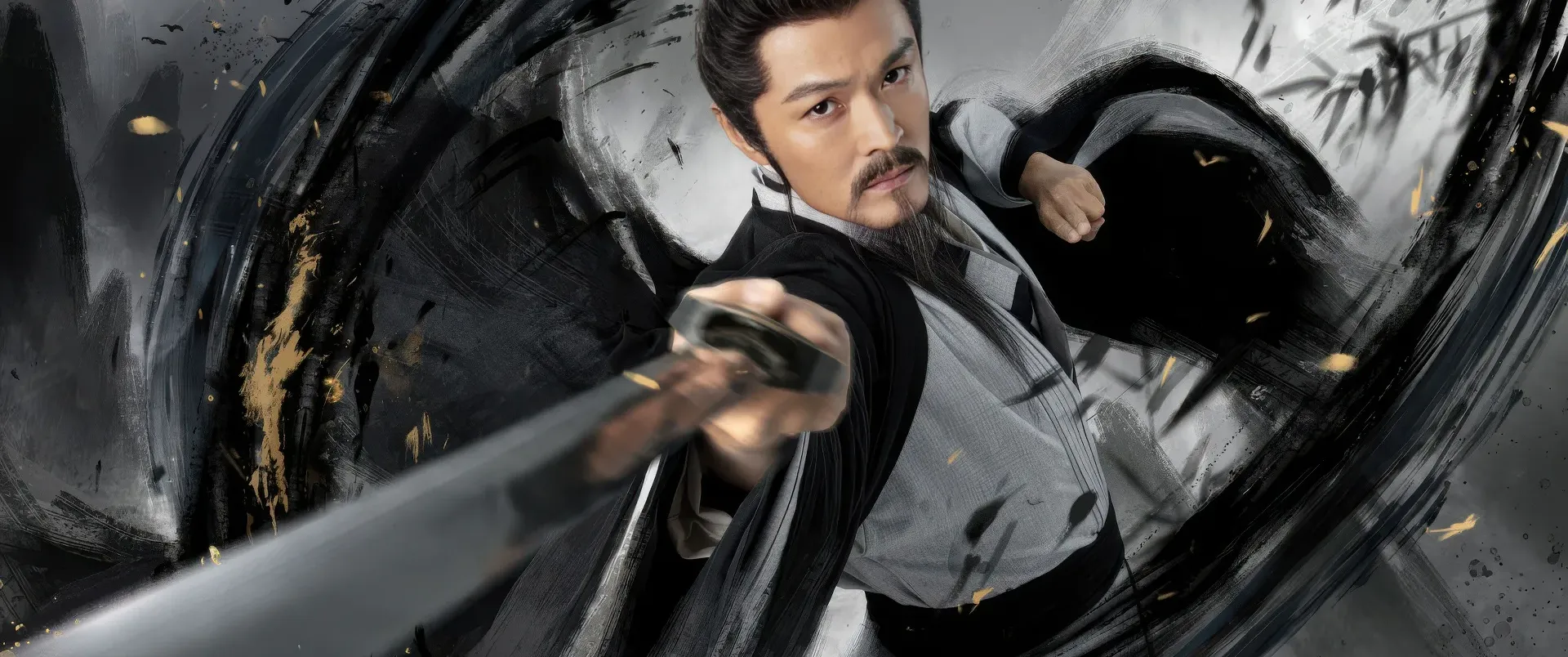
Wang Chongyang (simplified: 王重阳, traditional: 王重陽, pinyin: Wáng Chóngyáng, jyutping: wong4 cung4 joeng4), the Central Divine1 (中神通), also called Wang the Perfected One2 (王真人) and Chongyang the Perfected One3 (重阳真人), was the founder of the Quanzhen Order and the shifu of the Seven Zis of Quanzhen. At the first Huashan Sword Summit the other four of the Five Greats acknowledged him first under heaven in martial arts, and he took custody of the Nine Yin Manual. He had died before the events of The Legend of the Condor Heroes begin; his story is told by his junior and sworn brother Zhou Botong, by his disciples and by Great Master Yideng. The Return of the Condor Heroes adds his early life and his relationship with Lin Chaoying, founder of the Ancient Tomb School.
Biography
Early life and the uprising against the Jin
The Legend of the Condor Heroes says little of Wang Chongyang’s life before the Huashan Sword Summit. Zhou Botong recalled that the two of them had been good friends before Wang Chongyang became a Daoist.
In The Return of the Condor Heroes, Qiu Chuji told Guo Jing that his shifu had not been born a Daoist. As a young man he studied letters and then martial arts and roamed the jianghu. Enraged by the Jin invasion, he raised an army against the Jin, took towns and territory, and for a time built a great enterprise in the Central Plains, until the Jin proved too strong and his soldiers were almost all killed. Before the uprising he had used thousands of labourers over several years to build a vast underground storehouse for weapons, armour and grain, disguised as a tomb and fitted with mechanisms against attack. After the defeat he withdrew to it in bitterness, called himself the “Living Dead Person” (活死人), and for years would not step outside, as a man who would not live under the same sky as the Jin. Old friends and former comrades came to urge him to try again; he refused them all. The Jin emperor sent dozens of skilled fighters to kill him there, and he captured or killed every one.
Lin Chaoying and the Tomb of the Living Dead
The following account comes from The Return of the Condor Heroes. After eight years in the tomb, a lifelong rival stood outside and abused him for seven days and seven nights until he came out to fight. She laughed and said, “Since you have come out, you need not go back in.” He realised that her provocation had been kindly meant, and the two became friends and travelled the jianghu together. The rival was Lin Chaoying. She loved him and wished to marry him, but, unable to forget the enmity of his country, he pretended not to understand. Believing that he looked down on her, she turned against him, and they agreed to settle matters by a duel in the Zhongnan Mountains. Because he would not strike in earnest, they fought several thousand moves without result, and he proposed a contest of skill in place of combat.
At dusk the next day Lin Chaoying set the terms: if she lost, she would cut her own throat; if she won, he must give her the Tomb of the Living Dead and obey her for life, or else become a monk or a Daoist and build a temple on the mountain to keep her company for ten years. Knowing she would keep her word, he resolved to lose. She proposed that each write on a rock with a finger, and when he protested that no one could, she wrote eight lines of verse on Zhang Liang into the stone. He moved out of the tomb that night, became a Daoist the next day, and built a small Daoist temple nearby, the forerunner of Chongyang Palace.
Later Huang Yaoshi visited him on Zhongnan, and Wang Chongyang mentioned the riddle. A month afterwards Huang Yaoshi returned and wrote the rest of the poem into the same rock with his finger. When Wang Chongyang poked the rock it took the print of his finger. The trick, as Qiu Chuji later explained, was a stone-softening drug, 化石丹, which Lin Chaoying had held in her left palm while she stroked the stone before writing.
The Return of the Condor Heroes (3rd edition) also gives its narrator’s own account of why the match failed: each was proud of their martial skill, every stirring of affection brought rivalry with it, and Lin Chaoying was in the end slightly the stronger, so that Wang Chongyang, unwilling to stand below a woman, kept checking his feelings for her. In the same novel, love letters he wrote to her before he entered the Dao, signed with his given name Zhe (喆), were kept in her chest in the tomb; some told of his army’s defeats.
Founding of the Quanzhen Order
In The Return of the Condor Heroes, Qiu Chuji says that Wang Chongyang was bitter when he first became a Daoist, but through reading Daoist books he reached a great awakening and devoted himself to building up the order. He founded the Quanzhen Order and took seven disciples, in order of seniority: Ma Yu, Tan Chuduan, Liu Chuxuan, Qiu Chuji, Wang Chuyi, Hao Datong and Sun Buer.
Some of the Seven Zis’ conversions are recalled in The Legend of the Condor Heroes. Hao Datong, the richest man in Ninghai in Shandong and a student of the Book of Changes, became his disciple at the Cave of Smoke and Mist. Wang Chongyang took off his own robe, tore off both sleeves and gave it to him with the words, “Do not fret that you have no sleeves. You must complete yourself”, a pun on 袖 (sleeve) and 授 (to impart); Hao Datong afterwards wore half-sleeved robes. When he converted Sun Buer he gave her a painting of a skeleton, a reminder of how short life is, and she wore a skeleton on her Daoist robe.
Wang Chongyang also taught Zhou Botong martial arts, but told him not to become a Daoist, since he was obsessed with martial arts and too attached to them for the Daoist ideal of stillness and non-action. Of his seven disciples, Qiu Chuji was the strongest fighter but the one Wang Chongyang liked least, because he neglected the Dao for martial study; Ma Yu inherited his religious lineage. When Zhou Botong asked to become his sworn brother, Wang Chongyang at first demurred, but the two did swear brotherhood. Zhou Botong also recalled him saying that Zhou had the talent for martial arts but lacked the heart to save the world and help others, and so would never reach the summit.
The Huashan Sword Summit
Decades before the novel’s events the Nine Yin Manual resurfaced, and more than a hundred fighters died in the struggle for it. Wang Chongyang, Huang Yaoshi, Ouyang Feng, Emperor Duan of Dali and Hong Qigong met on the summit of Mount Hua at Wang Chongyang’s invitation, agreeing that the manual would go to the greatest fighter among them. It was the depth of winter and the mountain was snowbound. For seven days and seven nights the five discussed and fought in the snow, and in the end the other four acknowledged Wang Chongyang first under heaven. They became known as the Eastern Heretic, Western Venom, Southern Emperor, Northern Beggar and Central Divine. Qiu Qianren of the Iron Palm Keep was also invited but declined, knowing his Iron Palm was not yet strong enough to beat Wang Chongyang.
Guo Jing guessed, and Zhou Botong confirmed, that Wang Chongyang had not gone to Mount Hua for the title but to take the manual out of circulation and stop the jianghu killing over it. He did not practise it. He put it in a stone casket under the flagstone beneath his meditation cushion and several times meant to burn it, but could not bring himself to. Huang Yaoshi, too proud to do less, also refused to practise the manual because Wang Chongyang had not.
Journey to Dali
The year after the summit Wang Chongyang travelled to Dali with Zhou Botong and stayed some ten days to half a month at the palace of Emperor Duan, who had not yet become a monk. Emperor Duan explained the secrets of the One Yang Finger to him, and he in turn taught the emperor his Innate Skill. As he left he said that his old illness had returned and he did not expect to live long, but that with the Innate Skill passed on and the One Yang Finger in Emperor Duan’s hands there was now someone in the world who could keep Ouyang Feng in check. Only then did Emperor Duan understand that the visit had been made to leave behind a counter to the Western Venom; asking for the One Yang Finger first had been a courtesy, so that the Innate Skill could be given as an exchange. Wang Chongyang did not, it was said, practise the One Yang Finger or teach it to his disciples. Zhou Botong’s idle wanderings around the palace during this visit led to his affair with the emperor’s consort, Consort Liu, later Yinggu.
Yideng later recalled that Wang Chongyang had told him what he knew of Huang Shang, the author of the Nine Yin Manual, and that even Wang Chongyang could not understand the passage written in transliterated Sanskrit.
Death
Knowing that his time had come, Wang Chongyang settled the order’s affairs and had Zhou Botong bring the manual so that he could burn it. He stroked it for a long time, then sighed: “This is the heart’s blood of a whole lifetime, left by one who went before us. How can I destroy it with my own hands? Water can carry a boat, and it can overturn one too. It depends on how those who come after make use of this manual. But no one of my school is ever to practise the martial arts in it, lest people say I wanted the manual for selfish ends.” Then he closed his eyes and appeared to die.
That night, as he lay in state with the manual on the altar, skilled enemies attacked the temple. The Seven Zis drew them away to keep them from the body, leaving Zhou Botong alone at the bier. Ouyang Feng wounded Zhou Botong with a palm strike and reached for the manual, when Wang Chongyang shattered the lid of his coffin with a palm and leapt out. He had known for days that the Western Venom was lurking, and had sealed his breath with neigong to feign death, telling no one, since grieving disciples who knew the truth would have given the game away. His One Yang Finger, charged with Innate Skill, struck Ouyang Feng between the brows and damaged the Toad Skill he had spent years building. Ouyang Feng fled to the Western Regions and was said never to have come back to the Central Plains. Wang Chongyang sat cross-legged on the altar table to recover; when the others returned they found him slumped to one side and cold, truly dead this time. Ouyang Feng later trained his Toad Skill back.
Fearing Ouyang Feng would return, Zhou Botong set out to hide the manual in the Yandang Mountains, and on the way met Huang Yaoshi and his new wife, Feng Heng, who tricked him into letting her read it. Ma Yu succeeded as head of the order. The Quanzhen Order’s great enemy in the Western Regions was one whom only their shifu had been able to hold in check; the Mutual Destruction Swordplay was meant for use against him.
The Nine Yin Manual in the tomb
In The Return of the Condor Heroes, Lin Chaoying died before the first Huashan Sword Summit. When Wang Chongyang heard of her death he slipped into the tomb by a secret passage, wept over her body, and found her portrait of him and the carvings of the Jade Maiden Heart Manual (玉女心经), every move of which countered a Quanzhen technique. He spent three years in a hut in the mountains trying to devise a counter, and gave up. Ten-odd years later, after winning the Nine Yin Manual, he could not resist reading it once, worked out its essentials within ten-odd days, and saw that with them the Jade Maiden Heart Manual could be broken. He returned to the tomb, carved the manual’s essentials and the counters on the ceiling of its most hidden lower chamber, and wrote sixteen characters inside the lid of an empty stone coffin: “玉女心经,欲胜全真。重阳一生,不弱于人” (“The Jade Maiden Heart Manual would surpass Quanzhen. In all his life Chongyang was never inferior to another”). He did it, the narrator says, out of a single moment’s competitiveness, expecting the secret to be read only by Lin Chaoying’s dying successors. Knowing that her art was her own invention while his rested on another man’s book, he became humble from then on and often taught his disciples restraint and self-effacement.
Personality and traits
Physical appearance
The Legend of the Condor Heroes does not describe him. In The Return of the Condor Heroes, Lin Chaoying’s portrait of him in the tomb shows a very tall Daoist with a long jian at his waist and his right index finger pointing to the north-east, standing with his back turned so that his face cannot be seen; disciples of the Ancient Tomb School spat on it. The portrait in Chongyang Palace, inscribed “Living Dead Person”, shows a man of about thirty, jian in hand, in a few spirited strokes.
Personality
Zhou Botong described him as born exceptional, understanding much of martial arts by nature rather than by toil. Mei Chaofeng recalled her senior fellow disciple Qu Lingfeng saying that he was fair and kind and never used his strength to oppress others, which was why his winning the manual satisfied everyone. Huang Yaoshi said that Wang Chongyang had been a man of soaring spirit all his life. His handling of the Nine Yin Manual was without selfish motive, though he could not bring himself to destroy it. The Return of the Condor Heroes adds a proud, competitive streak, shown in his rivalry with Lin Chaoying and in the inscription he left in the tomb.
Martial arts abilities
Wang Chongyang was the greatest martial artist of his generation. After his death the leading masters each considered the title of first under heaven open again, and at the second Huashan Sword Summit Huang Yaoshi said that since his death there had been no one first under heaven.
- Innate Skill4 (先天功): his most formidable art, which he taught to Emperor Duan. Hong Qigong held that only Wang Chongyang’s Innate Skill and One Yang Finger could break Ouyang Feng’s Toad Skill.
- One Yang Finger5 (一阳指): learnt from Emperor Duan; charged with Innate Skill, it struck Ouyang Feng between the brows.
- Neigong: his neigong was strong enough to seal his breath and feign death for a night, and to shatter his coffin lid with a palm. Qiu Chuji’s neigong was the orthodox Quanzhen art Wang Chongyang had taught him.
- Big Dipper Formation6 (天罡北斗阵): the highest art of the Quanzhen Order, on which Wang Chongyang had spent great effort. Used by a few fighters it was a fighting formation; enlarged, it could serve on the battlefield. He devised it without having seen the Nine Yin Manual, but because Daoist martial arts share one source, its workings fell within the manual’s principles.
- Quanzhen Swordplay7 (全真剑法): the swordplay of the school he founded, used by his disciples.
In The Return of the Condor Heroes he also carved the essentials of his own martial arts on the ceiling of a chamber in the tomb built for practising them.
Relationships
Disciples
The Seven Zis of Quanzhen were his disciples. Ma Yu, the eldest, succeeded him as head of the order and inherited his religious lineage, while Qiu Chuji and Wang Chuyi surpassed Ma Yu in martial arts. His disciples forbade themselves to practise the Nine Yin Manual in obedience to his last instruction. Ouyang Feng mocked the Seven Zis as a worthless batch of disciples, and Huang Yaoshi laughed that a man of Wang Chongyang’s soaring spirit had taken such a bashful grand-disciple as Cheng Yaojia. The six surviving Zis, fighting Huang Yaoshi, took it as a stain on the order that Wang Chongyang’s disciples could not together match one of his peers.
Zhou Botong
Zhou Botong was his friend before he became a Daoist, his sworn brother and his junior, and learnt martial arts from him without becoming a Daoist. Wang Chongyang refused to show him the Nine Yin Manual and scolded him for asking. After Wang Chongyang’s death, Zhou Botong kept his order not to practise the manual, though in teaching it to Guo Jing he absorbed it without meaning to.
The Five Greats
The other four of the Five Greats accepted his primacy at the Huashan Sword Summit. Huang Yaoshi said that Wang Chongyang had been his equal in fame, and in The Return of the Condor Heroes he visited him on Zhongnan. Hong Qigong’s Eighteen Palms of Dragon Subduing won the praise of Wang Chongyang and the others at the summit. With Emperor Duan he exchanged the Innate Skill for the One Yang Finger. Ouyang Feng was the enemy he took pains to counter, and tried to seize the manual at his bier.
Lin Chaoying
In The Return of the Condor Heroes, Lin Chaoying was his rival, companion and lost love; see Lin Chaoying and the Tomb of the Living Dead above. Qiu Chuji said that she cared deeply for him and that he was not unmoved, but that a marriage was somehow never to be. He forbade any Quanzhen disciple to set foot inside the tomb.
Behind the scenes
Wang Chongyang is based on the historical Wang Zhe (王喆), founder of the Quanzhen school of Daoism. Jin Yong’s appendix on the Quanzhen school, printed with the novel, quotes the stele inscriptions on him: he was a native of Xianyang, courtesy name Zhiming (知明), with Chongyang as his religious name; he had a fine beard and an imposing frame, and studied letters and enrolled for the military examinations; he dug himself a burial mound at Nanshi village and labelled it “Tomb of the Living Dead” (活死人墓); and he later went east to Ninghai, where Ma Yu and his wife, Sun Buer, became his disciples, followed by Tan Chuduan, Liu Chuxuan, Qiu Chuji, Wang Chuyi and Hao Datong. One inscription records that a Zhou Botong of Ninghai invited him to live in a hermitage named the Golden Lotus Hall. The appendix also cites the late-Qing writer Chen Youshan, who argued that Wang Zhe had in fact raised forces against the Jin, a fact Jin-era inscriptions did not dare state openly. Jin Yong treats the stelae’s miracle stories as exaggerated accounts of martial feats.
Portrayals
Wang Chongyang has appeared in various adaptations of Jin Yong’s novels, though his role is typically limited and often in flashbacks due to his death before the main events of the stories begin.
The Legend of the Condor Heroes
- 1976 series — Bau Hon Lam
- 1983 series — Lee Kin-Chuen
- 1988 series — Hsu Chia-Yung
- 1994 series — Kwok Tak-San
- 2003 series — Zhang Jizhong
- 2008 series — Ji Qilin
- 2017 series — Han Dong
- 2024 series — Calvin Yu
The Return of the Condor Heroes
- 1976 series — Bau Hon Lam
- 1983 series — Li Lung Kay
- 1995 series — Marco Lee
- 2006 series — Guo Jun
- 2014 series — Yan Kuan
Other adaptations
- 1992 series Rage and Passion — Ekin Cheng
- 1993 series The Mystery of the Condor Hero — Kong Hon
See also
- The Legend of the Condor Heroes characters
- The Return of the Condor Heroes characters
- Lin Chaoying — His rival and lost love (The Return of the Condor Heroes)
- Zhou Botong — His junior and sworn brother
- Seven Zis of Quanzhen — His disciples
- Quanzhen Order — His faction
- Five Greats — His ranking
- Nine Yin Manual — The manual he won
Follow the archive routes
- Read: Continue with The Legend of the Condor Heroes or browse the translation archive.
- Explore: Follow the Legend of the Condor Heroes character pages and the Quanzhen Order.
- Understand: Start with wuxia and jianghu for the genre and social-world context.
- Watch: Follow wuxia adaptations for the screen route.
- Write: Study story elements in wuxia fiction for craft grounded in the novels.
External links
- Wang Chongyang on Wikipedia
- Wang Chongyang (Chinese) on Chinese Wikipedia
Footnotes
-
中神通 — Zhōng Shéntōng. Literally divine one of the centre. His title among the Five Greats. ↩
-
王真人 — Wáng Zhēnrén. Literally Wang the Perfected One. ↩
-
重阳真人 — Chóngyáng Zhēnrén. Literally Chongyang the Perfected One. ↩
-
先天功 — Xiāntiān Gōng. Literally skill of the primordial. A neigong method. ↩
-
一阳指 — Yīyáng Zhǐ. The finger art of the Duan family of Dali. ↩
-
天罡北斗阵 — Tiāngāng Běidǒu Zhèn. A formation of seven fighters positioned on the seven stars of the Big Dipper. ↩
-
全真剑法 — Quánzhēn Jiànfǎ. The swordplay of the Quanzhen Order. ↩