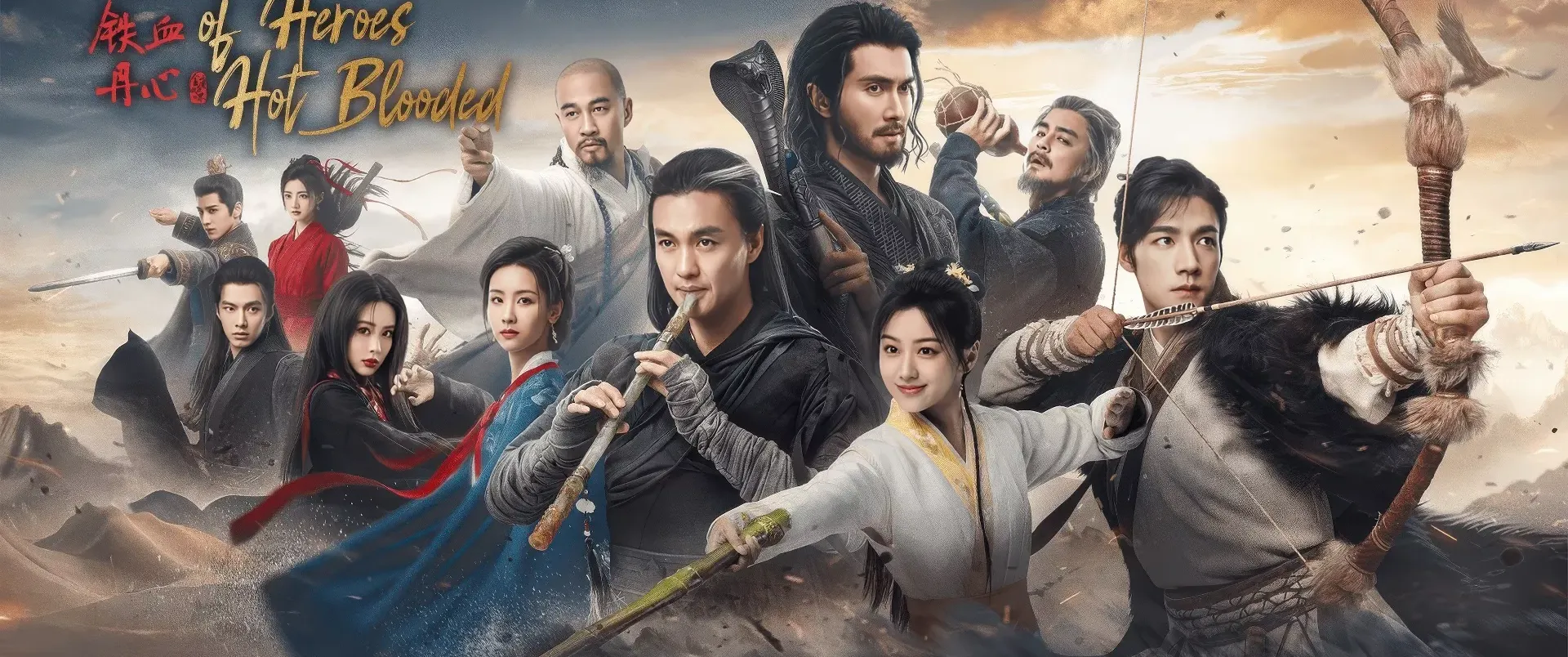
The Legend of the Condor Heroes Chapter 39 – Part 2
Translation by Jenxi Seow
Guo Jing then told Qiu Chuji1 of the doubts that had been troubling him these past days: how right and wrong were hard to discern, how martial arts brought harm to the world. He finished with a sigh, “I have resolved never to fight again for the rest of my life. I wish I could forget every scrap of the martial arts I have learnt, but old habits are hard to break. Just now I was careless for a moment and sent a man sprawling with a broken head.”
Qiu Chuji shook his head. “Jing-er, you are wrong to think that way. Decades ago, when the martial manuscript the Nine Yin Manual2 first appeared in the world, countless people in the jianghu3 courted death because of it. Later, at the Huashan Sword Summit,4 my shifu5 Chongyang the Perfected One6 alone stood above all the heroes and won the Manual. He had intended to destroy it, but then he said, ‘Water can bear a vessel, and water can also capsize it. Whether a thing brings fortune or disaster depends on how men use it.’ In the end he preserved the book. All the learning and martial strategy under heaven, every stout weapon and keen blade, can bring blessing to men, and every one of them can bring calamity on the world. If your heart is set on doing good, then the stronger your martial arts the better. Why must you forget them?”
Guo Jing pondered for a moment, then said, “What the Daoist Elder7 says is no doubt true. But consider the present age. Those who practise the martial arts speak of the Eastern Heretic,8 the Western Venom,9 the Southern Emperor10 and the Northern Beggar11 as the four mightiest under heaven. I have thought it over carefully. To train one’s martial arts to the level of these four seniors would be hard beyond measure, and even if it could be done, what good would it do anyone, others or oneself?”
Qiu Chuji was taken aback. “Huang Yaoshi behaves in eccentric ways. It springs from his contempt for a world he finds intolerable, and there is a pain in him he will not speak of. But he follows his own will and rarely considers others. That I cannot approve. Ouyang Feng has done evil without number. That needs no saying. Emperor Duan is gentle and generous. Had he gone on reigning over his realm, he might have brought blessing to his people. Yet for a small, personal grievance he forsook the world and hid himself away. That too I cannot call great benevolence or great rightness. Only Guild Chief Hong walks the path of xia,12 upholding the right and succouring the desperate. He alone has my admiration, from the bottom of my heart. The last Huashan Sword Summit was near twenty-five years ago. Even if someone were to surpass Guild Chief Hong in martial arts today, every man of valour under heaven would still hold Guild Chief Hong to be the foremost man in the wulin13 of our time.”
At the words “Huashan Sword Summit” Guo Jing gave a start. “Has my shifu’s injury fully healed? Will he be attending the Huashan gathering?”
“Since returning from the Western Regions I have not seen Guild Chief Hong myself,” Qiu Chuji said. “But by my reckoning, the second Huashan Sword Summit draws near. Whether or not Guild Chief Hong enters the contest, he will certainly go to Mount Hua. I am travelling this way for that very purpose. Why not come with me and see?”
These past days Guo Jing had been sunk in gloom, and he was heartily sick of contests for supremacy. He shook his head. “A place where men talk of martial arts and contend with the jian is not for me. I would rather not go. I hope the Daoist Elder will not take it amiss.”
“Where do you mean to go, then?”
Guo Jing stared blankly ahead. “I do not know. Wherever my feet take me!”
Qiu Chuji saw how dejected he looked, how haggard and wasted, as though he were just up from a grave illness, with no life left in him at all. He was deeply troubled, and though he tried every means to lift the young man’s spirits, Guo Jing only shook his head and said nothing. Qiu Chuji reflected, He has always followed Guild Chief Hong’s words. If we reach Mount Hua and shifu and disciple meet again, it may put new heart into him and set him to living properly again. But how can I persuade him to go west? Then a thought occurred to him.
“Jing-er, if you want to forget all the martial arts you have learnt, there is a way.”
“Truly?”
“There is a man in this world who, quite by accident, learnt the highest martial arts from the Nine Yin Manual. Later, remembering that this broke an oath he had sworn and betrayed a trust laid on him, he forced himself to forget those skills. If you wish to follow his example, you must go and ask him.”
Guo Jing leapt to his feet. “Yes, Zhou Botong,14 Big Brother Zhou.”15 Then he remembered that Zhou Botong was Qiu Chuji’s shishu,16 and that by blurting out “big brother” he had set himself a whole generation above Qiu Chuji. He felt most awkward.
Qiu Chuji smiled faintly. “Zhou shishu has never stood on ceremony about rank among us. Call him whatever you like. I do not mind in the least.”
“Where is he?”
“Zhou shishu will certainly attend the Huashan gathering.”
“Very well. Then I will go to Mount Hua with you, Daoist Elder.”
They went on to the next market town, where Guo Jing took out silver and bought Qiu Chuji a riding horse. The two rode west side by side, and before many days had passed they reached the foot of Mount Hua.
Mount Hua is called the Western Peak among the Five Sacred Peaks.17 The ancients compared the Five Sacred Peaks to the Five Classics, saying that Mount Hua corresponded to the Spring and Autumn Annals, its governing principle awe and severity. Of all the famous mountains under heaven, none is so wild and perilous. The two came to the Shansun Pavilion18 at the southern gate of the mountain. Beside the pavilion grew twelve great dragon-vines,19 gnarled and many-jointed, their trunks hollow, like flying dragons. Seeing the way the ancient vines’ branches soared into the air, Guo Jing was struck suddenly by a memory of the move Flying Dragon in the Sky.20 It occurred to him that, following the general principles of the Nine Yin Manual, one might well devise twelve sets of ancient, stately fist-moves from the postures of those twelve dragon-vines. He was lost in these thoughts when he caught himself with a start, thinking, I want nothing more than to forget the martial arts I have already learnt. How can I be devising new moves, studying ways to wound and kill? I am so deep in the mire that there is no curing me.
Then he heard Qiu Chuji speak. “Mount Hua is a sacred place of our Daoist order. These twelve dragon-vines are said to have been planted by Mister Xiyi,21 the Old Patriarch Chen Tuan.”22
“The Old Patriarch Chen Tuan? The Immortal Elder who slept for years on end without waking?”
“Chen Tuan was born in the late Tang,” Qiu Chuji said. “He lived through the Five Dynasties of Liang, Tang, Jin, Han and Zhou. Whenever he heard of a change of dynasty, he would turn grave and cheerless, bar his door and take to his bed. The world says he slept for a year at a time, but in truth he was grieved at the turmoil of the realm and the suffering of the people, and would not go out. When he heard that Song Taizu23 had ascended the throne, he roared with laughter and was so overjoyed that he fell off his donkey, saying that the world was at peace at last. Song Taizu was kind and loved the people, and the common folk truly benefited from his rule.”
“If Chen Tuan had been born in our time,” Guo Jing said, “he would have had no choice but to shut his door and sleep for years on end again.”
Qiu Chuji gave a long sigh. “The Mongols have risen mighty in the north and plan to invade the south. The Song court is as benighted as ever. The affairs of the world seem past remedy. Yet a man of spirit must do what he knows cannot be done. Mister Xiyi was a man of rare gifts, it is true, but to fold his arms and take to his bed out of grief for the world is far from the conduct of a humane and chivalrous man.”
Guo Jing was silent.
They left their horses at the foot of the mountain and climbed on foot. They passed Taohua Ping, went through Xiyi Gorge and climbed to Suomeng Ping. The mountain path grew ever more treacherous. At the West Xuan Gate they had to haul themselves up by iron chains, but with their superb qinggong24 they were at the top in moments. Seven li on they reached Qing Ping. At the far end of the plateau the rock face sheared away like a blade, and a great boulder blocked the path below the northern cliff.
“This stone is called the Return-Heart Stone,”25 Qiu Chuji said. “Beyond it the path is so perilous that travellers ought to turn back here.” In the distance they could make out a tiny stone pavilion. “That is the Chess-Wager Pavilion.26 It is said that Song Taizu and Mister Xiyi once played chess here, wagering Mount Hua itself. Song Taizu lost, and from that day the land upon the mountain was freed from tribute and tax.”
Guo Jing said, “Genghis Khan, the King of Khwarezm, the emperors of Great Jin and Great Song, they all seem to be using the world as their wager and playing chess.”
Qiu Chuji nodded. “Just so. Jing-er, you have been pondering deeply of late, and you have seen a good deal. You are no longer the muddled, simple lad you were.” He went on, “When these kings and marshals wager the world, the loser does not merely lose his throne and his life. He brings ruin on the common people.”
They passed through Thousand-Foot Gorge and Hundred-Foot Gorge, where the path was so narrow a traveller had to turn sideways to squeeze through. Guo Jing thought, If an enemy were to strike from ambush here, there would be no defence.
The thought had barely formed when a shout rang out from ahead, “Qiu Chuji, we spared your life outside the Misty Rain Pavilion.27 What are you doing on Mount Hua?”
Qiu Chuji darted forward several paces and secured a hollow in the side of the peak. Only then did he look up. Sha Tongtian,28 Peng Lianhu,29 Venerable Lingzhi30 and Hou Tonghai31 stood four abreast, blocking the way where the path ran out.
As he climbed, Qiu Chuji had expected to encounter Ouyang Feng, Qiu Qianren and other formidable foes, and calculated that with Zhou Botong, Hong Qigong and Guo Jing all present they could hold their own. He had not expected Sha Tongtian and his kind to have the audacity to climb the mountain. The spot where he stood was somewhat wider than the rest, but the terrain was still desperately dangerous. If pressed, he would tumble into the abyss a hundred thousand feet below. The crisis allowed no time for thought. With a swish he drew his long jian and launched White Rainbow Crossing the Sky32 in a fierce thrust at Hou Tonghai. Of the four enemies before him, Hou Tonghai was the weakest, and he had lost an arm besides, so it was at that weak point the thrust was aimed.
Hou Tonghai saw the ferocity of the strike and twisted aside, raising his trident one-handed to parry. Peng Lianhu’s Judge’s Brushes33 and Venerable Lingzhi’s bronze cymbals attacked from left and right, driving hard to force Qiu Chuji into the chasm.
Qiu Chuji’s jian clung to Hou Tonghai’s trident, his strength flowed to its tip, and he rode the force to leap clear over Hou Tonghai’s head. Peng Lianhu and Venerable Lingzhi’s weapons struck the rock face, showering sparks. Sha Tongtian had lost an arm at Iron Spear Temple34 in Jiaxing, but the wound had healed. Seeing his shidi’s error, he at once deployed Shifting Forms Changing Positions,35 attempting to cut Qiu Chuji off. Qiu Chuji’s jian flashed as he lunged with several swift thrusts. Sha Tongtian shifted and failed to block. Qiu Chuji dashed past him. Sha Tongtian and Peng Lianhu shouted and gave chase. Qiu Chuji turned and parried several strokes. Venerable Lingzhi came at him swinging his cymbals. Three weapons kept up a fierce, unbroken assault.
Guo Jing saw that Qiu Chuji was in dire straits and should have rushed to his aid. But the very act of fighting another person seemed to him a grave wrong, and the fury of the combat filled him with disgust. He turned his head away, seized the vines and undergrowth, and clambered down the mountain by another route. He walked without direction, two thoughts warring endlessly within him, Should I go and help Daoist Elder Qiu? Or must I truly never fight again?
The more he thought, the more muddled he became. He wondered, If Daoist Elder Qiu is killed by Peng Lianhu and the rest, would that not be my fault? But if I go and help, and send Peng Lianhu and the others tumbling into the valley, would that be right? He walked further and further away, until at last he could no longer hear the clash of weapons. He leaned against a rock alone, lost in a daze.
After a long while, he heard a rustle from behind a pine tree at his side. Someone leaned out from behind it. Guo Jing turned. The man had white hair and a ruddy face. It was Liang Ziweng the Ginseng Old Eccentric.36 Guo Jing took no notice and continued to brood. Liang Ziweng, however, was badly startled. He knew Guo Jing’s martial arts had advanced greatly and that he was no match, so he shrank back at once and hid behind the tree. After a while, seeing that Guo Jing did not pursue him, and observing the young man’s vacant, grief-stricken expression, muttering to himself as though bewitched, he thought, What has come over the lad today? He is behaving most strangely. Let me test him. He dared not go near, but picked up a stone and threw it at Guo Jing’s back. Guo Jing heard it whistle through the air and sidestepped, still paying him no heed.
Footnotes
-
丘处机 — Qiū Chǔjī. See Wuxia Wiki. ↩
-
九阴真经 — Jiǔyīn Zhēnjīng. Literally true scripture of the nine yin. See Wuxia Wiki. ↩
-
江湖 — jiānghú. Literally rivers and lakes. The world of martial artists, outside mainstream society. See Wuxia Wiki. ↩
-
华山论剑 — Huàshān Lùnjiàn. Literally sword discussion at Huashan. Use of discussion is key as the participants were engaged in a martial arts exchange and a philosophical debate on mastery, rather than just a physical contest. See Wuxia Wiki. ↩
-
师父 — shīfù. Teacher responsible for technical instruction and moral guidance. Shī means teacher. Fù means father. See Wuxia Wiki. ↩
-
重阳真人 — Chóngyáng Zhēnrén. Literally Chongyang the Perfected One. See Wuxia Wiki. ↩
-
道长 — dàozhǎng. Literally Daoist elder. A respectful form of address for a Daoist priest. ↩
-
黄药师 — Huáng Yàoshī. See Wuxia Wiki. ↩
-
欧阳锋 — Ōuyáng Fēng. See Wuxia Wiki. ↩
-
段智兴 — Duàn Zhìxīng. See Wuxia Wiki. ↩
-
洪七公 — Hóng Qīgōng. See Wuxia Wiki. ↩
-
侠 — xiá. A person adept in the martial arts who acts with chivalry and upholds the right. See Wuxia Wiki. ↩
-
武林 — wǔlín. Literally martial forest. Those who actually practise, teach or study martial arts. The wulin sits inside the jianghu and is narrower than it: every member of the wulin belongs to the jianghu, but a pedlar or physician of the jianghu who never trained is no part of the wulin. See Wuxia Wiki. ↩
-
周伯通 — Zhōu Bótōng. See Wuxia Wiki. ↩
-
大哥 — dàgē. Literally big brother. The address to an elder brother or an elder sworn brother. ↩
-
师叔 — shīshū. Junior lineage uncle. The shidi or shimei of one’s shifu. Shī means teacher. Shū means father’s younger brother. See Wuxia Wiki. ↩
-
五岳 — Wǔyuè. The Five Sacred Peaks: Mount Hua (west), Mount Tai (east), Mount Heng 衡山 (south), Mount Heng 恒山 (north) and Mount Song (centre). ↩
-
山荪亭 — Shānsūn Tíng. Literally mountain fragrant-grass pavilion. A pavilion at the southern gate of Mount Hua. ↩
-
龙藤 — lóngténg. Literally dragon vine. Great old vines whose twisting trunks recall dragons. ↩
-
飞龙在天 — Fēi Lóng Zài Tiān. Literally flying dragon in the sky, a line of the Book of Changes. A move of the Eighteen Palms of Dragon Subduing. ↩
-
希夷先生 — Xīyí Xiānshēng. An honorific title bestowed on the Daoist Chen Tuan, meaning Master of the Inaudible and Invisible, drawn from the Daodejing. ↩
-
陈抟老祖 — Chén Tuán Lǎozǔ. Literally Old Patriarch Chen Tuan, a legendary Daoist hermit of the late Tang and Five Dynasties (c. 871—989), said to have slept for months at a time. ↩
-
宋太祖 — Sòng Tàizǔ. Emperor Taizu of Song (r. 960—976), founder of the Song dynasty. See Wikipedia. ↩
-
轻功 — qīnggōng. The martial art of body lightness. See Wuxia Wiki. ↩
-
回心石 — Huíxīn Shí. Literally turn-back-the-heart stone. A boulder on the path up Mount Hua, where travellers traditionally turn back. ↩
-
赌棋亭 — Dǔqí Tíng. Literally chess-wager pavilion. A stone pavilion on Mount Hua. ↩
-
烟雨楼 — Yānyǔ Lóu. Misty Rain Pavilion, on South Lake in Jiaxing. ↩
-
沙通天 — Shā Tōngtiān. See Wuxia Wiki. ↩
-
彭连虎 — Péng Liánhǔ. See Wuxia Wiki. ↩
-
灵智上人 — Língzhì Shàngrén. Literally the venerable of spiritual wisdom. See Wuxia Wiki. ↩
-
侯通海 — Hóu Tōnghǎi. See Wuxia Wiki. ↩
-
白虹经天 — bái hóng jīng tiān. Literally white rainbow crossing the sky. ↩
-
判官笔 — pànguānbǐ. Literally judge’s brush. A short stabbing weapon shaped like a writing brush, usually carried in pairs. ↩
-
铁枪庙 — Tiěqiāng Miào. A temple to Wang Yanzhang, the Iron Spear general of the Five Dynasties, its tower home to crows. See Wuxia Wiki. ↩
-
移形换位 — Yíxíng Huànwèi. An art of shifting position without bending the knees or taking a step, as Sha Tongtian does. See Wuxia Wiki. ↩
-
梁子翁 — Liáng Zǐwēng. See Wuxia Wiki. ↩