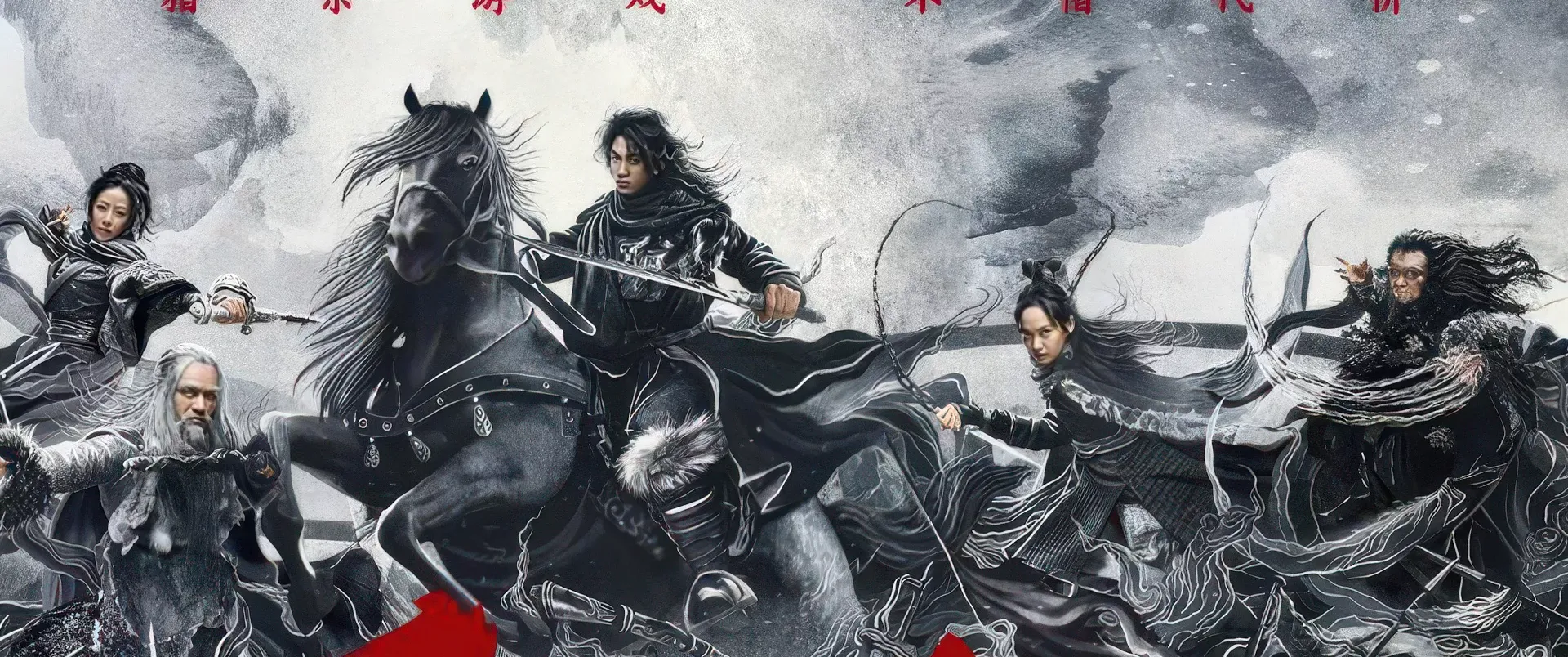
Flying Fox of the Snowy Mountain depicts the jianghu1 during the Qing Dynasty.2 The story centres on the feud among the four families descended from Li Zicheng’s bodyguards, while the Qing court’s Imperial Guard pursues the anti-Qing Xinghan Beggars’ Guild and Li Zicheng’s treasure.
Families
- Hu Family 胡家 – The family of Hu Yidao and Hu Fei, descended from Li Zicheng’s bodyguard Hu
- Miao Family 苗家 – The family of Miao Renfeng and Miao Ruolan, descended from the bodyguard Miao
- Tian Family 田家 – The family of Tian Guinong, descended from the bodyguard Tian, founders of the Tianlong School
- Fan Family 范家 – The family of Guild Chief Fan, descended from the bodyguard Fan, heads of the Xinghan Beggars’ Guild
Guilds
- Xinghan Beggars’ Guild 兴汉丐帮 – The Beggars’ Guild, which added 兴汉 (“Revive the Han”) to its name in open opposition to the Qing; led by Guild Chief Fan
Imperial Court
- Imperial Guard 御前侍卫 – The emperor’s bodyguard under Commander Sai, including Liu Yuanhe; it seizes Guild Chief Fan and sets a trap for Miao Renfeng
Armed escort services
- Pingtong Armed Escort 平通镖局 – Beijing escort agency led by Xiong Yuanxian, long at odds with the Yinma Creek Stockade
Martial arts schools
- Tianlong School 天龙门 – Liaodong school divided into a Northern and a Southern Branch, with members Ruan Shizhong, Cao Yunqi and Yin Ji; it held Li Zicheng’s Treasured Dao
- Wuji School 无极门 – Henan school of Master Jiang, one of Du Ximeng’s helpers
- Qingzang School 青藏派 – The school of Great Master Xuanmingzi, one of Du Ximeng’s helpers
- Eight Trigrams School 八卦门 – The school of Shang Jianming, whom Hu Yidao killed
Strongholds
- Yinma Creek Stockade 饮马川山寨 – Bandit stronghold led by Tao Baisui
- Du Family Manor 杜家庄 – Du Ximeng’s manor on Jade Brush Peak, also called Jade Brush Manor (玉笔山庄)
Religious orders
- Baihui Temple 百会寺 – Shandong temple of the monk Jingzhi, killed in the fight over the iron box
See also
- Jin Yong factions
- Demi-Gods and Semi-Devils factions
- The Legend of the Condor Heroes factions
- The Return of the Condor Heroes factions
- The Heavenly Sword and the Dragon Sabre factions
- Laughing in the Wind factions
- Ode to Gallantry factions
- Sword Stained with Royal Blood factions
- The Deer and the Cauldron factions
- The Book and the Sword factions
- Side Story of the Flying Fox factions
Footnotes
-
江湖 – jiānghú. Literally rivers and lakes. The itinerant world beyond settled society and official reach, holding not only martial artists but the trades that travel with them, including pedlars, physicians, fortune-tellers, entertainers, boatmen, beggars, outlaws and the like. See Wuxia Wiki. ↩
-
清朝 – Qīng Cháo. Dynasty ruled by the Manchu people under the House of Aisin-Gioro from 1644 to 1912 CE. See Wikipedia. ↩