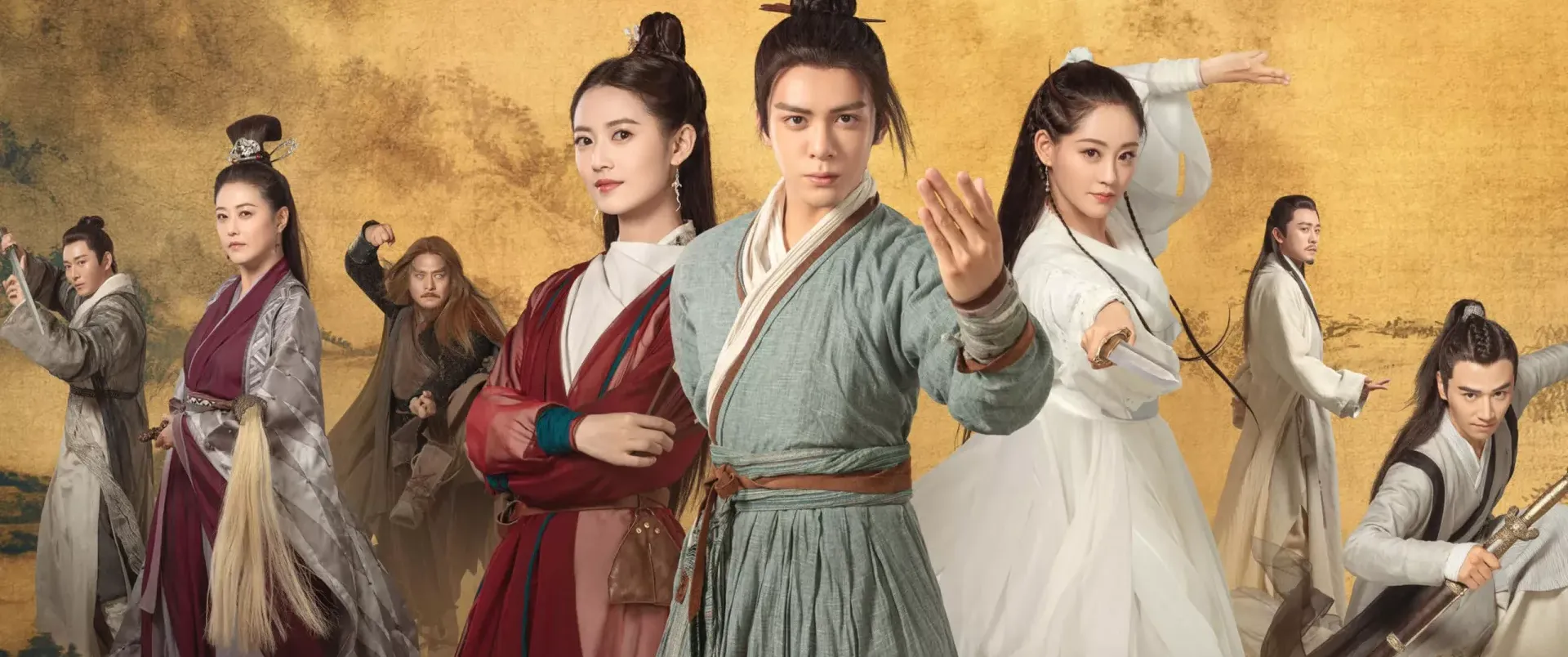
The Seven Xia of Wudang (simplified: 武当七侠, traditional: 武當七俠, pinyin: Wǔdāng Qī Xiá, jyutping: mou5 dong1 cat1 haap6) were the seven personal disciples of Zhang Sanfeng and the second generation of the Wudang Order. In order of entry they were Song Yuanqiao, Yu Lianzhou, Yu Daiyan, Zhang Songxi, Zhang Cuishan, Yin Liting and Mo Shenggu.
They stand at the head of the orthodox jianghu at the opening of The Heavenly Sword and the Dragon Sabre, and the novel spends its length taking them apart.
The name
侠 is the operative word and it is not decoration. These are not simply Zhang Sanfeng’s students but men the jianghu has agreed to call xia — a judgement about conduct rather than skill, which is why the group name carries moral weight that “the seven disciples of Wudang” would not. See why we render 侠 as xia rather than as hero or knight-errant.
Their seniority runs by order of entry under the same shifu, not by age, which is the standard within a shimen. Hence the ordinals that follow them everywhere: Zhang the Fifth Xia, Mo the Seventh Xia. A reader meeting “Sixth Brother” in older translations is meeting Yin Liting by his rank in that order.
A group defined by its gaps
What makes the seven interesting as a group is that Jin Yong almost never shows them complete.
Yu Daiyan is crippled early, his limbs shattered by the Great Strength Vajra Finger, and spends twenty years bedridden while the others carry the consequences. Zhang Cuishan vanishes to a distant island for a decade, returns married to Yin Susu of the Tianying Order, and takes his own life on Mount Wudang rather than betray either his wife or his brothers under the pressure of the assembled orthodox factions. Mo Shenggu, the youngest and the most direct, is ambushed and killed — the hand behind it belonging to Song Qingshu, the son of their own eldest brother.
That last detail is the novel’s sharpest cut. The Seven Xia are undone not by the heterodox cults they were raised to oppose but from inside their own lineage, by the next generation’s ambition and by the rigidity of the orthodoxy they represent. Zhang Cuishan’s death in particular is caused by nothing worse than a marriage; it is the wulin’s refusal to tolerate it that kills him.
Standing and reputation
Collectively the seven made Wudang the equal of Shaolin within a single generation — a remarkable claim for a school founded in living memory, and one the novel treats as genuinely earned. Their reputation rests on three things: Zhang Sanfeng’s transmission of internal cultivation, a consistency of conduct that made “Wudang” a guarantee in dealings, and the fact that they were known as a set. Sending word to one was understood to mean sending word to all seven.
That collective identity is also the group’s vulnerability. Their enemies target it deliberately — Yu Daiyan’s crippling is an attack on Wudang through a man rather than an attack on a man — and the pressure applied to Zhang Cuishan at the assembly is possible only because the seven are held to answer for each other.
Individual profiles
Fuller treatment of each member’s temperament, martial specialisation and role in the plot is given in the Wudang Order article and in their individual entries above.
Behind the scenes
The seven-fold structure is a familiar shape in wuxia — compare the Seven Zis of Quanzhen in the Condor novels — and Jin Yong uses the echo deliberately, since The Heavenly Sword and the Dragon Sabre closes the trilogy the Quanzhen Seven opened. The difference is in the treatment. The Quanzhen Seven are largely a fixed institution; the Wudang Seven are a family, and the novel is interested in what happens when a family is asked to enforce an orthodoxy against one of its own.
Older English translations render the group as “Seven Xia of Wudang”, and the individual members as “Zhang the Fifth Xia” or similar. This site uses Seven Xia of Wudang and [Name] the [Ordinal] Xia, on the reasoning set out in the terminology standard: “hero” describes an achievement, where 侠 describes a code.
See also
External links
- Wudang Order on Wikipedia