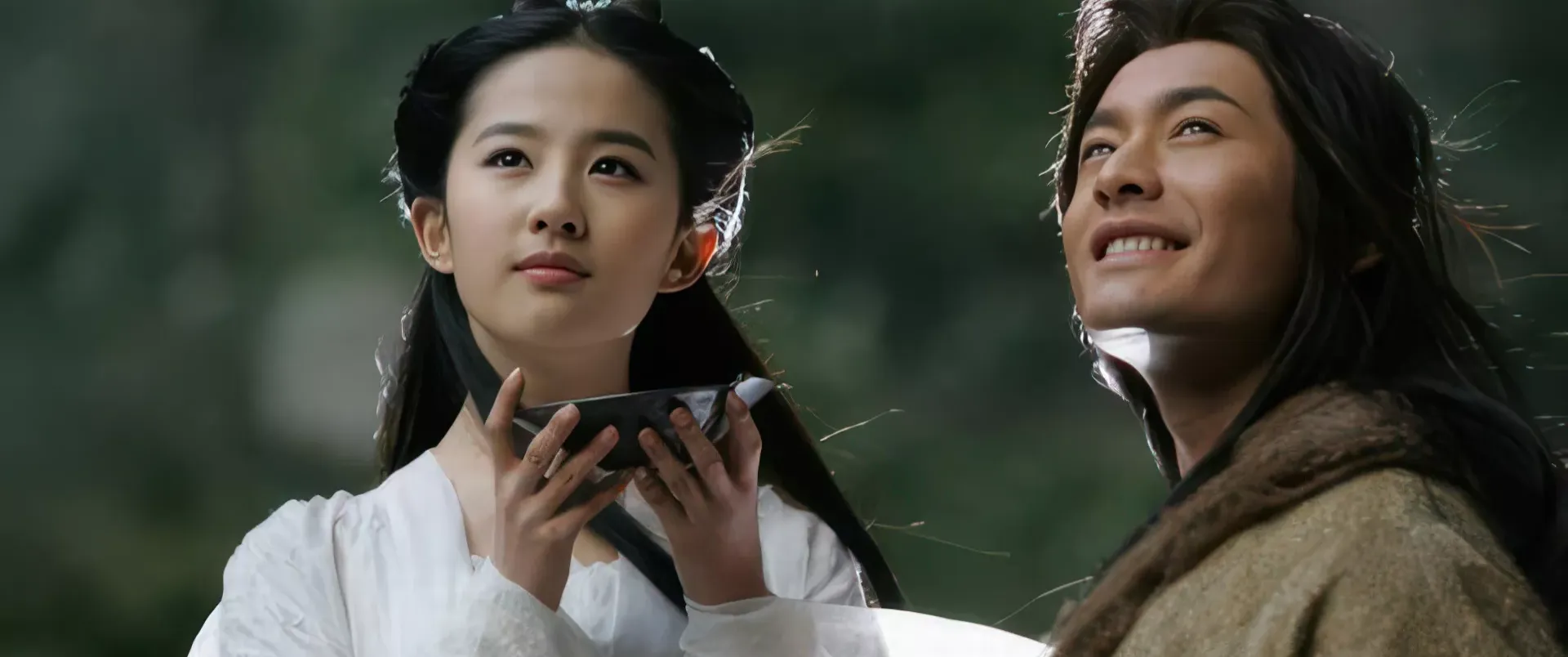
The Return of the Condor Heroes Chapter 31 – Part 1
Translation by Jenxi Seow
Half a miraculous pill
Passionless Valley1 covered a vast tract of land, more than forty thousand mu2 ringed by mountains. Its paths twisted and doubled back, with hills for screens and ravines for barriers, but Yang Guo3 and Xiaolongnü4 went at the full stretch of their qinggong,5 followed the map and were there in moments. Seventy or eighty feet ahead, several great elms spread their shade across one another, and beneath them stood a big kiln for firing bricks and tiles. According to the map, this was where the Indian monk6 and Zhu Ziliu7 were being held.
Yang Guo said to Xiaolongnü, “Wait here and I’ll go in and have a look. It’ll be all coal and ash in there, and filthy.” He stooped and went through the kiln door. As he stepped inside, a blast of heat struck him full in the face, and someone shouted, “Who’s there?” “The Valley Master’s orders,” said Yang Guo. “I’ve come for the prisoners.”
The man came out from behind a brick wall. “What?” he said, puzzled. Seeing that it was Yang Guo, he grew more startled and suspicious still. “You… you…” Yang Guo saw that he was one of the green-robed disciples. “The Valley Master has ordered me to bring out the monk and the scholar named Zhu.” The disciple knew that Yang Guo had saved the Valley Master’s life, that the Valley Master had declared before everyone that he would make him his son-in-law, and that Lü’e8 was on good terms with him. Nine chances in ten, this man would be Valley Master himself one day, and he did not dare offend him. “But… where is the Valley Master’s token?” Yang Guo ignored the question. “Take me in and let me see them.” The man agreed and turned back inside.
Past the brick wall the heat was fiercer still. Two labourers were heaving firewood and charcoal. Though it was the depth of winter, both men were stripped to the waist, wearing nothing but short breeches, and still they were running with sweat. The green-robed disciple pushed aside a big stone, uncovering a small hole. Yang Guo put his head to it and looked. Inside was a stone cell some ten feet square. Zhu Ziliu sat facing the wall, his forefinger sweeping across the stone. Plainly he was writing to ease his mind, and from the free, elegant rise and fall of his arm, he seemed very pleased with what he wrote. The Indian monk lay on the floor, and whether he was alive or dead there was no telling. “Uncle Zhu,” Yang Guo called, “are you well?”
Zhu Ziliu turned his head and smiled. “When a friend comes from afar, is that not a delight?”9 Yang Guo admired him in silence, thinking, Shut up here all these days, and he is as easy as if nothing had happened. Untroubled in danger, smiling lightly at rescue. I am nowhere near such largeness of heart. “Is the venerable divine monk asleep?” he asked. The moment the words were out, his heart began to pound, for Xiaolongnü’s life or death rested wholly on this Indian monk. Zhu Ziliu did not answer. After a while he gave a soft sigh. “When it comes to enduring heat and cold, my shishu10 has always been far beyond me. But he…”
From his tone, it seemed some mishap had befallen the Indian monk. Alarmed, Yang Guo did not wait for him to finish, but turned to the green-robed disciple. “Open the cell at once and let them out.” The disciple stared. “The key? The Valley Master keeps that key himself. If he had sent you to release them, he would have given you the key.”
Yang Guo’s patience gave out. “Stand aside!” He raised the Xuantie Heavy Sword11 and struck. There was a crack, and a great hole gaped in the stone wall. The disciple cried out and stood rooted, dumb with fright. Yang Guo thrust three times and slashed twice, and the little window, half a foot across, became a hole wide enough for a man to pass through.
“Brother Yang,” Zhu Ziliu called, “congratulations on your great advance in martial skill!” He bent, lifted the Indian monk in his arms and passed him out through the hole. Yang Guo reached out and took him. The monk’s arm was warm to the touch, and Yang Guo’s heart eased, but then he saw that the monk’s eyes were shut tight, and thought, Oh no, in this fire-washing chamber even a dead man would be steamed warm. Hastily he felt for the monk’s breath, and found it coming and going faintly. Zhu Ziliu leapt out through the hole after him. “Shishu has lost consciousness, but I think he is in no great danger yet.” Yang Guo flushed and cried inwardly, For shame! He knew that what he truly cared about was not whether the Indian monk lived or died, but whether his own wife could be saved. “Has the heat overcome the Great Master? Let’s get him out into the air, quickly.” He carried the monk out.
Xiaolongnü was overjoyed to see the three of them come out, and hurried to meet them. “Find some cold water to splash on the Great Master’s face,” said Yang Guo. “No,” said Zhu Ziliu, “my shishu has been poisoned by the passion-flower.”12 Yang Guo started. “Is it bad?” “I don’t think it will do him much harm,” said Zhu Ziliu. “Shishu took the thorns and pricked himself with them.” Yang Guo and Xiaolongnü were astonished. “Why?” they asked together.
Zhu Ziliu sighed. “My shishu says the passion-flower died out in India long ago, and he does not know how it found its way into the Central Plains. If it were to spread, it would do terrible harm. In years gone by, countless men and beasts in India died of its poison. All his life my shishu has made a deep study of curing poisons, but this flower’s venom is truly strange. When he entered this valley he knew already that the miraculous pill13 might well be beyond reach, and that even if it were won, it could save only one person. So he vowed to find a remedy for the poison that would relieve all who suffer from it. He has tried the poison on his own body, to learn its nature exactly, so that he can compound the cure.”
Yang Guo was astonished, and full of admiration. “The Buddha said, ‘If I do not enter hell, who will?’14 That the Great Master should brave such peril to save the world commands the deepest reverence.” Zhu Ziliu said, “The ancients tell how Shennong tasted the hundred herbs, seeking medicines to save the people, and how his face turned green because he so often ate poison by mistake.15 My shishu, one might say, has that same spirit.”
Yang Guo nodded. “Just so. When will the venerable monk come round, do you think?” “When he pricked himself,” said Zhu Ziliu, “he said that if his reckoning was right, he would wake after three days and three nights. Counting on my fingers, it has been nearly two days.” Yang Guo and Xiaolongnü exchanged a glance, and both thought, Three days and nights senseless. The poison must be very heavy. Luckily the passion-flower’s poison varies with the person, and strikes hardest when the heart stirs with love between man and woman. This great monk is without love or desire, and in that one respect he has the advantage of ordinary men.
“Where did you find passion-flowers in this kiln?” Xiaolongnü asked. “Since we were shut in the fire-washing chamber,” said Zhu Ziliu, “a young lady has often come to see us…” “Was she tall and slender,” asked Xiaolongnü, “with a fair, delicate face and a little mole beside her mouth?” “That’s the one.” Xiaolongnü smiled at Yang Guo, then said to Zhu Ziliu, “That is the Valley Master’s daughter, Miss Lü’e. She heard that you two had come to seek medicine for Yang Guo, and so she showed you special favour. Short of daring to open the cell and set you free, she gave you whatever you asked for.” “Just so,” said Zhu Ziliu. “Shishu asked her to break off passion-flower branches for him, and I asked her to get word out for help, and she did all of it. By the rule of the fire-washing chamber, a fierce fire burns in it for one shichen16 every day. It was only because she interceded that the fire never burned high, and so we could bear it. I often asked who she was, but she never would say. I never imagined she was the Valley Master’s daughter.” “And it was this young lady who showed us the way here, too,” said Xiaolongnü.
“Your honoured shifu, Great Master Yideng,17 is here as well,” said Yang Guo. Zhu Ziliu was overjoyed. “Ah, then let us go out.” Yang Guo knitted his brows. “The trouble is that the monk Ci’en18 has come too. I’m afraid there may be some difficulty.” Zhu Ziliu was puzzled. “Ci’en shixiong19 has come? Surely that is good? When brother and sister meet, Valley Master Qiu can hardly forget the love between them.” Although Zhu Ziliu had entered the shimen before Ci’en, Ci’en’s martial skill and his standing in the jianghu20 had always been the equal of Great Master Yideng’s own, and so Diancang Yuyin,21 Wu Santong,22 Zhu Ziliu and the others respected him and all addressed him as shixiong. In asking Lü’e to send word out for help, Zhu Ziliu had been hoping that Ci’en would come, so that the two houses might be reconciled. Yang Guo told him briefly how Ci’en’s mind had become unhinged, and how Qiu Qianchi23 had goaded him with her words.
Footnotes
-
绝情谷 — Juéqíng Gǔ. Hidden valley ruled by Gongsun Zhi, known for its deadly Passion Flowers and the Passionless Divine Palm technique. See Wuxia Wiki. ↩
-
亩 — mǔ. Traditional Chinese unit of land area, roughly 667 square metres or one-fifteenth of a hectare. ↩
-
杨过 — Yáng Guò. His name meaning “fault or transgression”; his courtesy name Gaizhi means “to correct it”. See Wuxia Wiki. ↩
-
小龙女 — Xiǎolóngnǚ. Literally little dragon maiden. See Wuxia Wiki. ↩
-
轻功 — qīnggōng. Literally lightness skill. Martial art of body lightness; practitioners leap great heights and move with extraordinary speed. See Wuxia Wiki. ↩
-
天竺僧 — Tiānzhú Sēng. Indian monk, a shidi of Great Master Yideng, renowned for his mastery of toxicology and healing arts. ↩
-
朱子柳 — Zhū Zǐliǔ. His name meaning “master willow”. See Wuxia Wiki. ↩
-
公孙绿萼 — Gōngsūn Lǜ’è. Her name meaning “green calyx”. See Wuxia Wiki. ↩
-
有朋自远方来,不亦乐乎 — Yǒu péng zì yuǎnfāng lái, bù yì lè hū. Famous line from the Analects of Confucius, expressing joy at a friend’s arrival from afar. ↩
-
师叔 — shīshū. Junior lineage uncle. Shidi or shimei of one’s shifu. Shī means teacher. Shū means father’s younger brother. See Wuxia Wiki. ↩
-
玄铁重剑 — Xuántiě Zhòngjiàn. Massive sword forged from meteoric iron (xuantie), weighing eighty-one jin. It belonged to the Sword Demon Dugu Qiubai. ↩
-
情花 — Qínghuā. Flower of the Passionless Valley whose thorns poison those who entertain thoughts of love. See Wuxia Wiki. ↩
-
绝情丹 — Juéqíng Dān. Antidote for passion-flower poison from the Passionless Valley. See Wuxia Wiki. ↩
-
我不入地狱,谁入地狱 — Wǒ bù rù dìyù, shéi rù dìyù. Famous Buddhist saying expressing the bodhisattva ideal of self-sacrifice for the salvation of all beings. ↩
-
神农尝百草 — Shénnóng cháng bǎi cǎo. Shennong, the Divine Farmer, is a mythological Chinese emperor who tasted hundreds of herbs to discover their medicinal properties. ↩
-
时辰 — shíchén. Traditional Chinese double-hour; the day was divided into twelve shichen, each roughly two hours. ↩
-
一灯大师 — Yīdēng Dàshī. Literally one-lamp master; a Buddhist honorific title. See Wuxia Wiki. ↩
-
慈恩 — Cí’ēn. Buddhist monastic name taken by Qiu Qianren upon his ordination. Ci means “compassion” and en means “grace.” ↩
-
师兄 — shīxiōng. Male senior. Both apprenticed to the same shifu. Shī means teacher. Xiōng means older brother. See Wuxia Wiki. ↩
-
江湖 — jiānghú. Literally rivers and lakes. Itinerant world beyond settled society and official reach, holding not only martial artists but the trades that travel with them, including pedlars, physicians, fortune-tellers, entertainers, boatmen, beggars, outlaws and the like. See Wuxia Wiki. ↩
-
点苍渔隐 — Diǎncāng Yúyǐn. Hermit Fisherman of Diancang; one of Great Master Yideng’s four disciples. See Wuxia Wiki. ↩
-
武三通 — Wǔ Sāntōng. His name meaning “three penetrations” or “three communications”. See Wuxia Wiki. ↩
-
裘千尺 — Qiú Qiānchǐ. Gongsun Zhi’s wife and Qiu Qianren’s younger sister; known as Iron Palm Lotus. See Wuxia Wiki. ↩