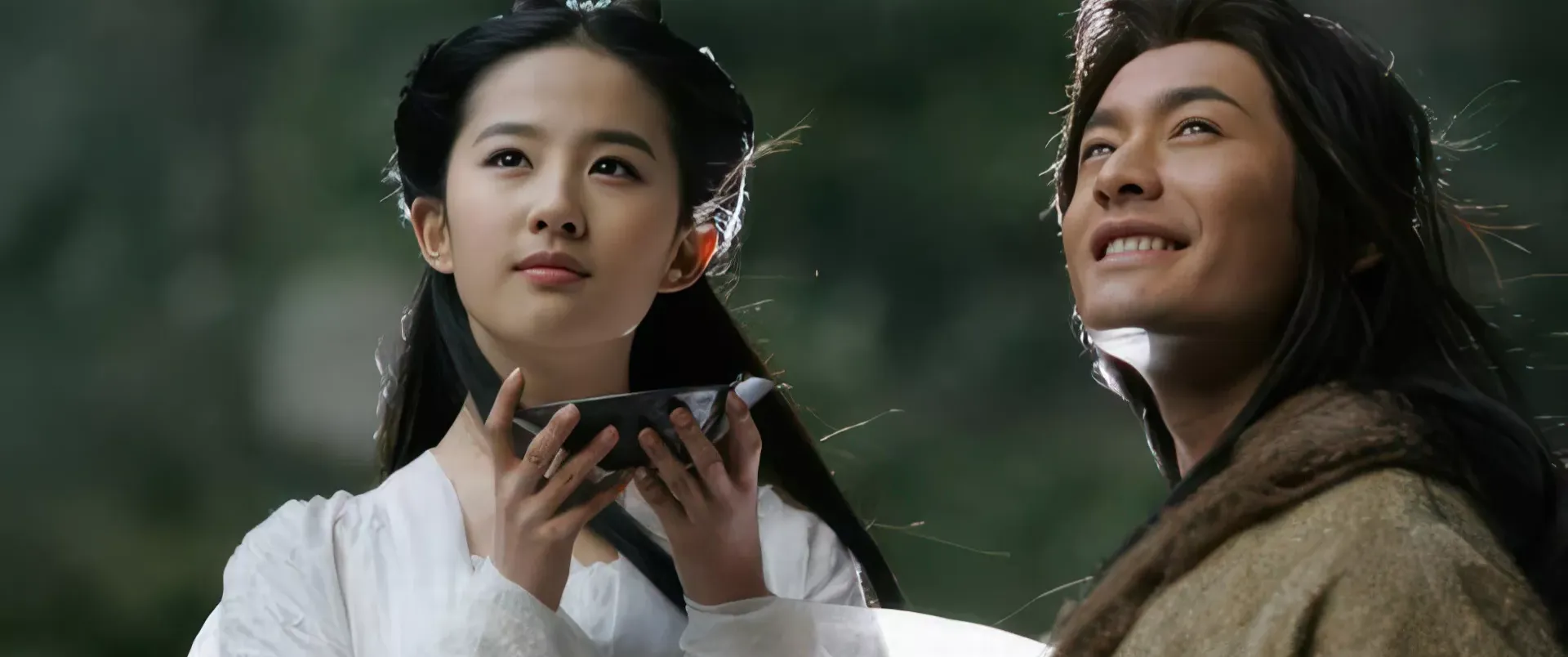
The Return of the Condor Heroes Chapter 13
Translation by Jenxi Seow
The Wulin Alliance Chief
State Preceptor Jinlun1 sat with his eyes now open, now closed, as though the fight before him were no concern of his. In truth he missed nothing. Seeing that Huo Dou2 had fallen behind, he suddenly called out, “Agusijinde’er, mimahasideng, qi’er qi’er hu!”3 No one knew what the Mongolian meant, but Huo Dou knew his shifu was warning him not to cling to defence alone: he must use the “Violent Gale Thunder Skill”4 and wrest the attack from his opponent. At once he let out a long howl, and with the fan in his right hand and the sleeve on his left he whipped up a fierce gust and hurled himself at Zhu Ziliu.5
The wind came hard and cutting, and the onlookers found themselves edging back step by step. From Huo Dou’s mouth came an unbroken bellowing like thunderclaps to drive his attack on, and they guessed that besides weapons, fists and feet, the Violent Gale Thunder Skill used these roaring war cries as one more formidable means of beating an enemy. Zhu Ziliu plied his brush in bold, sweeping strokes, advancing and retreating at will, and fought him to a dead level.
The two of them wheeled and tumbled through more than a hundred moves. Zhu Ziliu was nearing the end of the “Self-Statement”6 when his brushwork abruptly changed. His hand slowed, and his strokes turned lean and hard, steeped in the spirit of antiquity. Huang Rong7 murmured to herself, “The ancients said, ‘Only the lean and hard can touch the divine.’ This sequence, the ‘Baoxie Road Stone Inscriptions’,8 is truly a wonder unmatched in a thousand years.”
Huo Dou kept to the Violent Gale Thunder Skill, but the stronger his opponent’s force grew, the harder he drove his fan and the fiercer his shouts became. Those whose martial skill was weaker could no longer keep their feet in the hall and were pushed back, step by step, into the courtyard.
Huang Rong noticed that Yang Guo9 and Xiaolongnü10 were sitting side by side by a pillar, little more than ten feet from the two men locked in their savage fight, leaning against each other and murmuring softly, without the least interest in the duel. The sash of Xiaolongnü’s robe snapped and fluttered in the gale, yet she paid it no more mind than if nothing were happening, and only gazed at Yang Guo with tender, lingering eyes. The longer Huang Rong watched, the more she wondered, until she was watching the two of them more than Huo Dou and Zhu Ziliu, and she thought, This little girl seems to have martial arts of a high order, and Guoer is so close with her. I wonder which great master she studied under.
Xiaolongnü was past twenty by now. But she had grown up in the Ancient Tomb,11 never seeing the sun, her skin was soft and fine, and her neigong for preserving youth12 was of a high order, so she looked no more than sixteen or seventeen. Before she met Yang Guo she had seldom known joy, anger, grief or delight. The seven emotions and six desires13 do the most to wear down the body and spoil the face, and for her two years passed like one. If she could truly keep to her shifu’s teaching and cultivate herself with a clear, still heart, she could look forward not only to living a hundred years, but to having, even at a hundred, the strength and looks of a woman of fifty. So to Huang Rong’s eyes she seemed younger even than Yang Guo, and her artless, awkward ways and innocent simplicity showed more plainly than Guo Fu’s.14 No wonder Huang Rong took her for a little girl.
Yang Guo gazed at Xiaolongnü and saw that her hair was in disarray. He reached out and gently smoothed it, drew out the thornwood hairpin,15 tidied her hair and slid the pin back in. Xiaolongnü said, “Guoer,16 all the way here, looking for you, I never cared whether my hair was a mess. Nobody looks at me anyway. I only like it when you look at me. When you are not beside me looking at me, I am unhappy. When I could not find you, I cried, and cried so sadly. You are bad. You did not come to coax me, you did not come to comfort me.” As she spoke she twisted a little from the waist, as if wheedling him.
When Xiaolongnü was small, her shifu had taught her never to give way to feeling. Crying was forbidden, and laughing was not allowed either. In all things she was to be still and impassive, her heart like water without a ripple. Grandma Sun,17 faithful to the teaching of the school, had likewise never let her give vent to joy or anger, grief or delight. So from childhood she had never learned to beg for anything, still less had she any chance to play the spoiled darling with her shifu or Grandma Sun. Once she became Yang Guo’s shifu, she held herself as his elder, grave and solemn of face, and when Yang Guo joked and clowned, though she found it funny, she neither laughed nor answered. Yet for a girl to wheedle her way into someone’s tenderness is an instinct she is born with. Even a girl of five or six will coo and pout at her parents without ever being taught. Now that Xiaolongnü had left the Ancient Tomb, her whole heart was given to loving Yang Guo, and she had long since flung her shifu’s old teachings beyond the ninth heaven. She followed her nature alone, glad when she felt glad, sad when she felt sad, and no longer forced herself to rein in what her heart naturally felt.
Seeing how dear and lovable she looked, Yang Guo tightened the arm he had round her shoulders a little and said, “Guoer was wrong not to come and comfort you.” With his right hand he took her right palm and patted it lightly against his own cheek. “Take that, you bad boy!”
Xiaolongnü asked, “After I was gone, how many times a day did you think of me?” Yang Guo said, “After you left, I came out to look for you. From morning to night I looked for you, just shouting, ‘Aunt,18 Aunt!’” Xiaolongnü smiled. “So did you think of me or not?” “Of course I did,” said Yang Guo. “At least two hundred times a day.” Xiaolongnü said, “Two hundred is not enough. I want three hundred.” Yang Guo said, “I thought of you four hundred times a day, two hundred in the morning and another two hundred in the afternoon.” Xiaolongnü said, “And when you ate, you thought of me too. That is a hundred more, five hundred times a day.” Yang Guo said, “When I ate I thought of you too, and thought and thought until my mind was elsewhere and the noodles went up my nose.” Xiaolongnü giggled. “That must have been horrid.” Yang Guo said, “I did not care. One sniff, and the noodles went in through my nose. One suck, and they were in my mouth. One gulp, and down they went into my belly.” Xiaolongnü pulled a face. “Ugh, that is filthy!” Yang Guo said, “Not filthy, not filthy. I have eaten noodles that way since I was small, and they taste rather good. When I thought of you at meals, I was softly calling ‘Aunt, Aunt’ with my mouth, and with my mouth busy I ate the noodles with my nose.” Xiaolongnü was touched. “Guoer is so good! And at night you lie awake and think of me another hundred times.”
Yang Guo said, “Not sleeping at night will not do. I have to sleep before I can dream, so that night after night I dream of you, and hold you tight and say, ‘My darling, my good little wife, I want you to be my wife!’ And I call you that and kiss your face, and kiss your beautiful eyes.” Xiaolongnü sighed. “You say you want me to be your wife. That is so good. Of course I will be. Then you think of me in your dreams too, and that is another hundred. From now on, if we are ever parted, you must think of me at least six hundred times a day.” Yang Guo said, “From now on, whatever happens, we will not be parted. If we really must be, I will think of you seven hundred times a day.” “Eight hundred!” said Xiaolongnü. “Nine hundred!” said Yang Guo. “A thousand!” said Xiaolongnü. Yang Guo’s heart burned like fire, and he was on the point of pulling her to him and kissing her. But the whole hall was watching, and he had, after all, lived among ordinary people until he was past ten, so he felt it would not do and held himself back with an effort. He could only feel Xiaolongnü’s body growing warm in his arms.
When Xiaolongnü was small, her shifu and Grandma Sun had loved her but never once shown it, and had always been cold to her. Only now did she know what it was to be petted and cherished to the full, by Yang Guo. She had never felt anything like it, and the joy and sweetness in her heart were truly past telling. Her whole body went soft, and she leaned against him.
By now the fight in the middle of the hall was drawing tight. Zhu Ziliu’s brushwork grew ever more ungainly and crude, yet the force behind it mounted steadily, his strokes like spider-silk strung across a wall, taut and then empty again. Huo Dou was secretly alarmed, and found them harder and harder to read. State Preceptor Jinlun shouted, “Mami bami, gusi heisi.”19 No one knew what the eight syllables meant, but they set every ear in the hall ringing. Zhu Ziliu grew impatient, and thought, If he changes his moves again, who knows when this fight will ever end? I was once chancellor of the Dali Kingdom,20 and I am leading the first bout for the Great Song.21 On no account can I lose and bring shame on my country and my school. Suddenly his brushwork changed again. He no longer plied the brush as if writing, but as if he held an axe and were hewing at stone.
Even Guo Fu could see it this time. “Is Uncle Zhu carving characters?” she asked.
Huang Rong smiled. “So my daughter is not so stupid after all. These finger techniques of his are the Stone Drum Script.22 Those are characters carved with axe and chisel on drums of stone in the Spring and Autumn period.23 See if you can tell what Uncle Zhu is carving.” Guo Fu followed the line of his brush, but every character she saw was a tangle of coils and loops, more like a string of little pictures, and she could not read a single one. Huang Rong laughed. “This is the oldest great seal script.24 No wonder you cannot read it. I cannot read all of it myself.” Guo Fu clapped her hands and laughed. “Then that Mongol oaf certainly cannot. Mother, look at him, dripping with sweat and all in a flap. What a sight he is.”
Sure enough, Huo Dou could make out only one or two characters of this ancient seal script. Not knowing what his opponent was writing, he could hardly guess the frame of each character or the run of its strokes, and he was hard put to defend himself. Zhu Ziliu wrote out his seal script one character at a time. The writing was archaic and abstruse, and the Yiyang Finger25 beneath the calligraphy grew stronger to match. Huo Dou swept out his fan and was a fraction slow drawing it back, and with a quiver of his brush Zhu Ziliu had inscribed a great-seal character on it.
Huo Dou looked at it. “Is that the character for ‘net’?” he asked blankly.
Zhu Ziliu laughed. “No, that is the character for ‘thou’.”26 At once he reached out his brush and wrote another character on the fan. “That one is most likely ‘moon’?” said Huo Dou. Zhu Ziliu shook his head. “Wrong. That is the character for ‘art’.”27 Huo Dou’s heart sank. He swung his fan, trying to keep it away from the brush point and stop it being written on again, but Zhu Ziliu suddenly struck hard with his left palm. Huo Dou hastily raised a palm to meet it, and the brush slipped through the gap and wrote two more characters on the fan. In his haste Zhu Ziliu had no time for great seal script and wrote them in cursive,28 and these Huo Dou could read. “Barbarian!” he cried.
Footnotes
-
金轮国师 – Jīnlún Guóshī. Literally Golden Wheel State Preceptor. The Mongol Empire’s State Preceptor and a martial arts adept. See Wuxia Wiki. ↩
-
霍都 – Huò Dōu. State Preceptor Jinlun’s third disciple, a Mongol prince. ↩
-
Mongolian battle command. The State Preceptor speaks in Mongolian, which Jin Yong renders phonetically. Actual meaning is not given but is understood by his disciples as tactical instruction. ↩
-
Violent Gale Thunder Skill (狂风迅雷功). Kuángfēng Xùnléi Gōng. Mongolian Vajra School martial art that combines fierce attacks with thunderous battle cries to intimidate and overpower opponents. ↩
-
朱子柳 – Zhū Zǐliǔ. His name meaning “master willow”. See Wuxia Wiki. ↩
-
Self-Statement (自言帖). Zìyán Tiè. Famous piece of cursive calligraphy by the Tang dynasty “Sage of Cursive Script”, Zhang Xu. ↩
-
黄蓉 – Huáng Róng. Her name meaning “lotus” or “hibiscus”. See Wuxia Wiki. ↩
-
Baoxie Road Stone Inscriptions (褒斜道石刻). Bāoxié Dào Shíkè. Ancient stone carvings along the Baoxie Plank Road, featuring calligraphy in the “lean and hard” style praised by the ancients. Quote “Only when lean and hard can one penetrate the divine” (瘦硬方通神) refers to this calligraphic aesthetic. ↩
-
杨过 – Yáng Guò. His name meaning “fault or transgression”; his courtesy name Gaizhi means “to correct it”. See Wuxia Wiki. ↩
-
小龙女 – Xiǎolóngnǚ. Literally little dragon maiden. See Wuxia Wiki. ↩
-
古墓 – Gǔmù. Underground tomb complex beneath Zhongnan Mountain, home of the Ancient Tomb School. See Wuxia Wiki. ↩
-
Youth-preserving neigong (驻颜内功). Zhùyán Nèigōng. Ancient Tomb School’s internal cultivation methods preserve youthfulness. Combined with the absence of sunlight and suppressed emotions, practitioners age at roughly half the normal rate. ↩
-
Seven emotions and six desires (七情六欲). Qīqíng Liùyù. In traditional Chinese thought: the seven emotions are joy, anger, grief, fear, love, hate, and desire; the six desires arise from the six senses. Suppressing these was key to the Ancient Tomb School’s cultivation. ↩
-
郭芙 – Guō Fú. Her name meaning “lotus”. See Wuxia Wiki. ↩
-
Thornwood hairpin (荆钗). Jīngchāi. Simple hairpin made from thornwood, symbolising the austere, unadorned lifestyle of the Ancient Tomb School. Xiaolongnü wears no jewellery or ornamentation. ↩
-
过儿 – Guò’ér. Affectionate diminutive of Yang Guo’s name, with the diminutive suffix -er indicating affection or familiarity. ↩
-
Grandma Sun (孙婆婆). Elderly caretaker of the Ancient Tomb who rescued Yang Guo when he fled the Quanzhen Order. She was killed by Hao Datong while protecting Yang Guo, and with her dying breath she entrusted him to Xiaolongnü’s care. ↩
-
姑姑 – gūgu. Literally paternal aunt, used here as a term of respectful address for a young woman of the older generation. Yang Guo uses this to address Xiaolongnü, his shifu. ↩
-
Mongolian battle command. Second phonetic Mongolian utterance from the State Preceptor during combat; the heroes do not understand the words, but Huo Dou and other disciples recognise them as tactical instruction. ↩
-
大理 – Dàlǐ. Historical kingdom in present-day Yunnan Province (937–1253), contemporaneous with the Song dynasty. In the Condor Trilogy it is associated with the Duan imperial family and Great Master Yideng. See Wuxia Wiki. ↩
-
Great Song (大宋). Song dynasty (960–1279), the Han Chinese empire facing Mongol invasion from the north. ↩
-
Stone Drum Script (石鼓文). Shígǔwén. Oldest known Chinese stone inscriptions, dating to the Spring and Autumn period (c. 770-476 BCE). Carved on drum-shaped stones in great seal script, they are considered the origin of Chinese calligraphy. ↩
-
Spring and Autumn period (春秋). Chūnqiū. Era of Chinese history (c. 770-476 BCE) named after the Spring and Autumn Annals. Time of warfare among feudal states, it was also the golden age of Chinese philosophy. ↩
-
Great seal script (大篆). Dàzhuàn. Ancient form of Chinese writing predating the Qin dynasty unification of scripts. Its characters are highly pictographic and difficult for later readers to recognise. ↩
-
一阳指 – Yīyáng Zhǐ. Literally One Yang Finger. Dali Duan family’s signature finger technique. See Wuxia Wiki. ↩
-
‘Thou’ character (尔). Ěr. Archaic classical Chinese second-person pronoun. Ancient seal script form bears a superficial resemblance to the character for “net” (网), which is why Huo Dou misidentifies it. ↩
-
‘Art’ character (乃). Nǎi. Another archaic classical Chinese word. In ancient seal script, it somewhat resembles the character for “moon” (月), leading to Huo Dou’s second mistake. ↩
-
Cursive Script (草书). Highly abbreviated, flowing style of Chinese calligraphy where characters are written with swift, connected strokes. Most expressive and individualistic of the major scripts. ↩