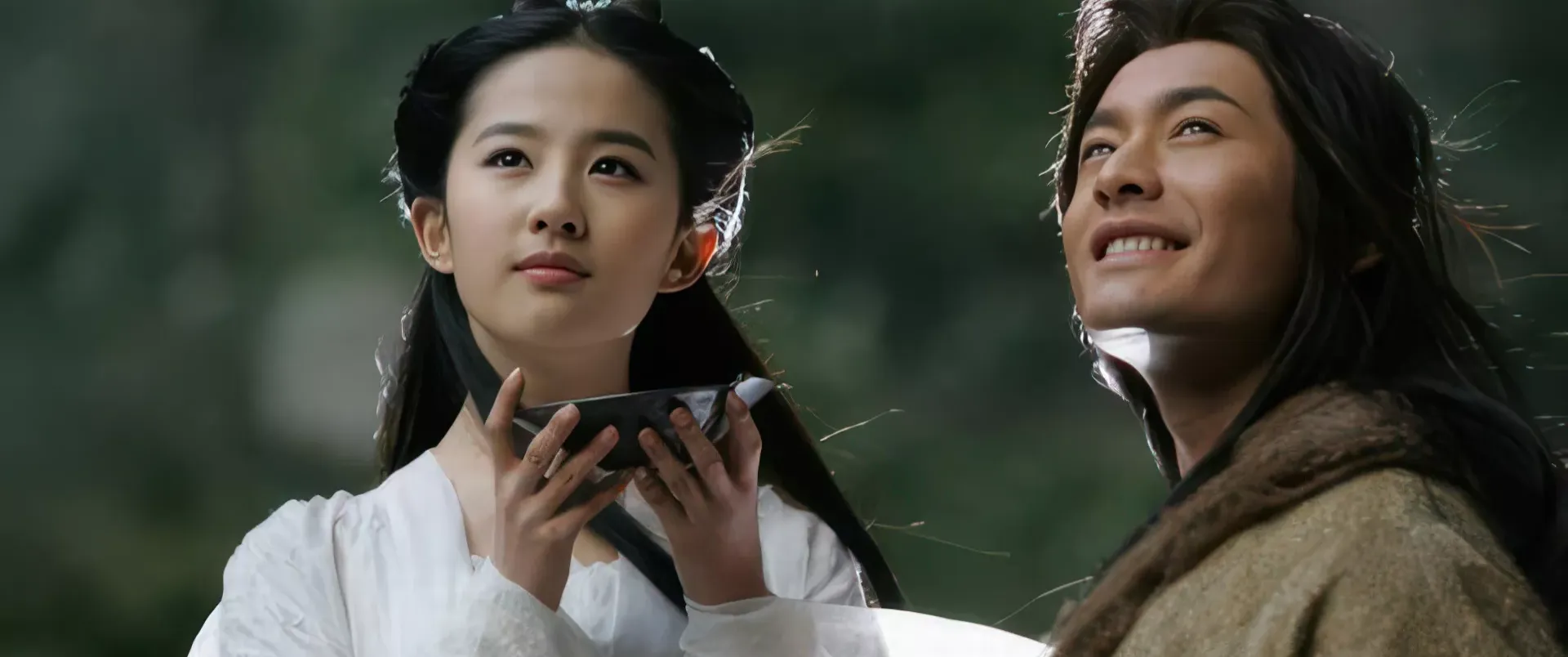
The Return of the Condor Heroes Chapter 13 – Part 2
Translation by Jenxi Seow
Zhu Ziliu roared with laughter. “Quite right: ‘Thou art a barbarian.’”1 The assembled heroes, who hated the Mongol cavalry for invading the land and butchering the common people, were every one of them full of bitter resentment, and when they heard Zhu Ziliu curse him with “Thou art a barbarian”, they roared their approval.
Zhu Ziliu’s “Yiyang Calligraphy Finger”, in all four scripts, regular, cursive, clerical and seal,2 had left Huo Dou barely able to defend himself, and his nerve had long since gone. The roar of cheering threw his mind into still greater confusion. He saw Zhu Ziliu flourish his brush and write three characters in the air in quick succession, and the last thing on his mind now was trying to read them. All he could do was raise his fan with all his strength to guard his face and the vital points of his chest. Suddenly his knee went numb. His opponent had turned the brush round and struck an acupoint3 with the butt of the shaft. The back of Huo Dou’s knee went weak and aching, he was on the point of sinking to his knees, and he thought, If I kneel now, I can never hold up my head as a man again. He forced a breath down towards the acupoint in his knee, meaning to spring clear and concede, but Zhu Ziliu’s brush came like lightning and struck again. Using the brush for a finger, he worked the Yiyang Finger through the shaft in a chain of strikes. How could Huo Dou withstand it? His knee went numb and slack, and at last he sank to his knees, every trace of colour gone from his face.
The heroes broke into cheers that shook the hall. Guo Jing4 said to Huang Rong, “Your clever plan has worked.” Huang Rong gave a faint smile.
The Wu brothers5 had been watching from the side, and the endless changes of their Zhu shishu’s6 Yiyang Finger filled them both with awe. Each of them thought, Zhu shishu’s skill is so deep and so strong, and turned into calligraphy it still holds all these subtle changes. I wonder when I shall ever learn to be as good as he is. One called, “Big Brother!” and the other, “Brother!” Both had the same thought, to speak their admiration of their shishu’s martial arts, when they heard Zhu Ziliu give a terrible cry. They turned their heads sharply and saw him topple over backwards.
It happened so suddenly that everyone was aghast. What had happened was this. When Huo Dou could hold out no longer and sank to his knees, Zhu Ziliu reflected that he had sealed the acupoint with the Yiyang Finger, which was quite unlike ordinary acupoint-sealing and would be hard for anyone else to undo, so he reached out, pressed several times beneath Huo Dou’s ribs and sent his neili through to free the sealed point. But the moment Huo Dou’s acupoint was free, murder rose in him. Still groaning faintly, before he had even straightened up, he pressed the catch on his fan handle with his right thumb, and four poisoned darts7 shot from the fan’s ribs and drove, every one of them, into Zhu Ziliu’s body. When experts compete, once the winner and loser are clear, no further blow may be struck, and with the whole hall watching, who could have foreseen a treacherous attack? Had Huo Dou loosed his hidden weapons during the bout, the darts in his fan, cunning as they were, could never have hurt his opponent. But Zhu Ziliu was freeing his acupoint, barely a foot from him, and helping him in good faith. He could never have dreamed that his kindness would be repaid with malice and a sudden treacherous blow. Hidden weapons loosed at such close quarters are hard to dodge, however great one’s skill. The four darts were steeped in a deadly poison from the snow mountains of Mongolia, and the moment they struck, Zhu Ziliu was racked from head to foot by unbearable pain and itching, and could no longer stand.
The heroes were seized by shock and fury together. They jabbed their fingers at Huo Dou and denounced him as vile and shameless. Huo Dou laughed. “This prince has turned defeat into victory. Where is the shame in that? Before our contest, no one said hidden weapons were forbidden. Had Brother Zhu here hit this prince with a hidden weapon first, I would simply have accepted my fate.” Everyone felt he was twisting the truth, but for the moment no one could rebut him, and the abuse rained down unabated.
Guo Jing rushed out and gathered Zhu Ziliu up in his arms. He saw the four little darts lodged in his chest and the strange look on his face, and knew the poison on them was no ordinary one. At once he sealed three major acupoints to slow the blood, close the meridians and keep the poison from spreading to the heart. “What do we do?” he asked Huang Rong. Huang Rong frowned and said nothing. To cure this poison, she knew, they would need Huo Dou or State Preceptor Jinlun to give the antidote themselves, but how to get it out of them she could not, for the moment, see.
Seeing his shidi8 so badly poisoned, the Diancang Fisherman9 was half frantic and half furious. He hitched up the hem of his robe, tucked it into his sash and was about to rush out and fight Huo Dou. But Huang Rong was weighing the whole course of the contest, and thought, They have won one bout already. If the Fisherman shixiong10 goes out, Da’erba11 will take him on, and we cannot be sure of winning. “Wait, shixiong!” she said quickly. “What is it?” asked the Diancang Fisherman. For all her endless resourcefulness, Huang Rong had no answer to give. With the first bout lost, the next two would be very hard going.
Having beaten Zhu Ziliu by a trick, Huo Dou stood at the entrance to the hall, very pleased with himself, looking about him as if the world held no one to match him. Then his eye fell on Xiaolongnü and Yang Guo, sitting shoulder to shoulder on the stone base of a pillar, hand in hand and deep in quiet talk, with not so much as a glance for his victory. Anger flared in him. He pointed his fan at Yang Guo and barked, “Little beast, stand up.”
Yang Guo’s whole attention was on Xiaolongnü. Wide as the world was, it seemed to him that nothing else in it could draw his mind away, so while Huo Dou and Zhu Ziliu fought fit to turn heaven and earth upside down, he had seen and heard none of it. In his years with Xiaolongnü in the Ancient Tomb, he had never really known that she was carved into his very bones, that he would live and die for her. When she had asked him that day whether he wanted her as his wife, the question had come so suddenly, and was so far beyond anything he had ever dared to think, that he had stood dumbfounded with no answer. After she vanished without a trace, he had said it in his heart more times than he could count, I do. Of course I do. I would sooner die this instant than not have Aunt for my wife.
The love between him and Xiaolongnü had sprung up in both of them without their knowing it, and only when they were parted did it burst out in a rush that nothing could hold back. Yang Guo, of course, feared neither heaven nor earth, and Xiaolongnü knew nothing whatever of the world’s customs and proprieties. She simply thought, If I want to love, I love. If I want to be happy, I am happy. What business is it of anyone else’s? And so, one not caring and the other not understanding, the two of them sat hand in hand amid a thousand watching eyes, on a field of savage combat, murmuring words of tender love.
Yang Guo was deeply stirred. “I am so used to it that my mouth still calls you ‘Aunt’,” he said, “but in my heart I call you ‘wife’.”
Xiaolongnü smiled. “Good. When nobody is around, you may call me ‘wife’. Mm, wife, wife. I love it when you call me that.”
Yang Guo said, “Then for all your life you must be my wife.”
Xiaolongnü said, “That goes without saying. Would I be your wife for three or four days and then stop? I could not do that, and neither may you. You must be my husband for ever and ever. You are not allowed to change your heart.”
Yang Guo said, “Of course I will never, ever change my heart or betray you. Li shibo1213 stirs up trouble and spreads lies, always trying to trick you into heartbreak. Do not believe her.”
Xiaolongnü nodded and said with absolute finality, “Mm. She is a bad woman!”
Huo Dou cursed him again, and still Yang Guo did not hear. Huo Dou was about to berate him further when State Preceptor Jinlun instructed, “We have won one bout. We may go on to the second.” Huo Dou shot Yang Guo a vicious glare, went back to his seat and announced loudly, “We have won one bout. For the second, my second shixiong Da’erba will take the field. Which hero of yours will come out and instruct us?”
Da’erba drew a weapon from beneath his crimson kasaya14 and strode to the centre of the hall. The sight of his weapon sent a chill through the crowd: it was a golden vajra pestle,15 thick and long. Such vajra demon-subduing pestles were customarily wielded by dharma-protecting elders16 in Esoteric Buddhism.17 It was not unusual for Tibetan or Mongolian monks to carry them as weapons, but Da’erba’s demon-subduing pestle was a full four feet in length, its head as thick as a rice bowl, its shaft gleaming with golden light as though forged from a mixture of gold and steel, or perhaps a steel pestle coated with layers of gold. Its weight was obvious at a glance.
He came to the centre of the hall, pressed his palms together in salute to the heroes, and tossed the golden pestle high into the air. Down it came with a crash, smashing two large blue-patterned floor tiles to powder and sinking more than a foot into the earth beneath. This opening stroke cowed them before a blow was struck. It showed how heavy the pestle was, and that a monk so dry and scrawny could wield it at all showed just as plainly what martial skill and strength he had.
Huang Rong thought, Jing gege18 could certainly subdue this hothead of a monk, but in the third bout the State Preceptor will fight, and we have no one who can stop him, so this contest is as good as lost. There is nothing else for it. I shall do my best to fight him with finesse. She took up the Dog-Beating Staff19 and said, “Let me take him on!”
Guo Jing was aghast. “No, no, you cannot. You are unwell. How can you fight anyone?” Huang Rong herself was by no means sure of winning, but if this bout were lost there would be no need for a third. As she hesitated, the Diancang Fisherman called, “Guild Chief Huang, let me take on this villain of a monk.” Having seen his shidi in torment from the poison’s numbing itch, he was frantic, and burned for revenge. Huang Rong had no better plan either, and thought, All we can do now is fight it out. If he beats the Mongol monk, Jing gege can then meet the State Preceptor strength for strength and settle which of them is the better. So she said, “Shixiong, please take care.”
The Wu brothers carried over the two iron oars20 their shibo fought with and presented them to him. The Diancang Fisherman tucked them under his arms and walked to the centre of the hall. His eyes blazing red, he circled Da’erba once. Da’erba, at a loss to know what he meant, simply turned to follow him round. Suddenly the Fisherman gave a great roar and, an oar in each hand, brought both chopping straight down at the crown of his head. Da’erba reached down, plucked his demon-subduing pestle from the floor and parried. Oar met pestle with a clang so loud that every ear in the hall rang. The webs of both men’s thumbs ached dully, and each knew the other was immensely strong. They sprang apart. Da’erba said something in Mongolian. The Fisherman cursed him in the Baiyi21 tongue of Dali. Neither understood a word of the other. All at once they closed in again, oar and pestle struck together, and once more metal crashed on metal.
This was a savage fight, nothing like the elegant, scholarly duel between Zhu Ziliu and Huo Dou. Bronze vat against iron jar, brute strength against brute strength, each man met the other with external hard skills22 of the highest order. Oar and pestle stirred up a gale, and the onlookers watched aghast.
Footnotes
-
“Thou art a barbarian” (尔乃蛮夷). Ěr Nǎi Mányí. Classical Chinese insult from the Central Plains perspective, dismissing non-Han peoples as uncivilised. Phrase draws on millennia of Sino-centric worldview. ↩
-
Regular, cursive, clerical, and seal scripts (真草隶篆). Four major styles of Chinese calligraphy, each used by Zhu Ziliu as a different mode of martial expression through the Yiyang Finger. ↩
-
acupoint (穴道). Xuédào. In Chinese martial arts theory, specific points on the body’s meridian system that can be struck to disable, paralyse, or kill. Sealing acupoints is a core technique in advanced martial arts. ↩
-
郭靖 – Guō Jìng. His name meaning “tranquillity” or “pacification”. See Wuxia Wiki. ↩
-
Wu Brothers. Wu Dunru (武敦儒) and Wu Xiuwen (武修文), sons of Wu Santong, disciples of Guo Jing and Huang Rong. ↩
-
师叔 – shīshū. Junior lineage uncle. Shidi or shimei of one’s shifu. Shī means teacher. Shū means father’s younger brother. See Wuxia Wiki. ↩
-
Poison darts (毒钉). Dúdīng. Small darts coated with a poison derived from Mongolian snow mountain toxins, concealed within the ribs of Huo Dou’s folding fan and fired by a spring mechanism. ↩
-
师弟 – shīdì. Male junior. Both apprenticed to the same shifu. Shī means teacher. Dì means younger brother. See Wuxia Wiki. ↩
-
点苍渔隐 – Diǎncāng Yúyǐn. Hermit Fisherman of Diancang; one of Great Master Yideng’s four disciples. See Wuxia Wiki. ↩
-
师兄 – shīxiōng. Male senior. Both apprenticed to the same shifu. Shī means teacher. Xiōng means older brother. See Wuxia Wiki. ↩
-
达尔巴 – Dá’ěrbā. State Preceptor Jinlun’s second disciple. See Wuxia Wiki. ↩
-
李莫愁 – Lǐ Mòchóu. Her name meaning “do not sorrow”. See Wuxia Wiki. ↩
-
师伯 – shībó. Senior lineage uncle. Shixiong or shijie of one’s shifu. Shī means teacher. Bó means father’s elder brother. See Wuxia Wiki. ↩
-
Kasaya (袈裟). Jiāshā. Traditional outer robe worn by Buddhist monastics. Da’erba’s is described as crimson red, following Tibetan Buddhist tradition. ↩
-
Vajra pestle (金刚降魔杵). Jīngāng Xiángmó Chǔ. Literally “vajra demon-subduing pestle.” A ritual implement in Esoteric Buddhism representing the indestructible vajra thunderbolt, adapted as a heavy bludgeoning weapon. ↩
-
Dharma-protecting elder (护法尊者). Hùfǎ Zūnzhě. In Esoteric Buddhism, wrathful deity figures who protect the dharma. Their iconography includes the vajra pestle. ↩
-
Esoteric Buddhism (密宗). Mìzōng. Also known as Vajrayana or Tantric Buddhism, the form of Buddhism practised in Tibet and Mongolia. It emphasises mantras, mandalas, and direct transmission from master to disciple. ↩
-
Jing gege (靖哥哥). Jìng Gēge. Huang Rong’s affectionate term for Guo Jing, literally “Jing gege.” The suffix “-gege” is an intimate form of address. ↩
-
打狗棒 – Dǎgǒu Bàng. Symbol of Beggars’ Guild chief’s authority; green bamboo staff. See Wuxia Wiki. ↩
-
Iron oars (铁桨). Tiějiǎng. Diancang Fisherman’s signature weapons, modelled on boat oars but forged from iron. Each weighs over fifty jin. ↩
-
Baiyi tongue (摆夷语). Bǎiyí Yǔ. 摆夷 is an old Chinese name for the Dai (Tai) peoples of Yunnan; Jin Yong uses it loosely for the native speech of the Dali region. Diancang Fisherman, being from Dali, curses in his native tongue. ↩
-
External hard-style martial arts (外门硬功). Wàimén Yìnggōng. Martial arts that focus on developing external physical strength, conditioning the body to deliver and withstand powerful blows, as opposed to neili cultivation. ↩