The Return of the Condor Heroes Chapter 12 – Part 8
Translation by Jenxi Seow
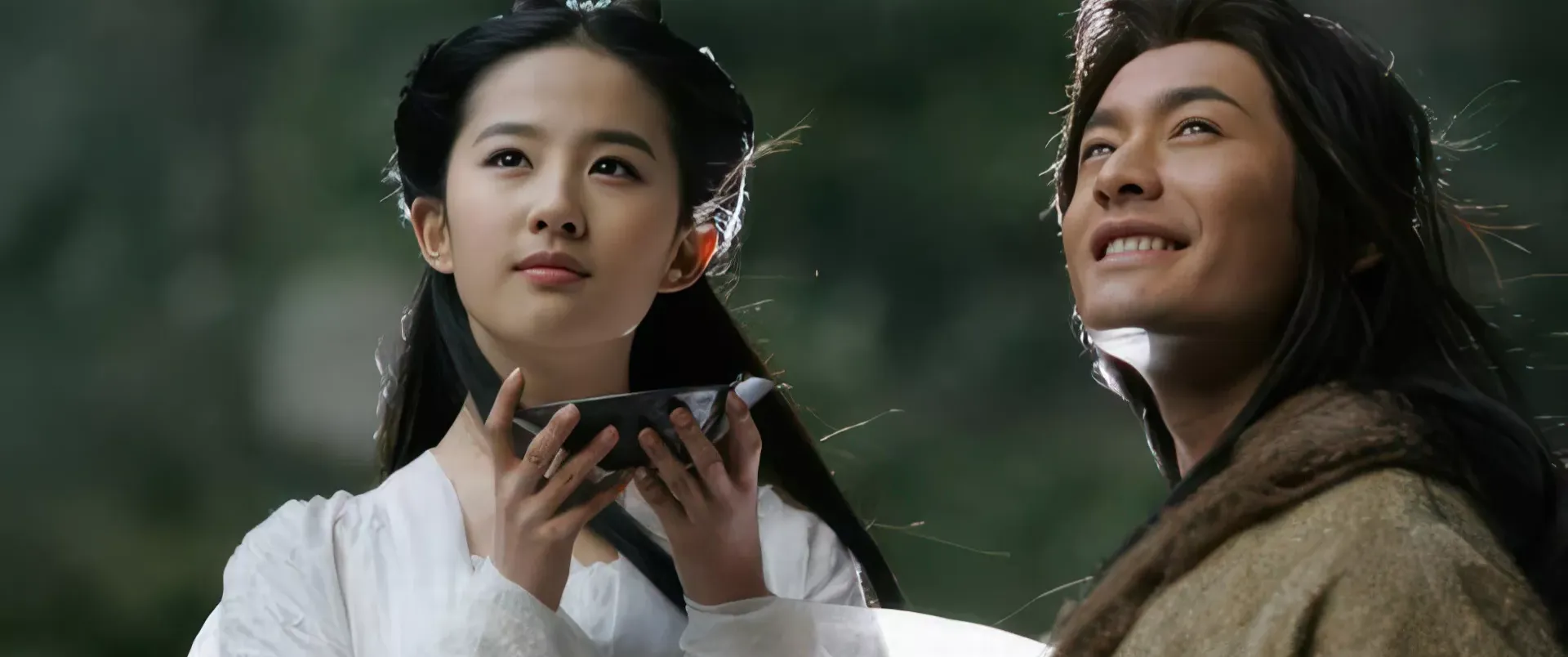
Until then every eye in the hall had been fixed on Zhu Ziliu and Huo Du, but the moment the girl in white came in, everyone found themselves looking at her. Her face was pale, as if she had been ill, and though the candlelight glowed like a sunset, it brought not the faintest touch of colour to her cheeks, which only made her look all the more pure and unworldly, lovely beyond compare. People often say a woman is “as beautiful as a heavenly immortal”, though no one really knows how beautiful a heavenly immortal is. Yet at the sight of this girl, those very words, “as beautiful as a heavenly immortal”, rose unbidden in every heart. She seemed wrapped in a thin veil of mist and haze, half real and half a dream, surely no creature of this mortal world.
The moment Yang Guo saw her he was wild with joy. It was as if a great iron hammer had struck him full in the chest. He leapt out of his corner, threw his arms round her and cried, “Aunt, Aunt!”
The girl was Xiaolongnü.
After parting from Yang Guo she had wandered in a loop through the hills and wilds, then dived back underwater into the stone chambers of the Ancient Tomb. Until she was eighteen she had lived in the tomb with a heart as still as water, never stirred by the smallest ripple. But now that she had met Yang Guo and gone through all those twists and turns, there was no going back to the old days when nothing troubled her. Whenever she sat in meditation on the Cold Jade Bed,1 she thought of how Yang Guo had once slept on it; whenever she sat at the table to eat, she remembered how Yang Guo had kept her company at meals. She could not practise for more than a few moments before restlessness took hold of her and she could go on no longer.
When more than a month had passed like this, she could bear it no longer and resolved to go and find Yang Guo, though what she would do once she had found him she had no idea. Since hearing Li Mochou’s mischief-making she had been sure Yang Guo’s heart had changed, and she had left in grief there and then. But after a few days she had thought, If his heart has changed, let it change. Whatever happens, I can’t be without him.
When she came down from the mountain, everything was new to her, and how was she to know the way? Whenever she met someone on the road, she asked, “Have you seen Yang Guo?” When she was hungry, she picked up other people’s food and ate it, with no idea that she ought to pay, and all along the way she made any number of comical blunders. But people saw how innocent and lovely she was and could not help making allowances, so no one gave her any trouble.
One day at an inn she happened to overhear two big men talking. They said that all the famous heroes and brave men of the realm were going to Lu Family Manor at Dasheng Pass2 for the Hero Assembly. She thought Yang Guo might well be there, so she asked the way and came to Lu Family Manor.
Apart from Hao Datong, Zhen Zhibing and Zhao Zhijing, not one of the two thousand and more people in the great hall knew who Xiaolongnü was. All they saw was that she was extraordinarily beautiful, and every one of them felt a strange stirring. Sun Buer knew of her but had never met her. Zhen Zhibing’s face went deathly white and he trembled all over. Zhao Zhijing watched him sidelong with a faint, cold smile. Guo Jing and Huang Rong were astonished to see how far beyond the ordinary Yang Guo’s affection for her went.
“Guoer,” said Xiaolongnü, “so you are here. I’ve found you at last.”
Tears ran down Yang Guo’s face. “You… you won’t leave me again?” he choked.
Xiaolongnü shook her head. “I don’t know.”
“Wherever you go from now on,” said Yang Guo, “I’ll go with you. Even if you kill me, I won’t be parted from you.”
Xiaolongnü was overjoyed. “Wonderful!”
A thousand people crowded the great hall, but the two of them talked on as if no one else were there. Xiaolongnü held Yang Guo’s hand, sorrow and joy mingling in her. He still called her “Aunt”, but he held her tight, as ardent as fire, and plainly he loved her deeply. He was not at all the faithless, fickle man her shijie3 had made him out to be, ready to cast her aside. She was overjoyed and comforted.
When Huo Du saw how Xiaolongnü looked, his heart stirred, but he did not know her for the girl he had once gone up Mount Zhongnan to ask in marriage. Seeing Yang Guo in his rags on such intimate terms with her, he was filled with dislike. “We’re about to have a contest,” he said. “Make some room, will you!”
Yang Guo had no mind to answer him. He led Xiaolongnü by the hand to one side and sat down with her, shoulder to shoulder, on the stone base of a pillar, so happy he felt he would burst. His left arm held her tightly round the shoulders, as if he were afraid she might suddenly go away again.
Huo Du turned back to Zhu Ziliu. “Since you won’t use a weapon, we may as well settle it with fists and feet.”
“Not so,” said Zhu Ziliu. “Ours is a nation of rites and righteousness. The junzi4 contends with letters and makes friends through the brush. I have a brush and no dao. What need have I of a weapon?”
“In that case,” said Huo Du, “take this!” He flicked open his fan and fanned it at him.
Zhu Ziliu slanted his body and stepped aside, wagging his head like a pedant at his books, his left palm skimming lightly before him while the brush in his right hand slashed straight at Huo Du’s face. Huo Du turned his head aside to dodge it, but seeing how light his opponent’s footwork was and how strange his moves, he did not dare press the attack. He meant first to see what school his martial arts came from and then decide how to meet them.
“My brush sweeps away a thousand armies,” said Zhu Ziliu. “You had better take care.” And the tip of his brush darted forward.
Huo Du had learnt his martial arts in Mongolia, but State Preceptor Jinlun’s learning was as deep and vast as a lake or the sea, and there was no famous martial art of the Central Plains he did not know. From the very start of his training Huo Du had resolved to go to the Central Plains and make a name for himself, so State Preceptor Jinlun had gone through the prize moves of every great school of the Central Lands with him one by one, showing him how to break them. Who could have known that today, meeting Zhu Ziliu, he would find not only the weapon strange, but the moves beyond anything he had ever imagined or heard of? The brush tip drew horizontal strokes and slanting hooks in the air, as if writing characters, yet everywhere it pointed lay one of the body’s great acupoints.
The Duan family of Dali came originally from Wuwei Commandery in Liangzhou.5 When they won their kingdom in Dali and took the title of emperor, their forebears had been Tuoba of the Xianbei,6 but long intermarriage with the Han and the influence of Chinese civilisation had made them no different from the Han, and they had long regarded themselves as Han. Chinese learning and culture had spread far across the southern frontier. Zhu Ziliu was the foremost calligrapher of the far south. Though he had studied martial arts, he had never given up letters, and later, as his martial arts grew ever more refined, the one art opened the way to the other until he had fused the Yiyang Finger and calligraphy into one. This skill was his own invention, and however strong an opponent’s martial arts, unless he had a grounding in letters, he would find it very hard to withstand an art in which letters held martial skill and martial skill held letters, both raised to the highest pitch.
As luck would have it, Huo Du had read the classics and learnt poetry with a Han Confucian scholar as a boy, so he could still parry and hold him off. He watched his opponent’s brush sway and dart, acupoint strikes within the calligraphy and calligraphy within the acupoint strikes, truly silver hooks and iron strokes, sharp and fierce, and within all that power a graceful, bookish elegance.
Guo Jing knew nothing of letters and watched in silent wonder. But Huang Rong had learnt from her father and was accomplished in both letters and arms, and seeing Zhu Ziliu’s marvellous art, she could not help admiring it greatly.
Guo Fu went over to her mother. “Mother, what’s he doing, waving his brush about like that?”
Huang Rong, her whole attention on the fight, answered without thinking, “The Fang Xuanling Stele.”7
Guo Fu was bewildered. “What Fang Xuanling Stele?”
Huang Rong was enjoying the fight too much to answer.
The Fang Xuanling Stele was an inscription written by the Tang8 minister Chu Suiliang,9 a masterpiece of regular script.10 The critics of old likened Chu’s calligraphy to “a heavenly maiden scattering flowers”: vigorous yet supple, every stroke alive and glancing, every stroke poised in mid-air, with all the subtleties of lift and press, check and release. Zhu Ziliu’s “Yiyang Calligraphy Finger”11 used the brush in place of a finger, and every move was as strictly disciplined as regular script, without a single careless stroke. Huo Du did not understand the deep secrets of the Yiyang Finger, but he had at least copied out the Fang Xuanling Stele himself, and he could foresee which vertical stroke would follow a given horizontal one, so he defended in good order and showed no sign of losing.
Seeing that Huo Du knew this hand, Zhu Ziliu shouted his approval. “Careful! Here comes the cursive.”12
Suddenly he snatched the cap off his head and flung it to the ground. His long sleeves flew as he rushed wildly about, his moves following no rules at all. He was like a madman, like a drunkard, like one possessed, his brush dripping with spirit, his finger running like dragons and serpents.
Guo Fu laughed in alarm. “Mother, has he gone mad?”
“Mm,” said Huang Rong. “Three more cups of wine and his brushwork would be even better.” She lifted the wine pot, poured three cups and called out, “Big Brother Zhu, drink three cups to add to the fun.” She held a cup in her left hand and flicked it with the middle finger of her right, and the wine cup flew off, flat and steady. Zhu Ziliu drove out a falling stroke with his brush that forced Huo Du back a step, scooped up the cup and drained it at a gulp. Huang Rong flicked the second cup after it, then the third.
Huo Du saw the two of them passing round wine in the middle of a fight as though he were not even there, and he tried to knock the cups down with his fan, but Huang Rong matched her flicks to the flow of Zhu Ziliu’s brush and always sent a cup through a gap, so that Huo Du could never hit it.
Zhu Ziliu drained the three cups one after another and cried, “Thank you. What a handsome Divine Finger Flick!”13
Huang Rong laughed. “And what a keen-edged ‘Autobiography’!”14
Zhu Ziliu smiled, and thought, All my life I’ve prided myself on my wits, yet I’m always a step behind this slip of a girl. An art I spent more than ten years of hard study perfecting, and she sees through it at a glance.
For what he was writing was the “Autobiography” of the Tang calligrapher Zhang Xu.15 Zhang Xu was known as the “Sage of Cursive Script”,16 the sage of the cursive hand, and Du Fu’s17 poem “Song of the Eight Immortal Drinkers”18 says, “Three cups, and Zhang Xu the Cursive Sage is the talk of all; / cap off, head bare before princes and lords, / he wields his brush, and it falls on the paper like clouds and smoke.” In urging three cups on him, Huang Rong had, first, suited the very nature of the art he was using; second, let the wine sharpen the edge of his brushwork; and third, blunted Huo Du’s spirit.
When Zhu Ziliu came to the character dao,19 “path”, in “the porter contends for the path”,20 he brought its last stroke hooking upwards and slashed it clean across Huo Du’s robe. The assembled heroes roared with laughter as Huo Du staggered back.
Footnotes
-
寒玉床 – Hán Yù Chuáng. Bed carved from rare deep-cold jade found by Lin Chaoying. Training on it greatly accelerates neili cultivation by forcing the practitioner to circulate qi constantly to resist the cold. ↩
-
大胜关 – Dàshèng Guān. Strategic pass between Henan and Hubei; site of Lu Family Manor and the Hero Assembly. ↩
-
师姊 – shījiě. Female senior. Both apprenticed to the same shifu. Shī means teacher. Jiě means older sister. See Wuxia Wiki. ↩
-
君子 – jūnzǐ. Literally noble man. Confucian ideal of the morally cultivated man. Often mistakenly translated as “gentleman”. See Wikipedia. ↩
-
凉州 – Liángzhōu. Ancient region in present-day Gansu, the ancestral homeland of the Duan family of Dali. ↩
-
鲜卑 – Xiānbēi. Ancient nomadic people of the steppes. The Tuoba of the Xianbei founded the Northern Wei dynasty; the novel makes them forebears of the Duan royal house of Dali. ↩
-
Fang Xuanling Stele (房玄龄碑). Famous Tang dynasty stele inscription by the master calligrapher Chu Suiliang, renowned as a masterpiece of regular script. ↩
-
Tang Dynasty (唐朝). China’s golden age (618–907), a period of extraordinary cultural and artistic achievement including the peak of calligraphy. ↩
-
Chu Suiliang (褚遂良). One of the Four Great Calligraphers of the early Tang dynasty, known for his elegant, flowing regular script. His style was described as “a celestial maiden scattering flowers”. ↩
-
Regular Script (楷书). Standard, most formal style of Chinese calligraphy, where each stroke is clearly written and characters are perfectly proportioned. ↩
-
Yiyang Calligraphy Finger (一阳书指). Zhu Ziliu’s original fusion of the Yiyang Finger with calligraphy, creating a martial art where each stroke writes characters while striking acupoints. ↩
-
Cursive Script (草书). Highly abbreviated, flowing style of Chinese calligraphy where characters are written with swift, connected strokes. Most expressive and individualistic of the major scripts. ↩
-
Divine Finger Flick (弹指神通). Huang Yaoshi’s signature technique, passed to Huang Rong. Flick of the finger releases devastating force; can also be used to propel small objects with precision. ↩
-
Autobiography (自言帖). Famous piece of cursive calligraphy by the Tang dynasty “Sage of Cursive Script”, Zhang Xu. ↩
-
Zhang Xu (张旭). “Sage of Cursive Script” of the Tang dynasty, one of the Eight Immortal Drinkers celebrated by Du Fu. Known for his wild, unrestrained cursive calligraphy, often performed while drunk. ↩
-
Sage of Cursive Script (草圣). Title bestowed on Zhang Xu, recognising him as the supreme master of cursive calligraphy. ↩
-
Du Fu (杜甫). One of China’s greatest poets, of the Tang dynasty. His poem “Song of the Eight Immortal Drinkers” celebrates eight famous drinkers, including Zhang Xu. ↩
-
Song of the Eight Immortal Drinkers (饮中八仙歌). Du Fu’s famous poem celebrating eight legendary drinkers of the Tang dynasty, including Li Bai and Zhang Xu. ↩
-
Dao (道). “Path” or “Way”, a character with deep philosophical significance in Daoism. In the “Autobiography”, it appears in the phrase “the porter struggles for the path”. ↩
-
Porter Struggles for the Path (担夫争道). Famous passage in Zhang Xu’s “Autobiography”, referring to an anecdote where Zhang Xu gained insight into calligraphy from watching a porter navigate a narrow path. ↩