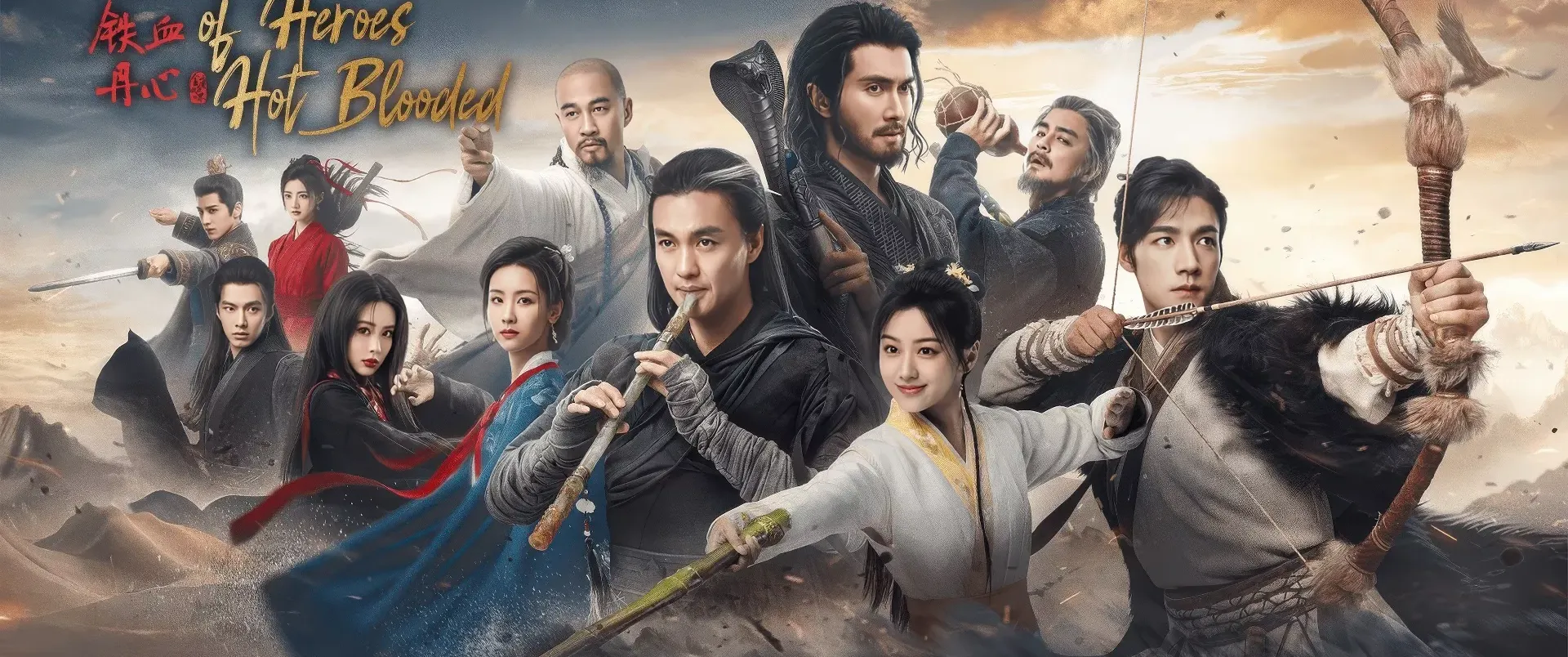
The Legend of the Condor Heroes Chapter 26 – Part 5
Translation by Jenxi Seow
As father and daughter went on in this way, question and answer, the Six Eccentrics of Jiangnan,1 eccentric as they were by nature, listened in stupefaction. Throughout the Song dynasty the barriers of ritual propriety were held most strictly, but Huang Yaoshi2 was a man who rejected the sage kings Tang and Wu and scorned the Duke of Zhou and Confucius. In everything he did he made a point of going against the ways of the world, which was why people had given him the title of the Eastern Heretic.3 Huang Rong,4 shaped by her father since childhood, believed that marriage was marriage and love was love. When had her little head ever held a single thought of chastity or wifely virtue? Anyone else hearing so shocking a conversation would have been left tongue-tied with astonishment, yet the two of them spoke as naturally as anything, as if they were chatting about household matters. Even Ke Zhen’e5 and the others, broad-minded as they were, could not help shaking their heads inwardly.
Guo Jing6 was wretched beyond words. He wanted to say something to comfort Huang Rong, but he was slow of speech at the best of times, and now he had even less idea what to say. Huang Yaoshi looked at his daughter, then at Guo Jing, threw back his head and let out a long cry that shook the treetops. The hills and valleys echoed it back, and a flock of magpies started up and circled over the wood.
Huang Rong called out, “Magpies, magpies, tonight the Cowherd meets the Weaver Girl.7 Hurry off and build the bridge!”
Huang Yaoshi snatched up a handful of grit and pebbles from the ground and flung it out. More than ten magpies came tumbling down, and every one of them lay dead on the ground.
In a ringing voice Huang Yaoshi said, “Deep love and tender feeling are all illusion. What bridge is there to build? Better to die early and be done with it!”
He turned and was gone as lightly as a drifting cloud, and in the blink of an eye his back in its green robe had vanished among the trees.
Tolui8 did not understand what they were saying. He knew only that Guo Jing would not go back on the old pledge, and was naturally pleased. He said, “Anda,9 I hope your great task is soon done, and that we meet again when you come back north.”
Huazheng10 said, “Keep this pair of white eagles with you, and come back soon.”
Guo Jing nodded and said, “Tell my mother that I shall kill my enemy with my own hands and avenge my father.”
Jebe11 and Boroqul12 also took their leave of Guo Jing, and the four of them rode out of the forest together.
Han Xiaoying13 asked Guo Jing, “What do you plan to do?”
Guo Jing said, “I…I mean to go and look for Hong shifu.”
Ke Zhen’e nodded and said, “Quite right. Island Master Huang has been to our homes, and our families are bound to be very anxious. We are going back now. When you find Guild Chief Hong,14 ask the old man to come to Jiaxing to recover. We shall keep the gate and guard the pass for him, and I promise you he will be safe.”
Guo Jing agreed, took his leave of his six shifus with a kowtow, and went back to Lin’an15 with Huang Rong.
That evening the two of them entered the imperial palace once more and searched carefully around the imperial kitchen, but where was there any sign of Hong Qigong? They found several eunuchs and pressed them for answers. All said that no spies or assassins had appeared in the palace these past few days. The two of them felt a little easier, reasoning that though Hong Qigong had lost his martial powers, a great master with his wits and experience was sure to have some means of escape. The Beggars’ Guild16 assembly was now close at hand, and there was no more time to delay. At dawn the next morning they rode west.
At this time half of the Middle Kingdom was already occupied by the Jin. The eastern boundary ran along the Huai River, the western along Dasan Pass. All that remained to the Southern Song were the two circuits of Liangzhe East and West, the Two Huai, the two circuits of Jiangnan East and West, the two circuits of Jinghu South and North, the circuit of Jingxi South, the five circuits of Bashu, Fujian, and the two circuits of Guangnan East and West, seventeen circuits in all. The nation’s power was waning, and its territory shrank by the day.
One day the two of them entered the territory of Jiangnan West Circuit and climbed a long ridge. Suddenly a cool gust swept past, and a great mass of dark clouds raced in from the east. It was the height of summer, and in summer rain comes without warning. The clouds had not yet reached them when thunder crashed and rumbled, and raindrops as big as soybeans were already pelting down.
Guo Jing opened his umbrella to shield Huang Rong’s head, when a sudden fierce wind struck and tore the canopy clean away, sending it flying far off. Guo Jing was left holding nothing but a bare umbrella handle.
Huang Rong burst out laughing and said, “So now you’ve taken up the Dog-Beating Staff17 too?”
Guo Jing laughed along with her. Before them stretched a long ridge, and as far as the eye could see there was nowhere to shelter from the rain. Guo Jing took off his outer coat to keep the rain off Huang Rong.
Huang Rong laughed and said, “It’ll keep it off a little longer, and then that’ll be soaked too.”
Guo Jing said, “Then let’s run for it.”
Huang Rong shook her head and said, “Jing gege, there’s a story in a book. One day it was raining heavily, and all the travellers on the road broke into a run. Only one man walked on at a leisurely pace. The others found this strange and asked him why he did not run. The man said, ‘It’s raining hard up ahead too. If I run on, won’t I be soaked through just the same?’”
Guo Jing laughed and said, “Quite right.”
Huang Rong was suddenly reminded of Huazheng, and thought, If what lies ahead is already fated to be sorrow and heartbreak, then however we go we can neither escape it nor hide from it, just like the two of us caught in the rain on this long ridge.
So the two of them walked slowly on through the downpour, and only when they were over the long ridge did they come upon a farmhouse and go in to shelter from the rain.
Their clothes and shoes were soaked through. They borrowed clothes from the farm family to change into, and Huang Rong put on an old farmwife’s ragged clothes. She was just finding it amusing when she heard Guo Jing in the next room crying out in distress, one lament after another. She hurried over and asked, “What is it?”
She saw him pulling a woeful face, holding the painting Huang Yaoshi had given him. In the downpour just now, the rain had ruined it. Huang Rong cried again and again, “What a pity!” She took the painting and looked at it. The paper was torn and the ink blurred. There was no way to remount and repair it. She was about to set it down when suddenly, beside the poem Han Shizhong18 had inscribed, she made out what appeared to be several additional lines of writing. Drawing close for a careful look, she saw that these characters had been written on the backing paper of the mounting’s inner layer. Had the painting not been soaked by the rain, they would never have become visible. But with the rain soaking it and the paper falling to pieces, the writing was broken and hard to read, though from the way it was laid out she could tell there were four lines in all.
Huang Rong studied them carefully and slowly read out, “…mu’s Art of War, …Iron Palm…, Middle…Peak, second…section.”
The rest of the damaged characters she could not make out, try as she might.
Guo Jing exclaimed, “This is talking about Wumu’s Art of War!”19
Huang Rong said, “No doubt about it. That villain Wanyan Honglie worked out that Wumu’s Art of War was hidden beside Cuihan Hall in the palace, but though he got the stone casket, there was no sign of the book. These four lines must be the vital clue to where it is. …Iron Palm…Middle…Peak…” She pondered a moment, then said, “That day at Returning Clouds Manor,20 I heard Lu shige21 and your six shifus talking about that fraud Qiu Qianren,22 and saying he was Chief of the Iron Palm Keep23 or some such. Father said the Iron Palm Keep’s might awed Sichuan and Hunan, and that it was a great power and truly formidable. Can Wumu’s Art of War really have something to do with Qiu Qianren?”
Guo Jing shook his head and said, “If it’s anything Qiu Qianren has a hand in, I won’t believe a word of it.”
Huang Rong smiled and said, “Nor will I.”
On the fourteenth day of the seventh month the two of them entered the territory of Jinghu North Circuit. The following day, before the hour of Wu,24 they reached Yuezhou.25 Having asked for directions, they led their horses and let their eagles fly, and made straight for Yueyang Tower.26 Near Yueyang Tower there was a wineshop.
The two of them went up into the wineshop, ordered wine and food, and gazed out over Dongting Lake.27 As far as the eye could see the waters spread vast and rolling, one boundless sheet of blue, with ranks of mountains ringed about them, dim and soaring, a magnificent sight, and a different scene altogether from the misty waves of Lake Tai.28
They had been admiring the view for a while when the wine and food arrived. Hunan cooking is fiercely hot, and neither of them found it to their taste, but the bowls were enormous and the chopsticks extra long, which had a bold and generous air about it.
The two of them ate and drank a little and looked round at the poems and inscriptions on the walls. Guo Jing silently recited Fan Zhongyan’s29 Record of Yueyang Tower. When he came to the lines “To worry before the world worries, to rejoice only after the world rejoices,” he could not help reading them aloud.
Huang Rong said, “What do you think of those two lines?”
Guo Jing recited them silently, turning them over in his mind, and did not answer at once.
Huang Rong went on, “Fan Wenzheng, who wrote this essay, once awed the Western Xia with his might. His literary talent and martial strategy could be called matchless in the world.”
Guo Jing begged her to tell him something of Fan Zhongyan’s life. As he heard how poor he had been as a boy, how his father had died young and his mother remarried, and all the hardships he had suffered, and how once he rose to wealth and rank he thought always of the common people, he was filled with reverence. He poured his rice bowl full to the brim with wine, tipped back his head and drained it, and said, “To worry before the world worries, to rejoice only after the world rejoices. That is just the heart a great hero, a great man of valour, should have!”
Huang Rong laughed and said, “A man like that is very fine, of course, but the world has far more sorrow than joy in it, so wouldn’t he never be happy his whole life long? I’d never do it.”
Guo Jing smiled faintly.
Huang Rong went on, “Jing gege, I don’t care whether the world is sorrowful or joyful. If you aren’t by my side, I shall never be happy.” Her voice sank lower as she went on, and she knitted her brows unhappily.
Guo Jing knew she was thinking of what their lives would hold. There was nothing he could say to console her, and he hung his head and said, “I won’t be happy either!”
Huang Rong suddenly looked up and smiled, saying, “Oh, never mind. It is what it is. Fan Zhongyan wrote a poem to the tune Trimming the Silver Lamp. Have you ever heard anyone sing it?”
Guo Jing said, “Of course I haven’t. Tell it to me.”
Huang Rong said, “The second half goes like this. ‘No one in this world lives to a hundred. The young are foolish, the old are haggard, and only in between lies a brief stretch of youth. Why endure chasing empty fame, binding oneself to rank and riches? Ask the white hair: how does one escape it?’” She explained the meaning of the poem, and Guo Jing said, “He urges people not to spend their finest hours chasing fame, seeking promotion, and amassing wealth. That is well said indeed.”
Huang Rong murmured softly, “Wine enters the sorrowing heart and turns to tears of longing.”
Guo Jing glanced at her and asked, “Is that by Lord Fan Wenzheng too?”
Huang Rong said, “Yes. Great heroes and great men of valour are not without feeling either.”
The two drank a few cups together. Huang Rong glanced at the drinkers in the wineshop and saw three middle-aged beggars seated at a square table to the east. Their clothes were much patched but all quite clean. By the look of them they were men of consequence in the Beggars’ Guild, come for that night’s assembly. Apart from them the customers were ordinary officials and merchants. In a big willow beside the wineshop the cicadas shrilled without end.
Huang Rong said, “This cicada shrills ‘I know, I know’30 all day long without stopping, and who knows what it knows? So even among insects there are shameless braggarts. It puts me in mind of someone I miss terribly.”
Guo Jing hastily asked, “Who?”
Huang Rong laughed and said, “That great windbag, Qiu Qianren, Iron Palm Skims the Water.31”
Guo Jing roared with laughter and said, “That old fraud…”
Footnotes
-
江南六怪 — Jiāngnán Liù Guài. Literally six eccentrics of Jiangnan. See Wuxia Wiki. ↩
-
黄药师 — Huáng Yàoshī. See Wuxia Wiki. ↩
-
东邪 — Dōng Xié. Literally eastern heretic. See Wuxia Wiki. ↩
-
黄蓉 — Huáng Róng. See Wuxia Wiki. ↩
-
柯镇恶 — Kē Zhèn’è. See Wuxia Wiki. ↩
-
郭靖 — Guō Jìng. His name meaning “to pacify”; paired with Yang Kang’s 康 it recalls the Jingkang Shame of 1127. See Wuxia Wiki. ↩
-
牛郎织女 — Niúláng Zhīnǚ. The Cowherd and the Weaver Girl, the stars Altair and Vega in a celestial love story. Separated by the Milky Way, they may meet only on the seventh night of the seventh month, when magpies form a bridge across the heavens. See Wuxia Wiki. ↩
-
拖雷 — Tuōléi. See Wuxia Wiki. ↩
-
安答 — āndá. The Mongol word for a sworn brother, bound by oath before Heaven. ↩
-
华筝 — Huázhēng. See Wuxia Wiki. ↩
-
哲别 — Zhébié. Literally spear and divine archer, in Mongolian. See Wuxia Wiki. ↩
-
博尔忽 — Bó’ěrhū. See Wuxia Wiki. ↩
-
韩小莹 — Hán Xiǎoyíng. See Wuxia Wiki. ↩
-
洪七公 — Hóng Qīgōng. See Wuxia Wiki. ↩
-
临安 — Lín’ān. Capital of Southern Song Dynasty (1127-1276) known for its cultural refinement and West Lake scenery. Modern day Hangzhou, Zhejiang Province. See Wikipedia. ↩
-
丐帮 — Gàibāng. Literally beggars’ guild. The largest band in the jianghu, with members throughout the realm. See Wuxia Wiki. ↩
-
打狗棒 — Dǎgǒu Bàng. The jade-green bamboo staff carried by the Guild Chief of the Beggars’ Guild as the token of his office. See Wuxia Wiki. ↩
-
韩世忠 — Hán Shìzhōng. The celebrated Song general who fought the Jin armies. See Wuxia Wiki. ↩
-
武穆遗书 — Wǔmù Yíshū. The military treatise left by Yue Fei (1103—1142), the Song general posthumously titled Wumu. See Wuxia Wiki. ↩
-
归云庄 — Guīyún Zhuāng. Literally returning clouds manor. The Lu family manor on Lake Tai. See Wuxia Wiki. ↩
-
陆师哥 — Lù Shīgē. Literally senior brother Lu, shige being the colloquial form of shixiong. See Wuxia Wiki. ↩
-
裘千仞 — Qiú Qiānrèn. See Wuxia Wiki. ↩
-
铁掌帮 — Tiězhǎng Bāng. Literally iron palm guild. Qiu Qianren’s sect, renowned for its palm techniques. See Wuxia Wiki. ↩
-
午牌 — wǔpái. The hour of wu, about 11 a.m. to 1 p.m.; 牌 is the placard on which the hour was posted. See Wuxia Wiki. ↩
-
岳州 — Yuèzhōu. A prefecture on Dongting Lake, modern Yueyang in Hunan. See Wuxia Wiki. ↩
-
岳阳楼 — Yuèyáng Lóu. Yueyang Tower, overlooking Dongting Lake at Yuezhou, immortalised by Fan Zhongyan’s Record of Yueyang Tower. See Wuxia Wiki. ↩
-
洞庭湖 — Dòngtíng Hú. Literally cavern court lake. Second largest freshwater lake in China (2,680 km²) located in northeastern Hunan Province. See Wikipedia. ↩
-
太湖 — Tàihú. Literally great lake. Lake Tai, on the border of Jiangsu and Zhejiang. See Wikipedia. ↩
-
范仲淹 — Fàn Zhòngyān (989—1052). A Song dynasty statesman, general and writer, posthumously titled Wenzheng (文正). He is best known for the Record of Yueyang Tower and his lifelong concern for the common people. See Wuxia Wiki. ↩
-
知了 — zhīliǎo. A common name for the cicada, from its call; the words also mean ‘I know’. ↩
-
铁掌水上飘 — Tiězhǎng Shuǐshàng Piāo. Literally iron palm floating on water. See Wuxia Wiki. ↩