The Return of the Condor Heroes Chapter 14 – Part 9
Translation by Jenxi Seow
In *The Return of the Condor Heroes*, I introduce this concept for discussion, with the primary purpose of emphasising independent thought and challenging traditions that may not be reasonable. At the time, Chinese authorities strictly controlled the marriages of their subordinates, personnel had to apply to their superiors for permission to marry, and the primary criterion for approval or denial was "class background," resulting in countless tragedies (particularly within the military). The author felt this keenly. Though I did not personally suffer from it, the influence on friends and colleagues gave me a sense of shared experience. Fortunately, the current marriage law, in Articles 3 and 4, emphasises the principle of marital freedom: "marriage must be based on the complete willingness of both parties" and "no third party may interfere." This must surely be counted as one of the great benevolent achievements of reform and opening up.
Marriage customs are endlessly varied. A detailed study could fill a great tome. Engels, drawing on the research of the American scholar Morgan, argued that the roots of the marriage system lie in relations of exploitation, relations of production, and private property. Freud approached it from a psychological perspective, connecting it to the Oedipus complex, the patricide complex, and fraternal rivalry over inheritance. Each of these theories has its merits. In modern and contemporary times, many scholars have built their arguments on biology, linking marriage to genetics, eugenics, and related concepts, a view the author also tends to accept.
A survey of marriage laws across various countries reveals many fascinating and difficult-to-understand peculiarities. In certain regions of China’s Tibet and the Greater Liangshan Mountains, polyandrous group marriage still exists, with several brothers often sharing a single wife. Readers frequently challenge the author, arguing that Wei Xiaobao’s1 one husband with seven wives in The Deer and the Cauldron2 is implausible. In fact, it was hardly unusual for high officials of the Ming and Qing to have multiple wives and concubines. Even ordinary minor officials or moderately wealthy landlords and merchants often took multiple wives, as depicted in Raise the Red Lantern.3 In my youth, I often visited “Wang Manor” in Hangzhou (now converted into the “Xizi State Guesthouse”) and saw the tomb complex of its owner, a tea merchant named Wang. The central two large tombs were for Master Wang and his primary wife. To the left and right were four smaller tombs each, the graves of Master Wang’s eight concubines. I often gave Master Wang’s large tomb a few kicks to express my displeasure. All these tombs have since been demolished and levelled. The former residence of the Qing-dynasty Hangzhou merchant Hu Xueyan4 is now open to the public, revealing that he had a total of thirteen wives at the time.
Even in advanced and civilised Britain, the marriage laws contain feudal traditions. Not long ago, a British couple seeking divorce had to present sufficient grounds and apply to Parliament, which had to pass a specific Act for each case before it could be granted, one can see how difficult divorce was. Current British marriage law further stipulates that a divorced man may not marry his wife’s sister, and a divorced woman may not marry her husband’s brother, that is, a sister-in-law after divorce may not marry her elder or younger brother-in-law. Yet some famous British novels feature plots that do not necessarily follow this rule, such as Galsworthy’s masterpiece The Forsyte Saga and Hardy’s masterpiece The Return of the Native. European royal families intermarried, avoiding marriage with commoners as much as possible, and generally did not prohibit cousin marriage. Queen Elizabeth II’s consort, Prince Philip, Duke of Edinburgh, was a distant cousin of the Queen.
Marriage taboos primarily derive from the prevailing social concepts of the time. Ancient Roman law, Islamic religious law, Indian caste customary law, the laws of contemporary African Muslim nations, the regulations of Roman Catholic countries, and the customs of Eastern nations not only differ from one another but have also varied enormously within the same country across different eras. The Tang-dynasty imperial house was deeply influenced by the Xianbei people of the Northern Qi and Northern Zhou and placed little importance on generational hierarchy in ethical relations. Emperor Taizong of Tang, Li Shimin,5 after killing his own brother Yuanji6 during the Xuanwu Gate Incident,7 took Yuanji’s wife as his consort. After his death, his son Emperor Gaozong, Li Zhi,8 took his father’s consort Wu Zetian9 as his empress. Emperor Xuanzong’s10 beloved consort Yang Guifei11 was originally the wife of his son, Prince Shou, a father usurping his son’s wife, which society more or less turned a blind eye to. By the Song dynasty, although legend has it that Emperor Taizong12 murdered his elder brother Emperor Taizu13 and also killed his younger brother Prince Jin, successive dynasties saw relatively few cases of incest and debauchery within the palace. In later folk sayings, it was “Tang flies, Song snot”, meaning the Tang had many cases of incestuous scandal, while the Song emphasised ethical propriety but was weak in foreign affairs.
In ancient societies, marriage between siblings was taken for granted. In Western mythology, Adam and Eve. In Chinese mythology, Fu Xi14 and Nüwa,15 both were sibling marriages. After the Greek Macedonians conquered Egypt, the Greek royal house, to preserve the purity of its bloodline, refused to intermarry with native Egyptians. According to records, of the fifteen kings of the Greek Ptolemaic dynasty, ten married their sisters as queens. The famous Queen Cleopatra also married her brother. (See Brent D. Shaw, Explaining Incest: Sister Marriage in Greco-Roman Egypt.)
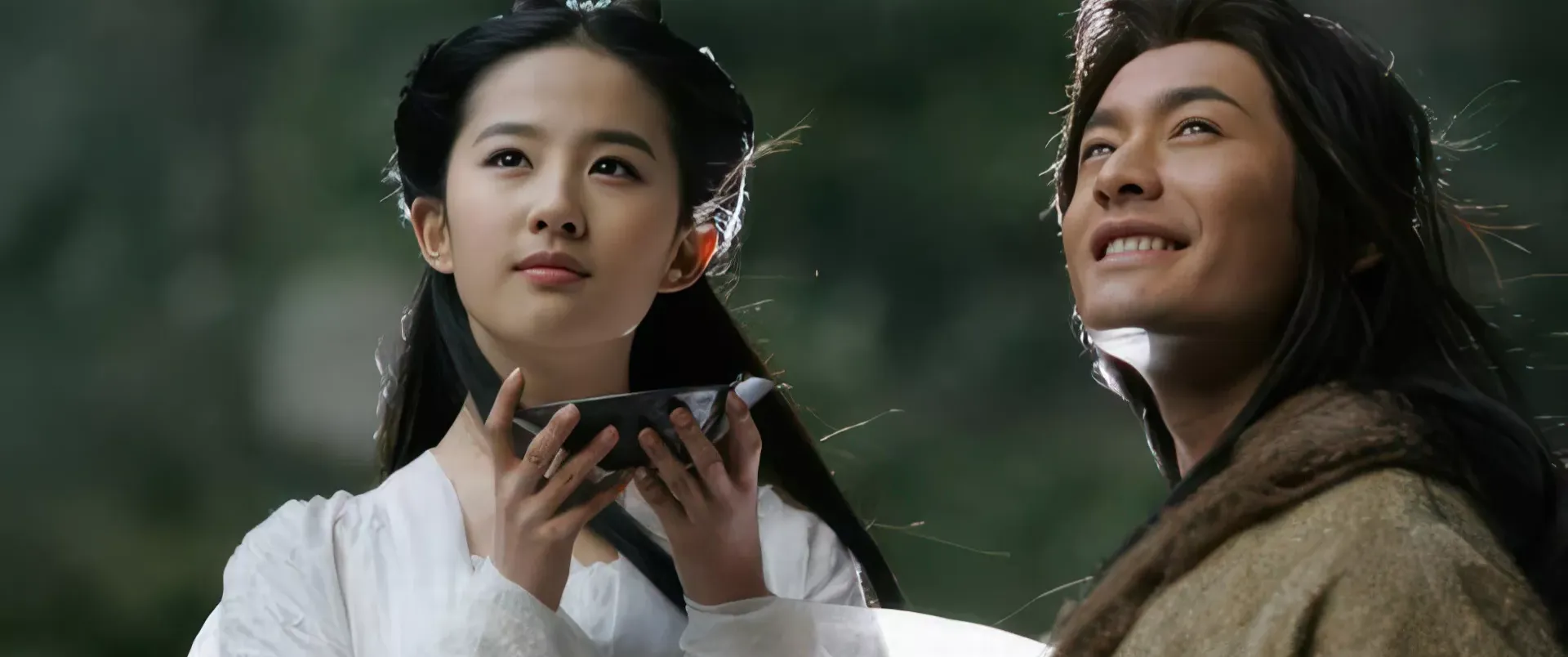
In Chinese opera, there is a fine play called “Beheading the Son at the Command Tent”16 The story goes that the famous Song-dynasty general Yang Yanzhao17 (Yang the Sixth) bound his son Yang Zongbao18 outside the command tent, intending to execute him for violating military discipline. A procession of high ministers and great generals came to plead for mercy, including She Taijun19 (Yang Yanzhao’s mother), Kou Zhun20 (the Grand Councillor), the Eighth Virtuous Prince (the emperor’s uncle), and others, but Yang Yanzhao refused them all and was determined to carry out the execution. The outcome was thoroughly comical: in the end, his daughter-in-law Mu Guiying21 came to challenge him, defeated her father-in-law in combat, and used force to compel him to release her husband. To draw an analogy with the story of The Return of the Condor Heroes, it is as though Yang Guo wanted to marry Xiaolongnü, and Guo Jing was about to strike him dead with a single palm. Huang Yaoshi, Ke Zhen’e,22 Huang Rong, Zhu Ziliu, and Great Master Yideng23 all tried to dissuade him, to no avail. Xiaolongnü, in desperation, deployed the Jade Maiden Heart Sutra martial arts and fought, defeating Guo Jing so soundly that he had no choice but to agree not to interfere in the two’s marriage. Folk drama often represents the shared beliefs of the common people. The story of “Beheading the Son at the Command Tent” is not historical fact, yet it expresses the general thinking of the broad masses.
On July 19, 2003, Hong Kong and foreign newspapers carried a report: the University of California, Berkeley (generally known as UC Berkeley, one of America’s most famous universities) issued a campus-wide circular announcing that faculty members (including deans, department chairs, professors, associate professors, and lecturers) were prohibited from dating or marrying students. Violators among the faculty would be dismissed. Students would be expelled. Yale University and others were reported to have already established such rules. Some faculty and students protested, citing the example of Nobel laureate Professor John Nash of Princeton University, who, while teaching at MIT, fell in love with and married his student Alicia, and later became one of the great scholars of his generation. Although American law does not prohibit teacher-student marriage, prejudice persists among academic and socially conservative circles.
The rules at UC Berkeley, Yale, and other institutions are not based on feudal notions that teachers and students cannot marry, but rather on concerns about fairness and favouritism in exam grading, allocation of research funds, conferral of degrees, and similar matters, analogous to the “avoidance system” in China’s imperial-era civil examinations and local official appointments, where the focus was on preventing opportunities for corruption and favouritism.
Critics ask: what Song-dynasty regulation of ritual and law stated that teacher and student could not fall in love and marry? In which book, in which statute?
In truth, it is not only the Song dynasty, even in the relatively open and Westernised present-day Taiwan and Hong Kong, countless prominent figures have opposed teacher-student romance and marriage. The marriage of Mister Qian Mu24 and Ms. Hu, and the marriage of Mister Liang Shiqiu25 and Ms. Han, both stirred tremendous public controversy at the time. Mister Liang’s disciples even organised a front to “fight to defend their teacher.” The celebrated novelist Xu Xu,26 in his essay “Gender Issues and Literature,” wrote: “The romance and union of Mister Qian and Ms. Hu also drew considerable criticism at the time, because Ms. Hu was Mister Qian’s student, and Ms. Hu’s father was a friend of Mister Qian. If judged by Western principles of love, since the two loved each other, their union was entirely moral. Rather, it was the critics who, in their subconscious, still clung to traditional Chinese concepts of sexual morality, regarding romance between an elder and a junior as a form of quasi-incest. Some say that the criticism of Mister Qian was not directed at his romance and marriage, but arose because Mister Qian was a proponent of Chinese cultural essentialism, a scholar who saw himself as the guardian of traditional Chinese morality, and was therefore judged on grounds of inconsistency between words and deeds. This argument is not without merit.”
Even the famously open-minded Mister Yin Haiguang27 expressed reservations on the matter. In Chapter Seven of his The Prospects of Chinese Culture, in the essay “Words and Deeds Not in Accord,” he wrote: “The moralists emphasise the ‘orthodox transmission of the Way’… Neo-Confucianism possesses a certain power in Chinese society and culture to shape a particular type of person. ‘Inconsistency between words and deeds’ is one of the most notable characteristics of this type.”
Mister Yeh Huo,28 the lead editorial writer of Hong Kong’s Sing Tao Daily at the time, wrote: “In my critique during the ‘Cultural Debate,’ I was not targeting the old gentleman’s marriage, but rather the inconsistency between his words and deeds. For this old gentleman is a proponent of Chinese cultural essentialism, one who ordinarily takes it upon himself to uphold traditional Chinese morality. Yet in his actual life, he does not at all follow that set of moral codes he himself proclaims, his thinking takes traditional Chinese culture as its standard, while his living (or at least his marriage) adopts the standards of Western culture.” (See Yeh Huo, Collected Essays on the Chinese Traditional Culture Debate.)
These gentlemen believed that teacher-student romance violated Chinese cultural tradition. Yet Jin Yong personally witnessed the happy married life of Mister Qian and Ms. Hu. After Mister Qian lost his sight, he relied entirely on Ms. Hu to read books and newspapers aloud, to draft articles and answer correspondence, and to review and collate his writings. Jin Yong holds this couple in the deepest admiration.
July 19, 2003
Footnotes
-
韦小宝 (Wéi Xiǎobǎo). Protagonist of Jin Yong’s final novel The Deer and the Cauldron. Streetwise rogue who rises to great power and ends up with seven wives — a deliberately comic and subversive departure from the traditional chivalrous hero. ↩
-
鹿鼎记 (Lù Dǐng Jì). The Deer and the Cauldron, Jin Yong’s last and most politically sophisticated martial arts novel, set in the early Qing dynasty. ↩
-
大红灯笼高高挂 (Dà Hóng Dēnglong Gāogāo Guà). Raise the Red Lantern, Zhang Yimou’s 1991 film adaptation of Su Tong’s novel Wives and Concubines, depicting the life of a wealthy man’s multiple wives in 1920s China. ↩
-
胡雪岩 (Hú Xuěyán). Hu Xueyan (1823–1885), a legendary merchant and banker of late Qing-dynasty Hangzhou, known as the “God of Wealth.” His lavish lifestyle and eventual bankruptcy became the stuff of legend. ↩
-
李世民 (Lǐ Shìmín). Emperor Taizong of Tang (598–649 CE), one of China’s greatest emperors. He seized the throne by killing his brothers in the Xuanwu Gate Incident but ruled with extraordinary competence, ushering in the golden age of the Tang dynasty. ↩
-
李元吉 (Lǐ Yuánjí). Li Yuanji (603–626 CE), the fourth son of Tang dynasty founder Li Yuan. He was killed by Li Shimin during the Xuanwu Gate Incident. Li Shimin subsequently took Yuanji’s wife, Lady Yang, as his consort. ↩
-
玄武门之变 (Xuánwǔ Mén Zhī Biàn). “The Xuanwu Gate Incident” (626 CE). Palace coup in which Li Shimin ambushed and killed his elder brother, Crown Prince Li Jiancheng, and younger brother Li Yuanji, seizing de facto control of the Tang dynasty. ↩
-
李治 (Lǐ Zhì). Emperor Gaozong of Tang (628–683 CE). He married his father’s former concubine Wu Zetian and elevated her to empress, a union that shocked Confucian sensibilities. ↩
-
武则天 (Wǔ Zétiān). Wu Zetian (624–705 CE), the only woman in Chinese history to rule as emperor in her own right. She began as a concubine of Emperor Taizong, later became empress to his son Gaozong, and eventually founded her own Zhou dynasty. ↩
-
唐玄宗 (Táng Xuánzōng). Emperor Xuanzong of Tang (685–762 CE), whose reign saw the peak of Tang culture and power before the catastrophic An Lushan Rebellion. His infatuation with Yang Guifei is one of Chinese history’s most famous love stories. ↩
-
杨贵妃 (Yáng Guìfēi). Yang Guifei (719–756 CE), the “Imperial Consort Yang,” one of the Four Great Beauties of ancient China. She was originally the wife of Emperor Xuanzong’s son before the emperor took her as his own consort. ↩
-
宋太宗 (Sòng Tàizōng). Emperor Taizong of Song (939–997 CE), the second Song emperor. According to popular legend, he murdered his elder brother Emperor Taizu to seize the throne. ↩
-
宋太祖 (Sòng Tàizǔ). Emperor Taizu of Song (927–976 CE), the founding emperor of the Song dynasty. His mysterious death — and the “shadow of the candle and the sound of the axe” — has fuelled centuries of speculation that his brother murdered him. ↩
-
伏羲 (Fú Xī). Culture hero in Chinese mythology, credited with creating the Eight Trigrams, teaching humanity to hunt and fish, and instituting marriage. He and his sister Nüwa are the primordial pair in Chinese creation myths. ↩
-
女娲 (Nǚwā). Mother goddess in Chinese mythology who created humanity from clay and repaired the pillar of heaven. She is both sister and wife to Fu Xi in the earliest myths. ↩
-
辕门斩子 (Yuánmén Zhǎn Zǐ). “Beheading the Son at the Command Tent.” A famous Chinese opera based on the legends of the Yang family generals. It dramatises the conflict between military duty and family bonds. ↩
-
杨延昭 (Yáng Yánzhāo). Yang Yanzhao (958–1014), a historical Song-dynasty general of the famous Yang family, popularly known as “Yang the Sixth.” His exploits were greatly embellished in folklore and opera. ↩
-
杨宗保 (Yáng Zōngbǎo). Yang Zongbao, the fictional son of Yang Yanzhao in the Yang family legends. His marriage to the warrior woman Mu Guiying is a beloved story in Chinese popular culture. ↩
-
佘太君 (Shé Tàijūn) – Lady She the Elder. 太君 is a title conferred under the imperial honours system on the mother of a ranking official, so the name is a rank and not a form of address. Mother of Yang Yanzhao and head of the Yang family in folklore, said to have lived past one hundred and to have led the Yang women into battle. ↩
-
寇准 (Kòu Zhǔn). Kou Zhun (961–1023), a celebrated Song-dynasty statesman and Grand Councillor known for his integrity and his role in resisting the Liao invasion. ↩
-
穆桂英 (Mù Guìyīng). Mu Guiying, the legendary woman warrior of the Yang family sagas. She defeated Yang Zongbao in combat, then married him, and became one of the most famous female generals in Chinese folklore. ↩
-
柯镇恶 – Kē Zhèn’è. His name meaning “subduing evil”. See Wuxia Wiki. ↩
-
一灯大师 – Yīdēng Dàshī. Literally one-lamp master; a Buddhist honorific title. See Wuxia Wiki. ↩
-
钱穆 (Qián Mù). Qian Mu (1895–1990), one of modern China’s most influential historians and philosophers, known for his defence of traditional Chinese culture. His marriage to his student Hu Meiqi sparked considerable controversy. ↩
-
梁实秋 (Liáng Shíqiū). Liang Shiqiu (1903–1987), a renowned Chinese essayist, translator (he translated the complete works of Shakespeare into Chinese), and literary critic. His late-life marriage to his former student also drew public debate. ↩
-
徐吁 (Xú Xū). Xu Xu (1908–1980), a popular Chinese novelist and essayist known for romantic and philosophical works. His observations on the Qian Mu controversy provide a contemporary perspective on teacher-student marriage debates. ↩
-
殷海光 (Yīn Hǎiguāng). Yin Haiguang (1919–1969), a prominent Taiwanese liberal philosopher and critic of traditionalism. Student of logic and analytic philosophy, he was a leading voice for intellectual freedom. ↩
-
野火 (Yěhuǒ). “Wildfire,” pen name of a prominent Hong Kong editorialist of the mid-20th century who participated vigorously in the cultural debates of the era. ↩