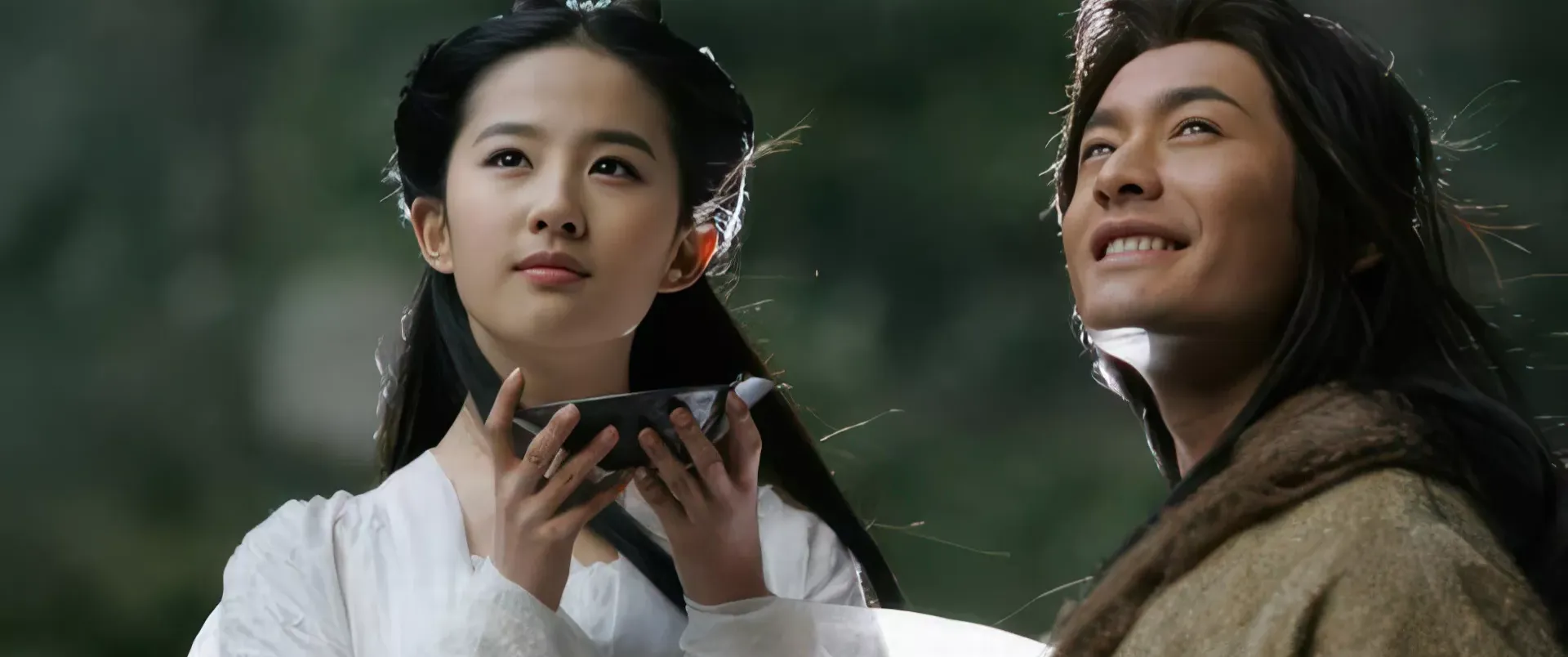
The Return of the Condor Heroes Chapter 14 – Part 8
Translation by Jenxi Seow
Having suffered this setback, he no longer dared to be careless. Brandishing his iron wheel, he focused his mind on the fight. Though his opponent was merely a youth of eighteen or nineteen, he treated him as he would a grandmaster of a great school, attacking with respect, defending with rigour. Under this pressure, Yang Guo immediately felt the strain. The Dog-Beating Staff Technique was brilliant, but learned and applied in the same moment, it could not yet be fully mastered. He used the "sealing" principle to block the wheel's onslaught while shifting his steps, darting east and lunging west. The State Preceptor adjusted his attacks and defence to match the bamboo staff's movements. Seeing Yang Guo break outward, he thought this was exactly what he wanted and kept retreating, intending to draw him far from the stone formation. Unexpectedly, after retreating a dozen paces, his right foot suddenly caught on a large rock. Without realising it, he had been lured into the formation.
He knew this was bad. He heard Huang Rong calling out in rapid succession, “Vermilion Bird shifts to Azure Dragon! The xun position1 moves to li! Yi Wood transforms to Gui Water!” The Wu brothers and Guo Fu shifted the stones, and the formation transformed with dizzying speed. The State Preceptor was horrified. He stopped his wheel and tried to assess his surroundings, but Yang Guo’s bamboo staff came tangling toward him. The Dog-Beating Staff Technique, though insufficient to defeat him in direct combat, was more than enough to disrupt his concentration. The State Preceptor stumbled several times and could not keep his footing. He knew the stone formation was extraordinarily dangerous. The longer one remained trapped, the more disorienting it became. In his desperation, he let out a great roar and leaped onto the rock piles. Ordinarily, climbing onto the rocks would free one from the formation’s confusion. Otherwise, with one’s sense of direction scrambled, even running in a straight line would only lead in circles within an area of a hundred feet or so, until one’s strength was exhausted and capture was inevitable. But the moment the State Preceptor mounted the rocks, Yang Guo’s staff swept at his ankles. The iron wheel was a short weapon and could not reach down to parry. He had no choice but to leap back to level ground and counter with a horizontal wheel strike.
After another dozen exchanges, he saw the twilight deepening. The jagged rocks all around seemed to emanate an eerie, ghostly chill. Bold and highly skilled though he was, he could not suppress a creeping dread. Suddenly, inspiration struck. The stones in the formation varied in size. The large ones were immovable, but the small ones could be dealt with. His left foot hooked upward, and a rock weighing over twenty jin2 flew into the air. His right leg followed, and another large rock soared up. His figure flickered as both legs swept in succession. Several smaller rocks collided in mid-air with thunderous crashes, sparks and stone chips flying everywhere. In an instant, the rock formation was shattered. Huang Rong and the other four were thrown into panic, dodging the falling stones.
At this moment, State Preceptor Jinlun could have escaped the formation with the greatest of ease. But instead of fleeing, he turned to the offensive, his left palm reaching out to seize Huang Rong. Yang Guo thrust the tip of his staff at the State Preceptor’s back, but the iron wheel swept it aside. The State Preceptor’s left hand had already reached Huang Rong’s shoulder. She could have leaped backward to evade, but her ear caught the whistle of fierce wind. A massive rock was hurtling down from above, directly behind her. She had no choice but to use the Great Grappling Hand3 to hook the State Preceptor’s left wrist in a counter-grip. “Good!” the State Preceptor cried. He let her hook his wrist, and just as she was about to use his momentum to fling him aside, he suddenly surged his divine strength and pulled inward with savage force.
On an ordinary day, Huang Rong could have channelled her energy to break free, but at this moment her neili was insufficient. She cried out and fell. Yang Guo, horrified, threw all thoughts of life and death aside. He lunged forward and wrapped his arms around the State Preceptor’s legs. Both men crashed to the ground.
State Preceptor Jinlun’s martial arts, after all, far exceeded Yang Guo’s. Before his body hit the ground, his right palm shot out and struck Yang Guo’s right chest. Yang Guo hastily raised his left arm to block. With a crack, palm met arm, and Yang Guo felt his chest churn with surging blood. His body flew backward like a bundle of straw. At precisely that moment, the last great stone in the air came crashing down, and by sheer coincidence, it struck the State Preceptor squarely in the back. The impact was devastating. However powerful his neili, he could not withstand it. Though he circulated his energy to deflect the boulder, his body swayed several times before he finally pitched forward and collapsed.
In the space of a single breath, the stones had fallen, the formation had shattered, and Huang Rong, Yang Guo, and the State Preceptor had all fallen wounded to the ground.
Author’s Note
The central conceptual conflict of this novel concerns the Song-dynasty belief that Yang Guo (as disciple) could not marry Xiaolongnü (as teacher). A certain professor of physics has formally raised the question: on what basis in Song-dynasty ritual and law was a teacher forbidden to marry? He argues that Song attitudes toward the barrier of ritual propriety4 were in fact quite relaxed, citing Li Qingzhao’s5 remarriage after widowhood as evidence. In truth, Song attitudes toward ritual propriety were anything but relaxed. That a certain individual violated the ritual code does not prove that the code did not exist. That cases of sons murdering fathers and mothers occur from time to time in present-day China, Hong Kong, and Taiwan does not prove that contemporary Chinese society condones patricide and matricide. The commonly recognised concepts of a society are usually not recorded in written law, for instance, the prohibition against marriage between father and daughter, or between mother and son, has been universally acknowledged since antiquity, yet the Analects, Mozi, Buddhist sutras, and Daoist canons generally do not mention it. That Confucius and Mencius did not explicitly condemn such marriages does not mean they approved of them. That a certain event or person existed in a certain era does not mean that era approved of or condoned that event or person. The example of Li Qingzhao does not withstand simple logic. That the Song dynasty had the traitor Qin Hui, and the Ming dynasty had Wu Sangui,6 does not prove that the people of the Song and Ming approved of their treachery. That the contemporary era produced Lin Biao and the Gang of Four does not prove that contemporary people condone them. Natural scientists do not study logic, but their reasoning must conform to logic. In science, a single isolated case is insufficient to prove the existence or non-existence of something.
The institution of marriage is among the most complex in human society. The people of the Song placed great emphasis on the Three Bonds and Five Constants, equating “teacher” with “father”, hence the compound term shifu (teacher-father). In the eyes of Song people, marrying one’s teacher was nearly equivalent to marrying one’s mother, or “marrying one’s elder brother’s widow.” Ouyang Xiu,7 a great Confucian scholar of the Song dynasty whose moral character and literary achievements were revered by all, once wrote a “romantic lyric” about his young niece: “Even then, when we met, I had already taken notice, how much more so now.” For this, he was falsely accused of committing adultery with his niece (though in truth nothing of the sort occurred), sparking a tremendous scandal that nearly cost him his life. In reality, attitudes toward marriage constantly shift with the times. During the Western Han, Liu Ying,8 Emperor Hui, son of the dynasty’s founder Liu Bang (Emperor Gaozu), married his own niece Lady Zhang as his empress upon ascending the throne. Lady Zhang was the daughter of Princess Luyuan, who was the daughter of Liu Bang and elder sister of Emperor Hui, and had married Zhang Ao. Emperor Hui made Lady Zhang his empress partly because he had been fond of this niece since childhood, and partly at the instigation of his mother, Empress Lü. Princess Luyuan was Empress Lü’s daughter, and Lady Zhang was Empress Lü’s granddaughter. Empress Lü favoured “adding kinship to kinship.” In the Han dynasty, a niece could become empress and serve as mother to the realm. By the Song dynasty, writing a romantic poem about one’s niece nearly resulted in a death sentence, one can see how drastically attitudes had shifted. Among certain of China’s ethnic minorities, marriage customs differ again. Wang Zhaojun,9 sent in political marriage to the Xiongnu, became the wife of the Chanyu10 Huhanye and bore him a son. After Huhanye’s death, his eldest son by another wife, Fuzhulei Ruodi Chanyu, succeeded him and, following Xiongnu custom, took Wang Zhaojun as his own wife, that is, married his stepmother, and she later bore him two daughters.
The new marriage law revised in China in the early 1980s stipulates in Article 6 that “marriage is prohibited between collateral relatives within three generations”, that is, between cousins. The prohibition against marriage between paternal cousins has a long history in China (in remote rural villages and mountainous areas, paternal cousins who fell in love and had secret relations were sometimes killed). Article 2 of the new marriage law stipulates “the implementation of family planning.” In the future, relationships such as maternal cousins, nieces, uncles, and paternal cousins will be greatly reduced, and relations between men and women will become much simpler.
In earlier times in China, marriage between those sharing the same surname was forbidden. In later generations, this prohibition gradually relaxed, but marriage between paternal cousins remained forbidden. Foreign countries do not necessarily have such rules. In the great English novelist Emily Brontë’s masterpiece Wuthering Heights, the avenger forces his nephew to marry his own son (maternal cousins marrying). In old China, this would have been perfectly natural, but the new marriage law does not permit it.
That teachers and students cannot fall in love and marry, this concept persisted in modern China as well. When Shen Congwen11 was teaching at Peking University, he pursued his student Ms. Zhang Zhaohe (later Madam Shen). Ms. Zhang was displeased and complained to her teacher Hu Shi,12 who encouraged her to accept, and the two were eventually married. In the 1970s and 1980s, Taiwan Normal University experienced several teacher-student romance scandals. At the time, Taiwanese public opinion was in an uproar, holding that teachers and students should not fall in love. The author of the martial arts classic Legend of the Swordsmen of the Mountains of Shu, Mister Li Shouwen13 (Huanzhu Louzhu), in his youth worked as a private tutor for a Mister Sun in Tianjin, teaching Mister Sun Zhongsan’s daughter and son. The second daughter, Sun Jingxun, and Mister Li grew close over time and fell deeply in love. Sun Zhongsan opposed teacher-student romance and forbade them from seeing each other. Miss Sun ran away from home and filed a complaint with the Tianjin Women’s Association. Sun Zhongsan colluded with the British concession authorities in Tianjin to have Mister Li arrested and brought to court. At the trial, Miss Sun testified that she was an adult (twenty-four years old) and had voluntarily chosen to marry Li Shouwen. The judge could not convict on the charge of “teacher-student romance” and had no choice but to release him. Later, Mister Li and Miss Sun married, one of the famous “teacher-student romance” disputes of the northern China of that era.
Footnotes
-
巽位 (Xùn Wèi). xun trigram position, representing wind and the southeast direction in the Eight Trigrams system. Huang Rong’s commands use trigram terminology to direct the rearrangement of the formation. ↩
-
斤 – jīn. Traditional Chinese unit of weight, approximately 500 grams or 1.1 pounds. See Wuxia Wiki. ↩
-
大擒拿手 (Dà Qínná Shǒu). “Great Grappling Hand.” An advanced joint-locking and grappling technique that targets the opponent’s joints and acupoints to immobilise or throw them. ↩
-
礼教大防 (Lǐjiào Dàfáng). “The Great Barrier of Ritual Propriety.” The “ritual teachings” (礼教) refers to the Confucian ethical code governing social relationships and hierarchies. “great barrier” (大防) is the inviolable boundary these codes establish – in this chapter, specifically the prohibition against marriage between teacher and student, which Song dynasty society regarded as akin to incest. Jin Yong’s extended authorial note at the end of this chapter discusses the historical and cross-cultural dimensions of this taboo at length. ↩
-
李清照 (Lǐ Qīngzhào). Li Qingzhao (1084–c.1155), one of China’s greatest poets. After her first husband Zhao Mingcheng died, she later remarried – a fact sometimes cited to argue that Song society was relaxed about widow remarriage. Jin Yong argues this single case does not reflect prevailing social norms. ↩
-
吴三桂 (Wú Sānguì). Wu Sangui (1612–1678), a Ming general who opened Shanhai Pass to the Manchu invaders, enabling the Qing conquest of China. He is remembered as one of history’s great traitors. ↩
-
欧阳修 – Ōuyáng Xiū. (1007–1072) One of the greatest literary figures of the Northern Song dynasty. Statesman, historian, essayist, and poet, he was a leading figure in the Classical Prose Movement. His ci poetry was celebrated for its emotional depth and lyrical beauty. See Wikipedia. ↩
-
刘盈 (Liú Yíng). Emperor Hui of Han (210–188 BCE), the second emperor of the Western Han dynasty. His marriage to his niece Zhang Yan was arranged by his mother Empress Lü. ↩
-
王昭君 (Wáng Zhāojūn). One of the “Four Great Beauties” of ancient China. During the Western Han, she was sent as a bride to the Xiongnu Chanyu as part of a peace alliance (heqin). After her first husband’s death, Xiongnu custom required her to marry his son. ↩
-
单于 (Chányú). Title of the supreme ruler of the Xiongnu, equivalent to “Khan” or “Emperor.” ↩
-
沈从文 (Shěn Cóngwén). Shen Congwen (1902–1988), one of modern China’s greatest writers, known for his lyrical depictions of rural life in western Hunan. His pursuit of his student Zhang Zhaohe, and their eventual marriage, was a celebrated literary romance. ↩
-
胡适 (Hú Shì). Hu Shi (1891–1962), a leading Chinese intellectual, philosopher, and diplomat. Key figure in the New Culture Movement, he advocated for vernacular literature and pragmatic reform. ↩
-
李寿民 (Lǐ Shòumín). Li Shoumin (1902–1961), pen name Huanzhu Louzhu (还珠楼主), author of the monumental martial arts fantasy series Legend of the Swordsmen of the Mountains of Shu (蜀山剑侠传), which deeply influenced the wuxia genre. ↩