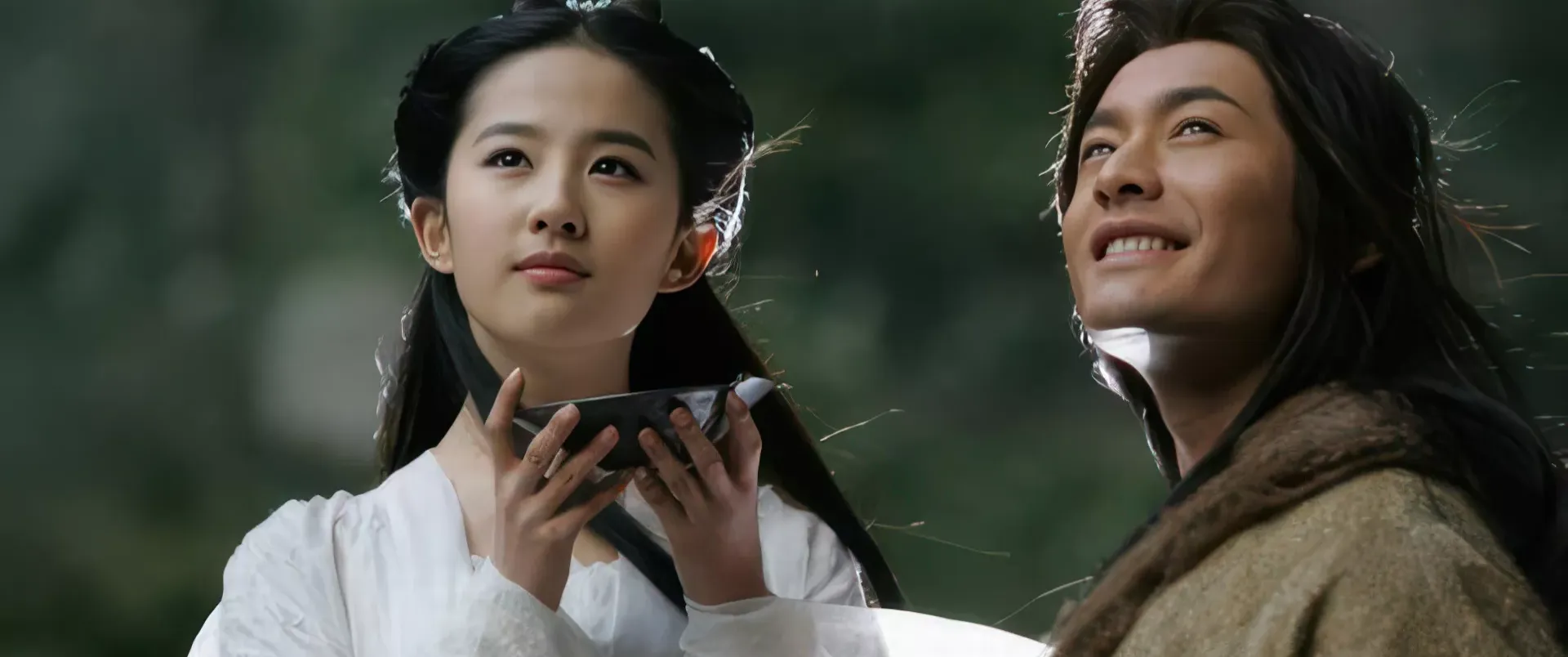
The Return of the Condor Heroes Chapter 39 – Part 9
Translation by Jenxi Seow
Now that the hatred that had walled in her heart was gone, she understood all at once how deep her care for him ran. When he charged into the enemy ranks to save Brother Qi, which of them was I more afraid for? I truly cannot say. There, amid thousands upon thousands of men and horses locked in slaughter, Guo Fu suddenly understood her own heart. When he gave my second sister those three great gifts on her birthday, why did I hate it to the bone? When he exposed Huodu’s1 plots and poisonous schemes, so that Brother Qi became Guild Chief of the Beggars’ Guild, why was I secretly angry? Guo Fu, Guo Fu, you are jealous of your own sister! He is so gentle and tender with Sister Xiang, and never once has he been so with me.
At that her anger rose again in spite of her, and she glared indignantly, once at Yang Guo and once at Guo Xiang. Then all at once she caught herself up. Why do I still care about this? I am a married woman, and Brother Qi loves me so dearly! Before she knew it she let out a long, quiet sigh. She lacked nothing in her life, and yet deep within her lay a regret she could not name. She had always had whatever she wanted. Only what she wanted most ardently was beyond her getting. So all her life she had often failed to understand herself: why was her temper so violent? Why, when everyone else was happy, would she fall into a rage and a vexation for no reason at all?
Guo Fu’s face went red, then white, as she turned over these strange matters of her heart. Yang Guo, Xiaolongnü, Yelü Qi and Guo Xiang meanwhile gazed intently at the fierce battle before the walls of Xiangyang. The Mongols were swarming up the wall like ants. Guo Jing, Huang Yaoshi and the rest attacked from behind to draw them off, but were too few to shake the great host’s array. The Great Khan’s standard pressed steadily nearer the rampart, and within the city the defenders seemed to have lost their order, with no strength left to beat the climbers down. Guo Xiang cried anxiously, “Big Brother, what is to be done? What is to be done?”
Yang Guo thought, That I have met Long’er again in this life shows that Heaven has been kinder to me than I deserve. If I die today I die without regret. For a man to fall on the field for his country is the best of endings. At the thought his spirit rose mightily, and he called, “Brother Yelü, let us go and cut our way in once more.” Yelü Qi said, “Nothing could be better.” Xiaolongnü and Guo Xiang said with one voice, “We all go together!” Yang Guo said, “Good! I take the van. Gather up all the spears you can and follow behind me.” Yelü Qi passed the order to his men at once, and they gathered spears from the field until each carried three or five in his arms.
Yang Guo took a spear, put his horse to the gallop and drove forward, the Divine Eagle striding at his horse’s flank and spreading its wings to sweep aside the arrows that flew at them. Xiaolongnü, Yelü Qi, Guo Fu and Guo Xiang followed close behind. Yang Guo rode hard, straight for the nine-tailed standard of the Mongol Great Khan. Yelü Qi was startled. The Great Khan had come to the front in person, he thought, so the guard about him must be strict past belief, with the best troops and fiercest captains at his side, and for their hundred-odd men to charge him was surely to throw their lives away. But then he thought that he owed this life of his to Yang Guo: into the water if the man went into the water, into the fire if into the fire. Wherever he went, there he would follow, and why waste words?
That company went fast, and in the twinkling of an eye they had covered several li2 and were beneath the walls of Xiangyang. Möngke’s bodyguard saw how fiercely he came on, and two companies of a hundred charged out to bar his way. Yang Guo swung his left arm and hurled a spear that pierced a commander of a hundred through his iron mail and out through the chest. He took a second spear from Yelü Qi’s hand as he passed and killed the second commander. The guardsmen were thrown into a moment’s panic, and Yang Guo was through their line. The rest took fright and came pressing in with dao levelled and halberds raised to cut him off. One spear from Yang Guo, one man dead: whoever stood in his way fell on the instant. The divine strength of his left arm had been trained in mountain torrents and sea tides. A spear cast by him would sink into solid rock, let alone an ordinary man’s flesh and blood. Every spear he loosed he aimed at a general in helmet and mail, and in a very little while he had thrown seventeen spears and killed seventeen of the Mongols’ fiercest captains.
That onset came like a thunderclap too quick to cover the ears. The Mongols had above a hundred thousand encamped below the city, yet Yang Guo at the gallop broke through as a man snaps rotten wood, straight and deep, and in one rush came up before the Great Khan’s horse.
Möngke’s bodyguard threw their lives in the way. Armoured halberdiers came charging in and screened the Khan’s front. Yang Guo swung his arm back for another spear from Yelü Qi’s hand and clutched at nothing: the Mongol men-at-arms had cut them apart. He saw alarm on the Great Khan’s face as the Khan pulled his horse about to withdraw. Yang Guo gave a long whistling cry, set both feet on the saddle, kicked off from it and flung himself forward. More than ten guard officers thrust their spears up at him. In mid air Yang Guo gathered his zhenqi,3 turned a somersault and went clean over a dozen and more spears.
The Great Khan saw how matters stood, gave his horse the rein and galloped. The beast under him was a Mongol horse chosen from ten thousand, dragon-backed and bird-necked, its bones straight and its sinews strong, its neigh like thunder and its running like the wind. It was called Feiyun Zhui,4 near a match for the blood-sweating horse5 Guo Jing rode in his day. With the Khan in the saddle its four hooves flew, and it made straight for open ground. Yang Guo unfolded his qinggong and went after him, and several hundred Mongol horsemen came racing behind Yang Guo in turn.
At that both armies, on the wall and below it, forgot the fighting. Ten thousand eyes fixed on the chase, and both sides shouted as one.
Yang Guo saw the Great Khan fleeing alone and rejoiced. Run as fast as you like, he thought, I shall catch you yet. But the Feiyun Zhui was no ordinary beast. Its hind hooves had only to push at the earth and it shot forward several dozen feet. Yang Guo drew up his breath and chased at full speed, and still the gap grew wider. He stooped, caught up a spear and hurled it with all his force at Möngke’s back.
The spear flew like a meteor chasing the moon. Both armies saw it plainly, and every man was struck dumb and forgot to breathe. Then the Feiyun Zhui made a great bound forward, and the spear, a foot or so short of the Great Khan’s back, spent its force and fell. The Song soldiers cried, “Ah, no!” The Mongols shouted together, “Ten thousand years!”
Guo Jing, Huang Yaoshi, Huang Rong, Zhou Botong and Yideng were all far off and could only fret to no purpose. What strength could they lend Yang Guo? The Mongol soldiers were thousands upon thousands, and could do no more than shout to hearten their lord. Loyal to the death as they were, how could they keep pace with the legs of the Feiyun Zhui?
Möngke looked back from the saddle, saw Yang Guo thrown further and further behind, and his heart eased. He turned west towards a division of ten thousand. The division shouted as one and came out to meet him. Once the two joined, high as Yang Guo’s skill, he could do the Great Khan no harm.
Yang Guo, seeing his work fail on the edge of success, was bitterly downcast. Then a thought struck him. A spear is too heavy to carry far. Why not a stone? He picked up two pebbles and flung them with all his force. They flew with a hissing whine and both struck the Feiyun Zhui on the rump. Yang Guo’s flying stones carried a divine strength. The horse screamed with pain, lifted its forefeet and reared like a man.
Though Möngke was Great Khan of the greatest empire there had ever been, he had been skilled with bow and horse from childhood, had campaigned several times with his grandfather Genghis Khan and his father Tolui,6 and had won especial distinction in Batu’s western war upon Europe. His life had been lived on horseback amid blade and spear, and now, with all overturned in a moment, he did not lose his head. He took up his carved bow, set a long arrow to it, gripped the horse hard between his legs, twisted about and loosed at Yang Guo.
Yang Guo ducked and let it pass, then raced forward. His left hand had already caught up a fist-sized stone, and he threw it with a whoosh square into Möngke’s back. So fierce was the force behind that throw that Möngke’s sinews snapped and his bones broke. He pitched backwards off his horse and died where he fell.
Seeing the Great Khan fall, the Mongols were in terror to a man and came rushing from every quarter. Guo Jing shouted his orders and pressed the attack, and the Song troops within the city opened the gates and came out to the killing. Guo Jing, Huang Yaoshi, Huang Rong and the rest set the Grand Formation of the Twenty-Eight Mansions7 in motion and charged back and forth. The heart had gone out of the Mongol army. They broke and fled and trampled one another, and the dead were past counting. All down the road they threw away banners and spears, kept no order at all, and streamed north in confusion.
Guo Jing and the rest were still in pursuit when a column came up from the west in very good order, the banners of the Fourth Prince, Kublai, in the midst of it. A Mongol army in defeat collapsed like a falling mountain, past gathering up in an hour. Strict as Kublai’s discipline was, the flood of routed troops threw his own men into disorder at once. Kublai saw how badly things stood, took a body of his guards to cover the rear and withdrew slowly north. Guo Jing and the others pursued for more than thirty li. Seeing that the retreat did not slacken, and with Lü Wenhuan sending messenger after messenger in a steady stream to call Guo Jing back to guard the city, the Song army at last turned and came home in triumph.
Never since the Mongols and the Song first met in battle had there been so great a defeat, and with the lord of the nation dead beneath the walls the army’s spirit sank utterly. The seat of Great Khan did not pass from father to son. It was settled by a council of the princes of the blood, the great ministers and the chief captains. Möngke being dead, his younger brother, the seventh prince Ariq Böke,8 was upheld by the princes at Karakorum,9 the old Mongol homeland in the north, and made Great Khan. By Mongol custom the eldest son charged the enemy and fought in the van while the youngest kept the home. And Ariq Böke, who had no great abilities, had princes and captains, empresses and households, the stored herds and family goods and the reserve troops all under his hand because he had kept the home, and so held the advantage in the council. Later Kublai led his army north to contend for the seat, and the brothers set their best troops against each other. In the end Kublai won. But the Mongol army was sapped to the root, without strength for the time being to strike south, and Xiangyang had peace. Not until thirteen years afterwards, in the ninth year of the Xianchun era10 of the Song emperor Duzong, did the Mongol armies attack Xiangyang again.
When Guo Jing led his army back to Xiangyang, the Pacification Commissioner, Lü Wenhuan, had long since drawn up his guards and officers outside the city, with a great blowing of horns and beating of drums, to welcome him. The common people crowded out beyond the gates too, setting out wine and incense and candles, and bowing all round to thank the men who had fought.
Guo Jing took Yang Guo by the hand, lifted a cup of fine wine the people had offered and gave it to him. “Guoer, you have done a great deed today. Your name will be famous throughout the land, that goes without saying, and there is not a soldier nor a citizen in this city who is not deeply grateful to you. You saved Xianger and Qier besides, and your Aunt Guo and I are deeply in your debt too.”
Yang Guo’s heart was moved. There was a thing he had hidden in it more than twenty years and never said, and now could hold it back no longer. He said clearly, “Uncle Guo, had you and Aunt Guo not raised and taught me when I was small, how should I have come to what I am today?”
Between those two all had always been understood without speech, and neither spoke words of thanks or obligation. Now they drank three cups together, and the two daxia of the age opened their hearts to each other, each feeling that a man who had come to such a moment could ask nothing more of life.
They went into the city hand in hand, soldiers and townsfolk cheering on both sides of the road, a noise like rolling thunder. Then a thought came to Yang Guo. More than twenty years ago Uncle Guo took my hand just so and brought me up Mount Zhongnan to the Chongyang Palace11 to learn the arts. His whole heart was true to me, and never once otherwise. Yet I was wild and unruly, I turned against my shifu and rebelled against his order, and what disasters I brought about! Had I gone astray for good, how should I ever have known this day, walking into the city hand in hand with him? At the thought the sweat ran down his back, and he was secretly afraid.
In Xiangyang every house hung out coloured silks and every door was loud with rejoicing. Some had lost a father or brother or son in the day’s fighting, but the army had won and the city stood whole, and their grief was a little lightened.
That evening a great victory feast was spread in the Pacification Commissioner’s residence, and Lü Wenhuan wanted Yang Guo to take the seat of honour. Yang Guo would not have it on any account. They deferred to one another a long while, and in the end Great Master Yideng was set in the seat of honour, and after him Zhou Botong, Huang Yaoshi, Guo Jing, Wang Jian, Diancang Yuyin, Wu Santong, Zhu Ziliu and Huang Rong, and only then Yang Guo, Yelü Qi, Xiaolongnü, Guo Fu and the Wu brothers. Yinggu, Cheng Ying, Lu Wushuang, Guo Xiang and the rest sat at another table. Lü Wenhuan was privately displeased. Island Master Huang is Guo daxia’s father-in-law, so that may pass. But that old monk Yideng has nothing remarkable about his looks, and old Zhou is half mad. How do they come to sit in the places of honour? The heroes talked freely of the day’s fighting, every one in high and soaring spirits, and Lü Wenhuan could not get a word in edgeways.
After several rounds of wine the city officials, captains and gentry came up in turn to drink to Guo Jing and Yang Guo, praising the two daxia to the skies for their deeds and planning, and for skill in arms beyond other men.
Guo Jing thought of the great kindness of his teachers, and said, “In those days, had Daoist Elder Qiu12 of the Quanzhen Order not stood up for what was right, had my seven Kind Masters13 not travelled all the way to Mongolia, and had I not afterwards been raised and taught by my old Kind Master Hong,14 how should Guo Jing ever have done this small service? Yet while we cheer and drink our fill here today, all my Kind Masters save old Kind Master Ke15 are long dead, and it grieves me to think of it.” Yideng and the others were cast down at that.
Guo Jing went on, “The Mongols have drawn off, but they may well come again. I ask you all to rest a while in Xiangyang and watch which way the enemy moves, lest we be caught by some evil trick. Old Zhou and several others have wounds not yet healed and must rest and mend too. When we know for certain the enemy has withdrawn, I mean to go to Mount Hua16 and sweep the grave of Kind Master Hong.” Zhou Botong heard his sworn younger brother Guo Jing get his form of address wrong, but he had just taken a large mouthful of wine and so let it pass. Yang Guo said, “Uncle Guo, I was about to say the same. What if we all went together?” Yideng, Huang Yaoshi, Zhou Botong and the rest were all thinking of their dead old friend, and agreed with one voice.
That night the heroes drank deep into the small hours, and parted very drunk.
Author’s Note
The History of Yuan,17 Basic Annals, scroll three, records: “Xianzong, taboo name Möngke, was the eldest son of Ruizong, Tolui. … In the second month of the ninth year, on bingzi, he led out all his troops… on dingchou, he directed the armies in battle beneath the walls… they attacked the Zhenxi Gate, the Dongxin Gate, the Qisheng Gate… they attacked the Huguo Gate… they climbed the outer wall and killed a great many Song soldiers… they attacked repeatedly and could not take it… on guihai, the Emperor died. … The Emperor was firm and clear-sighted, bold and resolute, decisive and sparing of speech… and he governed his officials very strictly.”
The Continuation of the Comprehensive Mirror18 says: “The Mongol ruler repeatedly directed his armies in the assault, and could not take it… the Mongol ruler died… Shi Tianze and the assembled officers bore the coffin back north, and with that the siege of Hezhou was raised.” The Examination of Variants says: “Xianzong of Yuan, his troops having lain long before the walls, fell sick and died. The Gazetteer of Chongqing holds that he was struck by a flying stone…” Hezhou stands where three rivers meet, and is also called Hezhou. It lies in the modern city of Chongqing.
By the historical record Xianzong died having failed to take Chongqing, that is Hezhou, in Sichuan. And whether a flying stone struck him the histories differ. But the longest and hottest fighting between the Mongol and Song armies was at Xiangyang, which the Mongols assaulted for decades on end and could not take. To make the novel more interesting, it has been arranged that Xianzong failed to take Xiangyang and was killed by a flying stone, and the siege lifted in consequence. Who threw the stone the histories nowhere say. The novel calls the man Yang Guo, and no history, official or unofficial, can prove it otherwise.
Footnotes
-
霍都 — Huòdū. A Mongol prince, known as Prince Huodu; a disciple of State Preceptor Jinlun. See Wuxia Wiki. ↩
-
里 — lǐ. Traditional Chinese unit of distance, approximately 500 metres or a third of a mile. ↩
-
真气 — zhēnqì. Literally true qi. Qi refined through neigong. See Wuxia Wiki. ↩
-
飞云骓 — Fēiyún Zhuī. Literally flying cloud piebald. The name of Möngke’s warhorse. A zhui is a dark horse marked with white. ↩
-
汗血宝马 — Hànxuè Bǎomǎ. Guo Jing’s legendary steed, a Ferghana horse from the Western Regions that sweats blood at full gallop and can cover a thousand li in a day. ↩
-
拖雷 — Tuōléi. Tolui, Genghis Khan’s youngest son and father of Möngke and Kublai. A sworn brother of the young Guo Jing. See Wikipedia. ↩
-
二十八宿大阵 — Èrshíbā Xiù Dàzhèn. Grand Formation of the Twenty-Eight Mansions, named for the twenty-eight lunar lodges into which Chinese astronomy divides the sky. ↩
-
阿里不哥 — Ālǐbùgē. Ariq Böke, youngest son of Tolui, proclaimed Great Khan at Karakorum in 1260 and defeated by his brother Kublai after four years of civil war. See Wikipedia. ↩
-
和林 — Hélín. Karakorum, the Mongol capital founded by Genghis Khan on the Orkhon river. See Wikipedia. ↩
-
咸淳 — Xiánchún. Reign era of Emperor Duzong of Song, 1265 to 1274; its ninth year is 1273, when Xiangyang at last fell. ↩
-
重阳宫 — Chóngyáng Gōng. Chongyang Palace, chief temple of the Quanzhen Order on Mount Zhongnan. See Wuxia Wiki. ↩
-
丘处机 — Qiū Chǔjī. One of the Seven Masters of Quanzhen, and the Daoist who set Guo Jing’s shifu upon their journey to Mongolia. See Wuxia Wiki. ↩
-
七位恩师 — qī wèi ēnshī. His seven gracious teachers, the Seven Eccentrics of Jiangnan who raised and trained Guo Jing in Mongolia. See Wuxia Wiki. ↩
-
洪七公 — Hóng Qīgōng. His name meaning “Hong Seven Lord” or “Hong Seventh Lord”. The Northern Beggar, chief of the Beggars’ Guild and Guo Jing’s shifu. See Wuxia Wiki. ↩
-
柯镇恶 — Kē Zhèn’è. His name meaning subduing evil. The blind first of the Seven Eccentrics of Jiangnan, and the last of Guo Jing’s seven shifus left alive. See Wuxia Wiki. ↩
-
华山 — Huà Shān. Mount Hua in Shaanxi, one of the Five Great Mountains and the site of the great contests for the title of first in the wulin. See Wuxia Wiki. ↩
-
元史 — Yuán Shǐ. The History of Yuan, official dynastic history of the Yuan, compiled under the Ming in 1370. See Wikipedia. ↩
-
续通鉴 — Xù Tōngjiàn. The Continuation of the Comprehensive Mirror to Aid in Government, a Qing history covering the Song, Liao, Jin and Yuan dynasties. ↩