The Return of the Condor Heroes Chapter 13 – Part 9
Translation by Jenxi Seow
Xiaolongnü saw from the corner of her eye that the golden wheel had fallen, and the threat from behind was gone. But she was still in midair. How was she to escape the formidable enemy in front of her? Desperation sharpened her wits. She lashed out her silk band, wrapped it round a pillar on the west side and pulled hard, and borrowing the force, her body flew slantwise through the air at the pillar, slid lightly down it and slipped round behind it, escaping by a hair’s breadth the State Preceptor’s palm, which came like the Five Strongmen splitting the mountain.
The State Preceptor had had the victory in his grasp, only for Yang Guo to step in and spoil it. Not only had his opponent escaped, but his own all-conquering weapon had been knocked to the ground, the worst setback he had ever met in his life. He had always kept a clear and luminous mind and a radiant wisdom, but now he could not help being overcome by the fires of ignorance.1 Without waiting for Yang Guo to get up, he struck out at him with a whistling palm through the empty air. By rights he was the master of a whole school, and to strike such a blow at a junior who had fallen and not yet risen was wholly unworthy of his standing and of the pride he always took in himself. But in his towering rage he was past caring.
Guo Jing saw the State Preceptor glare at Yang Guo, hunch his shoulder and draw back his arm, and knew he meant to strike a deadly blow. He cried inwardly, This is bad! If he rushed in, he might block it once, but Yang Guo would still be hurt. In the crisis, with no time to think, he used “The Dragon Flies in Heaven”,2 leaping bodily into the air and striking down at the State Preceptor’s head. Unless the State Preceptor withdrew his palm, he could kill Yang Guo with it, but would die himself under this incomparably fierce Dragon-Subduing Palm. His palm swung sharply round, and with a grunt of “Hey” he met Guo Jing’s palm with his own.
This was the second time the two great masters of the age had traded palms. Guo Jing was in midair with nothing to push against. He went with the force of his opponent’s palm, turned half a somersault and came down behind. The State Preceptor stood fast where he was, his body unshaken, his feet unmoved, as though nothing had happened. Hao Datong, Sun Buer,3 the Diancang Fisherman and the others, who all knew Guo Jing’s martial arts well, were appalled at the sight, and thought, This foreign monk’s skill is truly unfathomable. In fact, both times Guo Jing had traded palms with him he had given ground and so shed his opponent’s force as a matter of course, which is the true way of the martial arts. The State Preceptor, his face lost through Yang Guo’s meddling, had been bent on winning it back by taking Guo Jing’s force head-on, and that had cost him dearly in neili and zhenqi.4 He seemed to have had the better of it, but inside he had come off worse. Both men were heroes without peer in their age, and a few dozen moves between them would hardly decide anything. By forcing an advantage in a single move, the State Preceptor had once again earned himself a dull ache in his chest. Luckily his opponent wanted only to save the boy and pressed no further, so he kept his lips shut tight and quietly worked his neili to clear the knot of stagnant qi5 lodged in his chest.
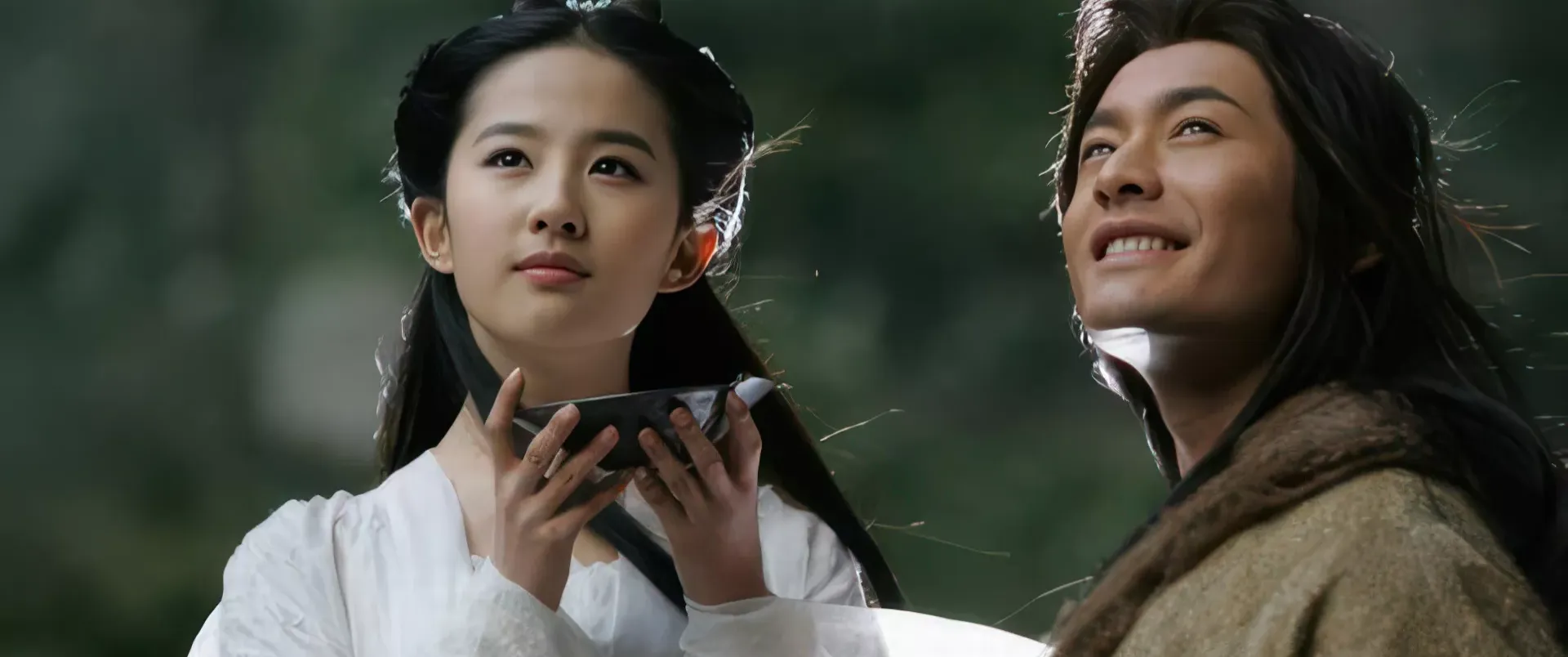
Yang Guo, having escaped death, scrambled to his feet and ran to Xiaolongnü’s side. She was also coming over to check on him. In the same breath, they asked, “Are you all right?” Both nodded at once, and both faces broke into smiles. They embraced, hearts overflowing with joy.
Yang Guo then raised the vajra pestle, balanced the golden wheel on its tip and spun it like a juggler’s plate, and even got some clanging out of it himself. “Mongol warriors, listen,” he shouted. “Your great State Preceptor’s weapon has been taken off him by me, so what is all this talk of Alliance Chief of the wulin under heaven? Clear off back to your barbarian grannies’ stinking hen’s eggs and stinking duck’s eggs!”
The Mongol warriors would have none of it. They had seen that the State Preceptor had already beaten Xiaolongnü, and that the other side, not content with sending out Yang Guo, had sent out Guo Jing as well. They shouted one after another. “Three against one, have you no shame?” “The State Preceptor threw his golden wheel himself. How could a brat like you take it off him?” “One against one, fight it out properly, and nobody else joins in!” “Right, right, fight it again.” The din was deafening, but it was all in Mongolian, and apart from Guo Jing not one of the Central Plains heroes understood a word.
Those of the Central Plains heroes who could see reason also felt that in martial arts the State Preceptor was certainly better than Xiaolongnü. But the title of Alliance Chief of the wulin could not on any account be let fall to a Mongol State Preceptor. Otherwise the wulin of the Central Plains would be utterly disgraced, and just as they were gathering to resist the Mongols, their spirit would be broken before they began. The hot-blooded young men, seeing the Mongol warriors’ uproar, shouted curses back, and the two sides fell to a slanging match. Both drew weapons, and a mass brawl was in the making.
Yang Guo held the golden pestle and wheel high and said to the State Preceptor, “Still not admitting defeat? You have lost your weapon. What face have you got left? Was there ever an Alliance Chief of the wulin who had his weapon taken off him?”
The State Preceptor was quietly working his neili. He heard every word Yang Guo said, but dared not open his mouth to answer. Seeing how things stood, Yang Guo had already guessed a good part of it. “Heroes, hear me,” he declared loudly. “I will ask him three times. If he does not answer, he admits defeat.” Afraid that if he gave it time the State Preceptor would finish channelling his breath, he did not delay a moment, but asked in a single breath, “Have you lost or not? You would not dare so much as think of being Alliance Chief of the wulin now, would you? Not a word? Then you admit defeat?” The State Preceptor had just cleared the stagnant qi, and the ache in his chest was gone. He was about to answer when Yang Guo, seeing his lips begin to move, got in first. “Good. Since you admit defeat, we will not make things hard for you. All of you, off you go in peace.” He held the golden pestle and wheel high and gave them to Guo Jing. He had meant to give them to his shifu, but was afraid the State Preceptor would lose his temper and try to snatch them back, and Xiaolongnü would not be able to hold him off.
The State Preceptor’s face swelled purple with rage. But he was wary of Guo Jing’s formidable martial arts, and with the golden wheel in Guo Jing’s hands he would hardly get it back barehanded. He could see too that the Central Plains warriors far outnumbered his own, and that in a general fight his side would be routed. A brave man takes no needless beating. There was nothing for it but to withdraw for now and plan his revenge later. “You barbarians of the Central Plains are full of tricks,” he said loudly, “and win only by numbers. You are no heroes and brave men. Everyone, come with me.” He waved his right hand, and the Mongol warriors all withdrew out of the hall. From a distance he saluted Guo Jing. “Guo daxia,6 Guild Chief Huang, today I have learned from your fine skills. The green hills never change and the clear waters flow for ever. We shall meet again.”
Guo Jing bowed in return. “Great Master, your martial arts are deep and fine, and I admire them greatly. Please take back your weapons, yours and your disciples’.” He made to hand over the golden wheel and pestle. “State Preceptor Jinlun,” shouted Yang Guo, “would you have the face to reach out and take them?” Guo Jing had only just snapped, “Guoer, no nonsense,” when the State Preceptor, his robes swirling, turned and strode out of the hall without a backward glance.
Yang Guo suddenly remembered something. “Hey,” he called, “your disciple Huo Dou has been poisoned by my hidden weapons. Bring your antidote and trade it for mine.” The State Preceptor, confident in his divine arts and deep medical knowledge, believed he could cure any poison. He detested Yang Guo’s cunning and insolence and ignored him completely, walking straight out. Huang Rong saw that Zhu Ziliu had closed his eyes and drifted into sleep. This place has gathered many masters who use poisoned hidden weapons, she thought. Surely someone can treat his wounds. She saw that the State Preceptor was unwilling to exchange antidotes and did not take it too seriously.
By now, Lu Family Manor, front and back, was roaring with jubilation. Everyone was cheering for Yang Guo and Xiaolongnü’s victory over State Preceptor Jinlun. Crowds of hundreds gathered around the two, buzzing with discussion. Some said Yang Guo had defeated Huo Dou by giving him a taste of his own medicine. Others said Xiaolongnü’s qinggong was transcendent, that she had actually evaded the golden wheel’s ferocious flying attack. But as for how Yang Guo had used the Soul-Shifting Technique to make Da’erba knock himself unconscious, eight or nine out of ten could not understand it. When people asked, Yang Guo spun wild tales, and the questioners came away half-comprehending. If they pressed further, their confusion only deepened.
Author’s Note
In the first edition of this novel, State Preceptor Jinlun appeared as the Golden Wheel “Dharma King,”7 his identity being that of a Tibetan Lamaist Dharma King. Some readers criticised the author for discriminating against Tibetan Esoteric Buddhism by frequently casting lamas as villains. In truth, the author holds Tibetan Esoteric Buddhism in equal reverence, respecting it no differently than other schools of Buddhism, and absolutely does not discriminate against Tibetan compatriots in Tibet, Qinghai, Sichuan, Gansu, Yunnan, Inner Mongolia, or elsewhere. The author has received empowerment from the Tibetan Buddhist master Ningbuqie,8 who bestowed purification, clarity, and evil-warding mantras that the author can recite fluently after thorough study. In the author’s living room hangs a large thangka9 tapestry of Padmasambhava10 in divine manifestation, brought out of Tibet by Tibetan compatriots. According to historical records, after the mid-Yuan dynasty, Mongol rulers occupied the Central Plains and exploited a minority of Tibetan lamas to oppress the people, committing many licentious acts that violated Buddhist principles and precepts. The portrayal of lamas as antagonists in this story is not intentional discrimination. To avoid misunderstanding, in this third edition the original “Dharma King” has been changed to “Mongol State Preceptor”, though his personal conduct remains roughly based on the “foreign monk” behaviour described in historical records, wholly unrelated to the noble and saintly conduct of other lamas.
Footnotes
-
Flames of ignorance (无明). Wúmíng. Buddhist concept (avidya) referring to the fundamental ignorance that causes suffering and anger. The State Preceptor’s rage is described in Buddhist terms, ironically for a monk. ↩
-
“The Dragon Flies in Heaven” (飞龙在天). Fēi Lóng Zài Tiān. Fifth move of the Eighteen Palms of Dragon Subduing, a powerful airborne attack. Name comes from the Book of Changes. ↩
-
孙不二 — Sūn Bù’èr. Her name meaning “not two”, signifying non-duality. See Wuxia Wiki. ↩
-
真气 — zhēnqì. Literally true qi. Qi refined through neigong. See Wuxia Wiki. ↩
-
气 — qì. Literally breath or vital energy. Fundamental life force flowing through all living things, central to Chinese medicine and martial arts. See Wuxia Wiki. ↩
-
大侠 — dàxiá. Literally great xia. Honorific for a martial artist of great renown and chivalrous conduct. See Wuxia Wiki. ↩
-
法王 — fǎwáng. Dharma King: a title for high-ranking Tibetan Buddhist masters. In the first edition Jinlun was a Dharma King, implying a Tibetan lama; the third edition made him the Mongol State Preceptor (蒙古国师). ↩
-
Ningbuqie (宁布切). Níngbùqiè. Tibetan Buddhist master who gave the author empowerment and taught him mantras. ↩
-
Thangka (唐卡). Tángkǎ. Tibetan Buddhist painted or embroidered banner, typically depicting deities, mandalas, or spiritual scenes. Hung in temples and homes for meditation and blessing. ↩
-
Padmasambhava (莲花生上师). Liánhuāshēng Shàngshī. Also known as Guru Rinpoche, the 8th-century Indian Buddhist master who brought Esoteric Buddhism to Tibet. His name means “Lotus-Born.” ↩