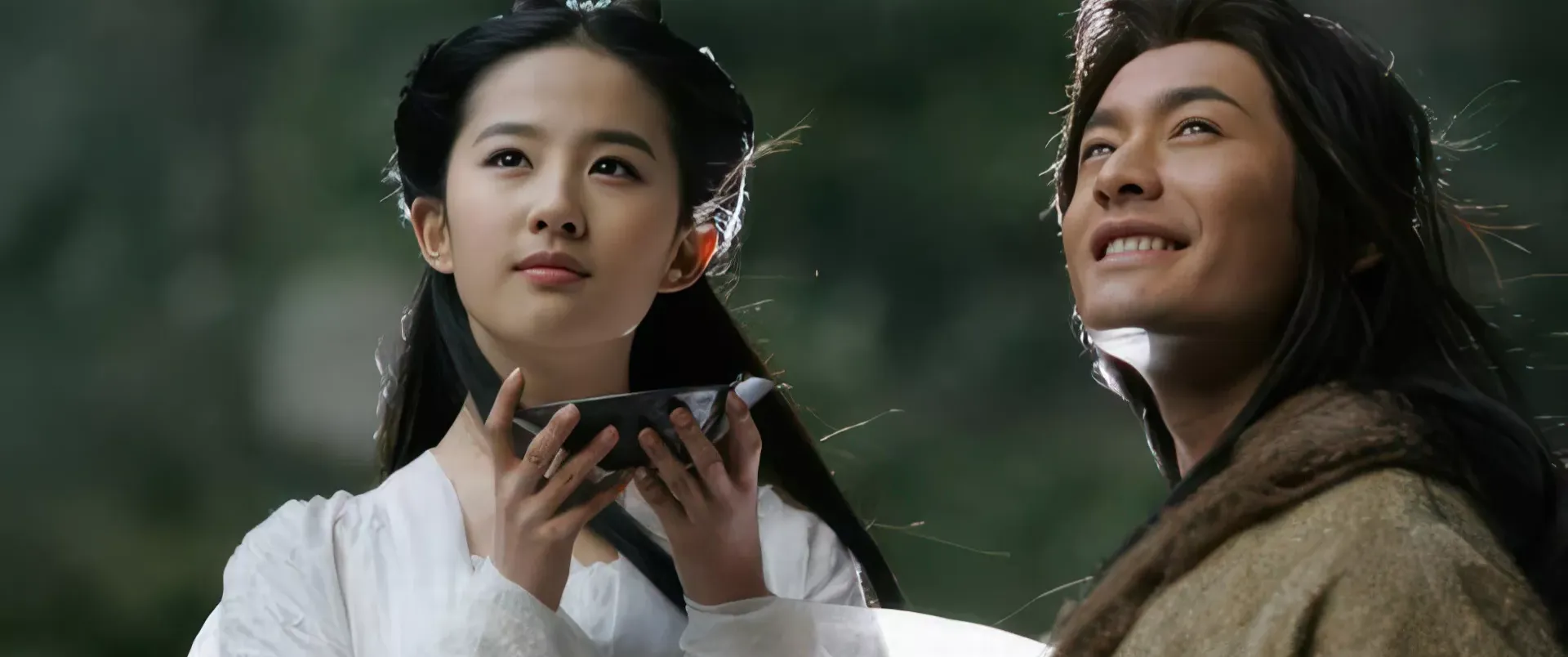
The Return of the Condor Heroes Chapter 1
Translation by Jenxi Seow
Wind and moon, loveless.
A maiden of Yue plucks lotus blooms by the autumn shore,
Her narrow sleeves of light gauze half-reveal twin bracelets of gold.
She bends to see her reflection, the flower mirrors her face.
Her maiden heart contends with the tangled silk of her thoughts.
At Cock’s-Crow Creek1 the evening wind stirs the waves,
Mist heavy, smoke light, she can no longer see her companions.
A faint song drifts back as the oars carry her far away,
Sorrow of parting draws her gaze to the southern shore.
A soft, lilting song drifted across the mist-shrouded surface of the lake. The singing came from a small boat, where five young maidens laughed and sang as they rowed, gathering lotus blossoms. The lyrics they sang were from the ci2 poem “Butterflies Love Flowers”3 by the great Northern Song poet Ouyang Xiu,4 which describes precisely the scene of a maiden of Yue5 gathering lotus. Though the poem is a mere sixty characters, it vividly paints the season, the hour, the place, the scenery, as well as the maiden’s countenance, her clothing, her ornaments, and her emotions, all rendered with crystalline clarity. The second stanza is even more remarkable: within the landscape description lies narrative, and within the narrative flows emotion, receding from near to far, leaving a lingering resonance that never quite fades.
Ouyang Xiu served as an official in Jiangnan6 for many years, and the mountains of Wu and waters of Yue, with all their tender sentiments and subtle affections, found their way into his verses. In the Song dynasty, everyone, from high officials and noble lords to the common folk in the lanes, took delight in singing ci poetry. Thus, whenever Liu Yong7 produced a new lyric, it would be sung wherever there was a well,8 and along the southern banks in spring when willows were plucked, or on autumn lakes when lotuses were gathered, the verses that accompanied the scene were often those of Ouyang Xiu.
The time was the reign of Emperor Lizong9 of the Southern Song dynasty, and the place was South Lake10 in Jiaxing.11 Mid-Autumn Festival12 was drawing near. The lotus leaves were beginning to wither, and the lotus seeds were plump and full. This burst of song reached the ears of a Daoist priestess standing by the lakeside. She had been standing motionless for a long while beneath a row of willow trees. The evening breeze stirred the hem of her apricot-yellow Daoist robe and ruffled the ten thousand silken strands of the horsetail whisk13 tucked at her collar. The thoughts surging in her heart were truly, as the poem said, “a maiden heart contending with tangled silk.” She listened as the song gradually drifted away. The singers had moved on to another of Ouyang Xiu’s “Butterflies Love Flowers” lyrics, and a gust of wind carried two faint lines to her ears:
Wind and moon are loveless. Hearts change in secret.
Old journeys are like dreams, and all that remains is a hollow ache…14
No sooner had the song faded than a burst of silvery giggles followed.
The priestess gave a long sigh. She raised her left hand and gazed at the palm, which was stained crimson with blood.
“What is there to laugh about?” she murmured to herself. “Those little girls are just singing blindly. They have no understanding of the longing and sorrow, the melancholy contained in those words.”
Over ten zhang15 behind the priestess, an old man in a dark green robe with a long beard had also been standing motionless. Only when those two lines, “Wind and moon are loveless, hearts change in secret. Old journeys are like dreams, and all that remains is a hollow ache,” drifted past did he let out the faintest of sighs.
The small boat glided across the lake’s surface, which gleamed like azure jade. Among the five maidens in the boat, three were around fifteen or sixteen years of age, while the other two were only nine. The two younger girls were maternal cousins. The elder cousin was surnamed Cheng, with the single given name Ying.16 The younger cousin was surnamed Lu, named Wushuang.17 They were about half a year apart in age.
The three older girls continued singing as they rowed the little boat out from among the lotus leaves. Cheng Ying said, “Cousin, look, that old uncle is still here.”
She pointed towards a figure beneath the drooping willows.
The man’s hair was a wild tangle, and his beard bristled in all directions like a hedgehog’s spines. His hair and beard were glossy black, which suggested he was not very old, yet his face was deeply furrowed with wrinkles, like that of a man of seventy or eighty. He wore a long, straight-cut blue cloth robe, and around his neck hung an infant’s embroidered satin bib, decorated with a pattern of a cat pouncing at a butterfly, though it was now old and tattered.
Lu Wushuang said, “That strange man has been sitting there for ages. Why doesn’t he move at all?”
Cheng Ying said, “Don’t call him strange, call him ‘old uncle’. If you call him strange, he’ll get angry.”
Lu Wushuang laughed. “Isn’t he strange? So old, and still wearing a bib around his neck! If he gets angry and his beard bristles up, that would really be something to see.”
She picked up a lotus seedpod from the boat and hurled it at the man’s head.
The boat was several zhang from the strange visitor. Though Lu Wushuang was young, the strength in her arm was by no means weak, and her aim was true. Cheng Ying cried, “Cousin!”
She tried to stop her, but it was already too late. The seedpod flew straight towards the stranger’s face. The strange visitor tilted his head back, caught the seedpod in his teeth, and without using his hands, curled his tongue, clamped down on the pod, and began chewing vigorously. The five maidens watched as he ate without even peeling the seeds, showing no fear of the bitterness, swallowing the husks and all. They exchanged glances, then burst out giggling. At the same time, they rowed the boat closer and came ashore.
Cheng Ying walked up to the man, tugged at his lapel, and said, “Old uncle, those aren’t good to eat that way.”
She took a lotus seedpod from her pouch, split it open, peeled out a dozen or so seeds, then tore away the green skin and removed the bitter core from each one before placing them in the stranger’s hand. The strange visitor chewed a few times and found the taste fragrant, fresh, and sweet, completely different from what he had eaten moments before. He cracked a grin at Cheng Ying and nodded. Cheng Ying peeled a few more seeds and handed them to him. The strange visitor tossed them into his mouth, chewed them up in a flurry, then looked up at the sky and said, “Follow me!”
With that, he strode off towards the west.
Lu Wushuang tugged at Cheng Ying’s hand. “Cousin, let’s follow him!”
The three other girls were timid.
“Let’s go home quickly,” they urged. “If you wander too far, your mother will scold you.”
Lu Wushuang pursed her lips and made a face. Seeing that the strange visitor was moving very quickly, she said, “Fine, don’t come then.”
She released her cousin’s hand and ran after him. Cheng Ying had come out to play with her cousin and could not very well abandon her and return alone, so she had no choice but to follow. The three other girls, though several years older, were all shy and fearful. They called out a few times, but the strange visitor and the two girls had already disappeared behind a grove of mulberry trees.
The strange visitor moved very fast. Seeing that the two girls’ short legs could not keep up, he stopped and waited a few times at first, but eventually grew impatient. Suddenly he turned around, stretched out his long arms, tucked one girl under each armpit, and raced forward. The two girls heard only the whistling of wind past their ears as the stones and grass along the path flew by before their eyes. Lu Wushuang grew frightened and cried, “Put me down! Put me down!”
The strange visitor paid her no heed and only ran faster. Lu Wushuang raised her head and bit down fiercely on the edge of his palm. The strange visitor’s palm merely tensed, and the impact sent a dull ache through her teeth. Lu Wushuang had no choice but to release her bite, but she kept her mouth busy, screaming and shouting with all her might. Cheng Ying, however, remained silent throughout.
The strange visitor ran on for a while longer, then set the two girls down. They were in a burial ground. Cheng Ying’s small face had turned deathly pale, while Lu Wushuang’s was flushed bright red.
Cheng Ying said, “Old uncle, we need to go home now. We won’t play with you anymore.”
The strange visitor stared at her with wide eyes, saying nothing. Cheng Ying saw in his gaze a look of sorrow, desolation, self-pity, and wounded pride, and she could not help but feel a surge of sympathy. Softly she said, “If no one will play with you, come back to the lake tomorrow, and I’ll peel lotus seeds for you again.”
The strange visitor sighed. “Yes, ten years. For ten years, no one has played with me.”
Suddenly a murderous gleam flashed in his eyes, and he demanded fiercely, “Where is He Yuanjun?18 Where has He Yuanjun gone?”
Cheng Ying was frightened by his sudden ferocity. In a small voice she said, “I… I… I don’t know.”
The strange visitor seized her arm and shook her several times. Lowering his voice, he rasped, “Where is He Yuanjun?”
Cheng Ying was so terrified she was on the verge of tears. They welled up and rolled in her eyes, yet she never let them fall.
Footnotes
-
鸡尺溪 – Jīchǐxī. Small waterway in the Jiangnan region whose name evokes the rustic, pastoral landscape of the water towns south of the Yangtze. ↩
-
词 — cí. Literally “lyric” or “song-words.” A classical Chinese poetic form with irregular line lengths, composed to fit a prescribed melodic pattern (tune title). See Wikipedia. ↩
-
蝶恋花 – Dié Liàn Huā. One of the most famous ci poem title patterns in classical Chinese poetry, dictating the metre, rhyme scheme, and number of characters per line. Many poets, including Ouyang Xiu and Liu Yong, wrote to this pattern. Title evokes romantic imagery: butterflies drawn to flowers as lovers are drawn to one another. ↩
-
欧阳修 – Ōuyáng Xiū. (1007–1072) One of the greatest literary figures of the Northern Song dynasty. Statesman, historian, essayist, and poet, he was a leading figure in the Classical Prose Movement. His ci poetry was celebrated for its emotional depth and lyrical beauty. See Wikipedia. ↩
-
越女 – Yuènǚ. Yue was an ancient kingdom in the Jiangnan region (present-day Zhejiang and northern Fujian). Yue maidens were famed in classical Chinese poetry for their beauty, and the region was known for its lotus-filled lakes. ↩
-
江南 – Jiāngnán. Prosperous region south of Yangtze River, continued from LOCH era. See Wuxia Wiki. ↩
-
柳永 – Liǔ Yǒng. (c. 987–1053) A renowned Northern Song ci poet known for his romantic, colloquial style. Immensely popular in his day, his lyrics were said to be sung in every wineshop and by every well. See Wikipedia. ↩
-
有井水处皆歌 – yǒu jǐngshuǐ chù jiē gē. Famous saying about Liu Yong’s popularity. Wells were gathering places where people drew water and exchanged news, so the phrase means his lyrics were sung wherever people gathered. ↩
-
宋理宗 – Sòng Lǐzōng. (r. 1224–1264) The fourteenth emperor of the Southern Song dynasty. His reign saw the beginning of the Mongol conquest of China. See Wikipedia. ↩
-
南湖 – Nánhú. Scenic lake in Jiaxing, Zhejiang Province, famed for its beauty and for the Mist and Rain Pavilion on its shores. ↩
-
嘉兴 – Jiāxīng. City in northern Zhejiang Province, known for its South Lake and its role as a key location in Jin Yong’s novels. See Wuxia Wiki. ↩
-
中秋 – Zhōngqiū. Mid-Autumn Festival, celebrated on the fifteenth day of the eighth lunar month and associated with family reunions and moon-viewing, when the moon is at its fullest and brightest. ↩
-
拂尘 – fúchén. Horsetail whisk: a handle with long, soft fibres attached. In Daoism it is a symbol of spiritual authority, and in wuxia fiction it is often wielded as a flexible weapon capable of entangling and disarming opponents. ↩
-
风月无情人暗换 – fēngyuè wúqíng rén àn huàn. Line from Ouyang Xiu’s ci poem that captures the central theme of this chapter. “Wind and moon” is a classical metaphor for romantic love and the pleasures of youth, and the line laments that love is ultimately heartless. It gives the chapter its title. ↩
-
丈 – zhàng. Traditional Chinese unit of length, approximately 3.33 metres or 10.9 feet. ↩
-
程英 – Chéng Yīng. Her name meaning “heroine” or “outstanding”. See Wuxia Wiki. ↩
-
陆无双 – Lù Wúshuāng. Her name meaning “peerless” or “without equal”. See Wuxia Wiki. ↩
-
何沅君 – Hé Yuánjūn. Her name meaning “Yuan River lord”; 沅 names the Yuan River and 君 means lord or gentleman. See Wuxia Wiki. ↩