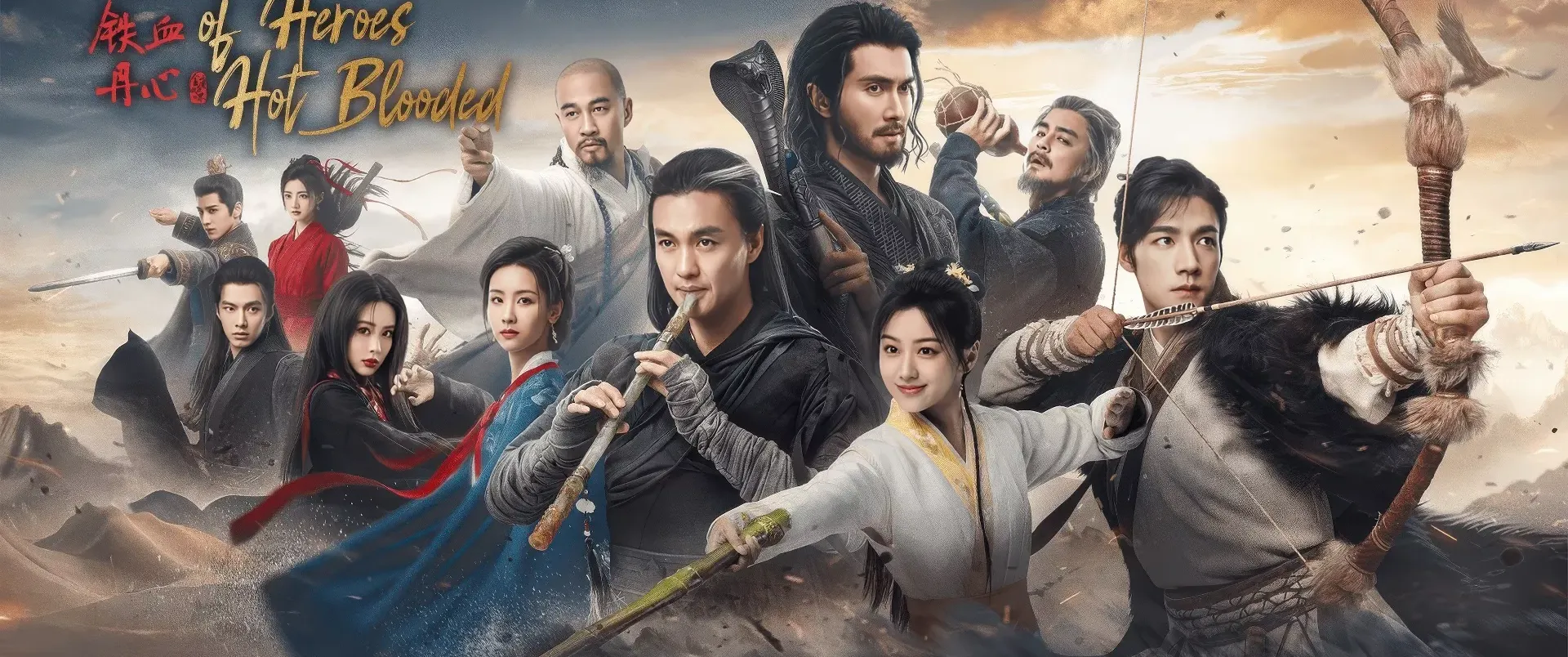
The Legend of the Condor Heroes Chapter 38 – Part 4
Translation by Jenxi Seow
After several dozen more exchanges, Guo Jing was drained to the last of his strength. The blows of Ouyang Feng and Qiu Qianren grew heavier and heavier. He could only parry and retreat, hoping to leap to the beams above for respite, yet Zhou Botong’s palm force kept him pinned beneath it, unable to break free. His alarm and fury boiled over at last, and he cursed, “Big Brother Zhou,1 you daft old man, why do you keep tangling with me?”
But the din of slaughter outside was deafening, and no one could hear a word he said. Guo Jing fell back a few more steps, tripped over the great boulder lying on the floor and nearly fell. Before he could straighten from his bent posture, Qiu Qianren’s Iron Palm2 was already slamming towards him. With no time in his extremity to change his move, he snatched up the boulder in both arms and held it against his chest. Qiu Qianren’s palm struck the stone. Guo Jing put strength into both arms and thrust outward, taking the blow. Then he heard a rush of wind to his left as Ouyang Feng’s palm force came at him again. Guo Jing drove strength through both arms, gave a great shout, and hurled the boulder straight up, then twisted aside to evade the incoming strike.
The boulder punched through the roof and flew out, and bricks, stones, earth and sand came down like rain. At once the faint light of the stars shone in through the roof. Zhou Botong was furious. “Now we can see. Where’s the fun in that?”
Utterly spent, Guo Jing pushed off hard with both feet and shot up through the hole in the roof. Ouyang Feng darted after him at once. Zhou Botong bellowed, “Don’t go, don’t go. Stay and play with me.” He snatched at Ouyang Feng’s left foot with a long arm. Ouyang Feng started and kicked back with his right foot, breaking the grip, but with no purchase in the air he fell back down. Qiu Qianren, without waiting for him to land, kicked at his chest. Ouyang Feng drew his chest in slightly and extended a finger to strike at the ankle. The three men traded blows in turn, locked once more in vicious combat. By now figures could be faintly made out, and the sounds of killing from beyond the door had gradually died away, nothing like as fearsome as the blind chaos of the dark battle. Zhou Botong was thoroughly put out. He took all his ill temper out on the two men, and his fist technique changed abruptly as he rained killing blows on both of them.
Guo Jing fled the stone house. Men and horses galloped to and fro, iron clashed against iron, and now and then a scream of agony rose from a soldier struck by blade or arrow. He forced his way through the press, ran clear of the village, and lay down in a small grove of trees to rest. After this desperate struggle through half the night, once he lay down he felt every sinew and bone in his body ache as though it would split. Though he worried for Zhou Botong’s safety, he thought that with the man’s martial ability, at worst he could escape. After lying there a while, he sank into a heavy sleep.
He woke at dawn the next morning to something cold on his face, something that wriggled and moved. Before he could even open his eyes he had leapt up, and he heard a joyful whinny. It was the little red horse3 licking his face. Guo Jing was overjoyed. He threw his arms around the horse, and man and steed, reunited after disaster, nuzzled each other with delight. While Ouyang Feng had held him prisoner in the stone house, the horse had foraged for herself on the grassland. When the armies fought the night before, her swift feet and quick wits had carried her clear of harm, and now she had found her master once more.
Guo Jing led the little red horse back to the village. Everywhere broken bows and snapped arrows lay scattered, men and horses dead in heaps. Here and there a wounded soldier still alive moaned in agony. He had seen battle often and grown accustomed to death, but now he thought of Huang Rong, and grief tore through him as though his heart would break. He stole back to the stone house and stood outside listening. No sound came from within. He peered in through a crack in the door, and there was no one inside. He pushed the door open and searched from front to back. Zhou Botong, Ouyang Feng, and Qiu Qianren had all long since vanished.
He stood rooted to the spot for some time, then mounted and rode east. The little red horse was swift, and it was not long before he caught up with Genghis Khan’s4 army.
By this time the cities of the Khwarezmian Empire5 had fallen one after another, surrendered or stormed, and the great host of hundreds of thousands crumbled like earth and shattered like tile. The Khwarezmian king, Muhammad, had always been arrogant and cruel. Deserted by his followers and abandoned by his kin, he fled west in disarray with a remnant of beaten troops. Genghis Khan sent his generals Subutai and Jebe at the head of two tumens6 in hot pursuit, while he himself led the main army home. Subutai and Jebe pursued him all the way to the neighbourhood of Kiev on the Dnieper, west of where Moscow stands today, where they utterly routed the combined forces of the Rus’ and the Kipchaks, numbering hundreds of thousands. The surrendered Grand Prince of Kiev and eleven Rus’ princes they crushed to death, every one, beneath the shafts of carts. This battle is known to history as the Battle of the Kalka River,7 and from then on the vast grasslands of Rus’ groaned for long years beneath the iron hooves of the Mongol army. Muhammad, at the end of his road, later died of sickness on a barren island in the Caspian Sea.
The day Genghis Khan lost sight of Guo Jing in the city of Samarkand, he was deeply troubled, fearing that, alone and cut off, he had been killed in the chaos of battle. When he saw him return, the Khan was greatly pleased. Princess Huazheng8 was happier still.
Qiu Chuji9 travelled east with the army, and along the way urged the Khan tirelessly to spare the people and limit the killing. Though Genghis Khan found little common ground with him in conversation, he knew Qiu Chuji was a man of the Dao, and would not flatly refuse his wishes. Thus amid the turmoil of war, countless common people owed their survival to a single word from Qiu Chuji.
The Khwarezmian Empire lay tens of thousands of li10 from Mongolia, and Genghis Khan’s great army took long months to return east. Once they reached the banks of the Onon River, a great feast was held to celebrate the victory, and the soldiers rested. Qiu Chuji, Lu Youjiao11 and the other Beggars’ Guild12 members took their leave one after another and departed south. Several more months passed. The autumn wind sharpened, the horses were fat and the men eager, and Genghis Khan turned his thoughts once more to a southern campaign. One day he summoned all his generals to deliberate the invasion of Jin.13
From the day Huang Rong died, Guo Jing had been hollow with grief. Often he rode off alone on the little red horse with his two eagles, wandering without purpose across the Mongol grasslands, lost and numb, often going days without speaking a word. Princess Huazheng spoke to him in gentle comfort, but he seemed not to hear. Everyone knew the reason and knew how bitter his grief was, and none dared raise the matter of marriage. Genghis Khan, consumed with planning the campaign against Jin, had no leisure to concern himself with it either. That day, in the Khan’s golden tent, the generals debated the southern march, each offering his own strategy. Guo Jing alone said nothing.
Genghis Khan dismissed the generals and spent half a day alone in thought upon a hilltop. The next day he issued orders: three armies to march against Jin. His eldest son Jochi and second son Chagatai were both in the west, governing the newly conquered lands. The central army against Jin would be led by his third son Ögedei, the left wing by his fourth son Tolui, and the right wing by Guo Jing.
Genghis Khan summoned the commanders of the three armies into his tent and bade the guards withdraw. He said to Ögedei, Tolui, and Guo Jing, “The Jin Empire’s elite troops are massed at Tong Pass,14 with the mountain ranges to hold to the south and the great river to bar the north, and they cannot be broken quickly. The strategies my generals have offered each have their merits, but a frontal assault would drag on for a long time. We Mongols are now allied with the Great Song, so once our army has taken Yanjing, the Jin Central Capital, the finest plan of all would be to borrow a road through Song territory, advance from Tangzhou and Dengzhou, and strike straight at the Jin capital, Daliang.”15
Ögedei, Tolui, and Guo Jing leapt to their feet at these words, embraced one another, and cried, “A brilliant plan!”
Genghis Khan smiled at Guo Jing. “You have a gift for war, and you are after my own heart. Tell me, after Daliang is taken, what then?”
Guo Jing thought for a long while, then shook his head. “Don’t attack Daliang.”
Ögedei and Tolui had plainly just heard their father speak of striking at Daliang. Why was Guo Jing now saying not to attack? They stared at him in puzzlement.
Genghis Khan still wore his smile. “And if you don’t attack Daliang?”
Guo Jing said, “It is neither attacking nor not attacking. It is attacking without attacking, and not attacking yet attacking.”
The words left Ögedei and Tolui more confused than ever. Genghis Khan laughed. “‘Attacking without attacking, not attacking yet attacking.’ Those eight words are well said. Explain them to your two elder brothers.”
Guo Jing said, “I take it the Khan’s plan is to make a feint at the Jin capital and destroy the enemy beneath its walls. Daliang is where the Jin emperor resides, yet its garrison is thin. The moment our army draws near, Jin will surely rush elite troops from Tong Pass to relieve the capital. The art of war of the Middle Kingdom says, ‘If you roll up your armour and hurry on, never halting day or night, marching double distance to contend for advantage a hundred li away, the generals of all three armies will be taken. The strong will be in front and the weary behind, and only one man in ten will arrive.’ If men march a hundred li at speed, barely one in ten arrives. From Tong Pass to Daliang is a thousand li. Even picked troops and crack soldiers, hurrying a thousand li to the rescue, would not bring one in ten to the field, and men and horses alike would be so worn out that those who did arrive could not fight. Our army rests outside Daliang and gathers strength, awaiting the spent at ease, and we shall surely break the Jin army utterly. The whole of Jin’s elite will be shattered in this one battle, and Daliang falls without a siege. If instead we assault Daliang by force and cannot take it quickly, we risk attack from both front and rear.”
Genghis Khan clapped his hands and laughed aloud. “Well spoken!”
He took out a map and spread it on the table. The three men looked and were all astonished. It was a map of the country about Daliang. Upon it were drawn the marching routes of both armies, showing how to fall upon the enemy’s back and strike at his heart, how to lure him on a weary march all the way from Tong Pass, and how to fall upon him in his exhaustion and wipe him out beneath the walls. It matched what Guo Jing had said in every particular. Ögedei and Tolui looked at their father, then at Guo Jing, both amazed and impressed. Guo Jing was filled with admiration, and he thought, I learned the art of war from Wumu’s Art of War,16 which gathers the wisdom of the Middle Kingdom’s great generals over thousands of years, so there is nothing remarkable in that. But the Khan cannot read and has never opened a book. He is a genius sent by heaven, wise by nature.
Genghis Khan said, “On this southern march, we shall surely break Jin. Here are three brocade pouches.17 Each of you is to keep one. After Daliang is taken, the three of you shall meet in the Jin emperor’s Golden Throne Hall and open them together, and act upon what is written within.” He took the brocade pouches from inside his robe and handed one to each of them. Guo Jing took his and saw that the mouth of the pouch was sealed with sealing wax, and the wax stamped with the Khan’s seal. Genghis Khan added, “You may not break the seal before you enter Daliang. Before the pouches are opened, the three of you shall examine each other’s seals to see whether they have been damaged.” All three bowed. “We dare not disobey the Khan’s command.”
Genghis Khan asked Guo Jing, “In everyday things you are very slow. How is it that you are so quick-witted when it comes to war?”
Guo Jing told him how he had studied Essentials for Defeating Jin18 until he knew it thoroughly. Genghis Khan asked after the story of Yue Fei.19 Guo Jing told how Yue Fei had broken the Jin army at Zhuxian Town,20 how the Jin soldiers had called him “Grandfather Yue,” how they had said, “It is easier to move a mountain than to shake the Yue family’s army,” and related each detail in turn. Genghis Khan was silent. He paced back and forth in the tent, his hands behind his back, and sighed, “I only regret I was not born a hundred years earlier, to try my hand against this hero. Who in the world today is a match for me?” There was a deep loneliness in his words.
Guo Jing took his leave of the Golden Tent. He thought that in the rush of war affairs these past days he had not seen his mother, and that tomorrow he would swear the oath and march south to avenge the Song Dynasty’s generations-old feud. Today he ought to spend the day with his mother. He set off towards her tent. But when he arrived, everything in it had been taken away. Only an old soldier remained on guard. On asking, he learned that his mother Li Ping had been moved by the Khan’s order to another tent.
Guo Jing asked the way and walked to the new location. The tent there was several times larger than their usual one. He lifted the flap and stepped in, and was startled. The tent blazed with gold and jade, heaped with brocade and silk, precious treasures plundered by the Mongol army from every quarter. Princess Huazheng sat with Li Ping, idly recalling amusing stories from Guo Jing’s childhood. She saw him enter and rose with a smile to welcome him.
Guo Jing said, “Mother, where did all these things come from?”
Li Ping said, “The Khan says you performed great service on the western campaign, and has rewarded you specially. But we’re used to living plainly. What use have we for so many things?”
Guo Jing nodded. He saw that there were now eight maidservants to wait on his mother, all women captured by the army on campaign.
The three of them chatted a while, then Huazheng took her leave. She thought that Guo Jing would depart again on the morrow, and that today he must have much to say to her. She waited outside the tent for some time, yet Guo Jing did not come out.
Li Ping said, “Jing-er, the Princess must be waiting for you outside. Go and speak with her a while.”
Guo Jing answered, but sat where he was and did not move.
Li Ping sighed. “We have lived twenty years in the north, and though we owe much to the Khan’s kindness, I miss home terribly. I only pray that you destroy Jin on this march, so that the two of us can soon go back where we came from. We shall settle in your father’s old house in Niu Family Village.21 You were never one to hunger after riches and rank, and you need never come to this northern land again. Only the matter of the Princess, I don’t know what ought to be done about it. There is a great deal of difficulty there.”
Footnotes
-
大哥 — dàgē. Literally big brother. The address to an elder brother or an elder sworn brother. ↩
-
铁掌功 — Tiězhǎng Gōng. Qiu Qianren’s palm art, on which his fame rests. See Wuxia Wiki. ↩
-
小红马 — xiǎo hóng mǎ. The red horse Guo Jing tames on the steppe, a sweat-blood steed. See Wuxia Wiki. ↩
-
成吉思汗 — Chéngjísī Hán. See Wuxia Wiki. ↩
-
花剌子模国 — Huālàzǐmó Guó. Central Asian empire destroyed by Genghis Khan in 1220, spanning modern Iran/Uzbekistan. See Wikipedia. ↩
-
万人队 — wànrén duì. Literally ten-thousand-man unit. The tumen, the largest standard formation of the Mongol army. See Wuxia Wiki. ↩
-
迦勒迦河之役 — Jiālèjiā Hé zhī Yì. The Battle of the Kalka River (1223), in which Subutai and Jebe destroyed the combined Rus’ and Kipchak armies. See Wikipedia. ↩
-
华筝 — Huázhēng. See Wuxia Wiki. ↩
-
丘处机 — Qiū Chǔjī. See Wuxia Wiki. ↩
-
里 — lǐ. A traditional unit of distance, about 500 metres or one-third of a mile. ↩
-
鲁有脚 — Lǔ Yǒujiǎo. His name meaning “has feet”. See Wuxia Wiki. ↩
-
丐帮 — Gàibāng. Literally beggars’ guild. The largest band in the jianghu, with members throughout the realm. See Wuxia Wiki. ↩
-
金国 — Jīn Guó. The Jin Empire of the Jurchen Wanyan clan (1115—1234), which holds northern China. See Wuxia Wiki. ↩
-
潼关 — Tóngguān. Tong Pass, a strategic pass on the border of Shaanxi and Henan. See Wuxia Wiki. ↩
-
大梁 — Dàliáng. The Jin capital, modern Kaifeng in Henan Province, earlier capital of the Warring States kingdom of Wei and of four of the Five Dynasties. ↩
-
武穆遗书 — Wǔmù Yíshū. The military treatise left by Yue Fei (1103—1142), the Song general posthumously titled Wumu. See Wuxia Wiki. ↩
-
锦囊 — jǐnnáng. Literally brocade bag. A small silk pouch for secret orders or stratagems, recalling Zhuge Liang’s brocade bags in Romance of the Three Kingdoms. ↩
-
破金要诀 — Pò Jīn Yàojué. A military treatise attributed to Yue Fei. See Wuxia Wiki. ↩
-
岳飞 — Yuè Fēi (1103—1142). The most celebrated Song general of the wars against the Jin, executed on false charges. See Wuxia Wiki. ↩
-
朱仙镇 — Zhūxiān Zhèn. A town near Kaifeng, where Yue Fei won a great victory over the Jin in 1140. ↩
-
牛家村 — Niújiā Cūn. Literally Niu Family Village. A village outside Lin’an. See Wuxia Wiki. ↩