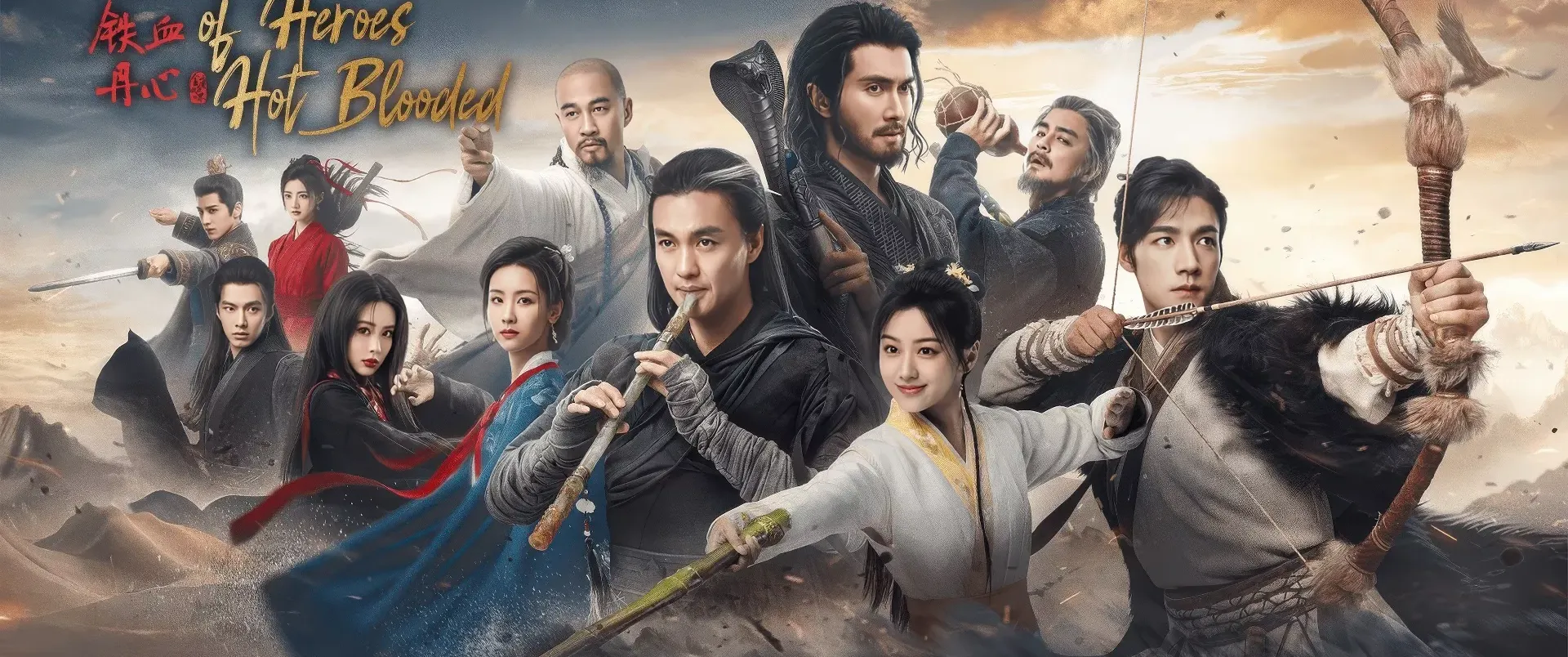
The Legend of the Condor Heroes Chapter 12 – Part 1
Translation by Jenxi Seow
Proud dragon repents1
Huang Rong was just about to tear the chicken apart when someone behind them suddenly said, “Tear it in three, and the parson’s nose is mine.”
Both of them started. How had someone crept up behind them without either of them noticing? They turned quickly and saw that the speaker was a middle-aged beggar. He had a long, squarish face, a wisp of beard on his chin and grizzled hair. His hands and feet were big and coarse, and his clothes were patched all over, a patch here and a patch there, yet washed perfectly clean. In his hand he held a green bamboo staff, as lustrous and green as jade, and on his back he carried a great gourd lacquered vermilion. His mouth was all but watering, and he looked so impatient that if they did not give him the parson’s nose, it seemed, he would reach out and grab it.
Before Guo Jing and Huang Rong could answer, he had planted himself squarely opposite them, taken the gourd off his back and pulled the stopper, and the smell of wine filled the air. He glugged down several mouthfuls and held the gourd out to Guo Jing. “Here, lad, you drink.”
Guo Jing thought the man very rude, but there was something so odd about the way he behaved that he knew he was no ordinary beggar, and he dared not be offhand. “I don’t drink,” he said, most respectfully. “Please, sir, you have it.”
The beggar turned to Huang Rong. “What about you, girl? Will you drink?”
Huang Rong shook her head, when suddenly she noticed that the man’s right hand, the one clutching the gourd, had only four fingers. The index finger was gone, flush with the palm. She gave a start. She remembered what her father had once told her of the Huashan Sword Summit2 and the five men who had taken part in it, and she thought of the Nine-Fingered Divine Beggar3 of the Five Greats.4 She thought, Can it be that by a stroke of luck we’ve met an eminent senior today? I’ll sound him out first.
The beggar was staring at the fat chicken in her hands, his throat bobbing as he swallowed his saliva. Laughing to herself, Huang Rong tore off half the bird and, sure enough, gave it to him parson’s nose and all.
The beggar was delighted. He snatched it from her and fell on it like a gale scattering clouds, until not a scrap was left, and all the while he ate he kept up his praise. “Superb, superb. Not even I, the founding father of all beggars, could turn out a beggar’s chicken as marvellous as this.”
Huang Rong smiled faintly and held out the remaining half to him. “How can I?” the beggar protested. “You two youngsters haven’t eaten yet yourselves.” For all his polite words his hand had already taken it, and in a moment it too was down to a few bones.
He patted his belly and cried, “Belly, oh belly, you’ve not often had a chicken as good as that inside you, have you?”
Huang Rong giggled. “This humble woman just happened to roast a beggar’s chicken, and it has had the honour of entering the august belly of the beggars’ founding father. I’m deeply flattered.”
The beggar roared with laughter. “You’re a sweet one, girl.” He fished several golden darts out of his robe. “Yesterday I saw some men fighting, and one of them must have been rolling in money. The darts he threw actually glittered with gold, so Old Beggar just helped himself to them as they went by. Inside this dart it’s scrap copper and old iron, but the outside is there for show, and the gilding is real gold. Here, lad, have it to play with. When you’re short of money it’ll fetch seven or eight qian5 of silver.”
He held it out to Guo Jing, but Guo Jing shook his head and would not take it. “We think of you as a friend. When we give a friend something to eat, we can’t accept a present for it.” This was the Mongols’ rule of hospitality.
The beggar looked awkward and scratched his head. “Now that’s a problem. It’s no matter for Old Beggar to beg a few scraps and cold leftovers off people, but today I’ve eaten a fine chicken like that from you two youngsters, a kindness as big as the sky, and I’ve no way to repay it. This…this is…”
Guo Jing laughed. “What kindness is there in one little chicken? To tell you the truth, we stole it ourselves.”
Huang Rong laughed. “We helped ourselves to a chicken, and you, sir, helped yourself to eating it. We’re all just helping ourselves.”
The beggar roared with laughter. “You two youngsters are good fun, just my sort. Come, tell me, what is it you wish for?”
Guo Jing could tell that he meant to lend them a hand, which would still be taking a present in return for a meal, so he shook his head. But Huang Rong said, “That beggar’s chicken was nothing much. I have a few little dishes I’m rather good at, and I’d like you to try them. Shall we all go on to the market town ahead?”
The beggar was overjoyed. “Superb! Superb!”
Guo Jing asked, “May I ask your surname, sir?”
The beggar said, “My surname is Hong, and I’m the seventh in my generation. You two youngsters can call me Qigong.6”
When Huang Rong heard the name Hong, she thought, So it is him. But he hardly looks a few years older than Daoist Elder Qiu. How can he be as famous as the shifu of the Seven Zis of Quanzhen? Hmm, but then my father isn’t very old either, and doesn’t he still deal with Hong Qigong and the others as equals? Those old Daoists of the Seven Zis must just be good-for-nothings. All their years have gone to the dogs.
Qiu Chuji had tried to force Guo Jing into marrying Mu Nianci, and Huang Rong had resented him for it ever since.
The three of them travelled south until they reached a market town called Jiang Miao Zhen, where they took rooms at an inn. Huang Rong said, “I’ll go and buy what I need for the cooking. You two have a rest.”
Hong Qigong watched Huang Rong go, his eyes creased in a smile. “She’s your little wife, isn’t she?”
Guo Jing blushed. He could not bring himself to say yes, yet nor did he wish to say no. Hong Qigong roared with laughter, then leaned back in his chair, eyes half closed, and dozed.
A good deal more than half a shichen7 passed before Huang Rong came back with her vegetables and went into the kitchen to cook. Guo Jing went to help, but she laughed and pushed him out again.
Not quite half a shichen later, Hong Qigong yawned, sniffed twice and cried, “What a strangely good smell! What dish is that? There’s something uncanny about it. This is all wrong!” He stretched out his neck and kept craning and peering towards the kitchen. Seeing him so impatient, itching like a man who cannot scratch, Guo Jing could not help laughing to himself.
Wafts of fragrance kept billowing out of the kitchen, yet Huang Rong never showed herself.
Hong Qigong scratched his ears and rubbed his cheeks. He sat down and stood up, stood up and sat down, quite unable to bear it. “That’s my rotten greedy nature,” he said to Guo Jing. “The moment I think of food, I forget everything else.” He held out his right hand, the one with only four fingers. “The ancients spoke of the index finger twitching, and they were dead right. Whenever I see or smell some rare delicacy, my right index finger won’t stop jumping. Once, out of greed, I let something important go wrong, and in my fury I chopped the finger clean off…”
Guo Jing gave a startled “Ah.”
Hong Qigong sighed. “The finger came off, but the greed wouldn’t.”
As he said this, Huang Rong came out, all smiles, carrying a wooden tray, and set it on the table. On it were three bowls of white rice, a wine cup and two large bowls of food. A sweet fragrance filled Guo Jing’s nostrils, more delightful than he could say.
One bowl held strips of roast beef, richly fragrant but, so far, nothing out of the ordinary. The other held a clear green broth in which floated dozens of crimson cherries, with seven or eight pink flower petals drifting on the surface, and beneath them diced tender bamboo shoots. Red, white, and green gleamed against one another, vivid and dazzling, and from the broth rose the clean scent of lotus leaves, suggesting the soup had been simmered with them.
Huang Rong poured wine into the cup and set it before Hong Qigong, smiling. “Qigong, try my cooking. What do you think?”
Hong Qigong did not need telling twice. Without even touching the wine, he seized his chopsticks, picked up two strips of beef and put them in his mouth. His whole mouth filled with a savour that was nothing like ordinary beef. Every chew brought a different taste, now rich and meltingly tender, now sweet and crisp, one flavour after another, ever changing, like the moves of a great martial master that come without end and that no one can foresee.
Hong Qigong was startled and delighted. On closer inspection, he saw that each strip of beef was in fact composed of four smaller strips laid together.
He closed his eyes to distinguish the flavours. “Hmm. One strip is from the haunch of a suckling lamb, one is from a piglet’s ear, one is from a calf’s loin, and one is…one is…”
Huang Rong pressed her lips together in a smile. “If you can guess that, you really are good…”
She had barely finished speaking when Hong Qigong cried, “It’s river-deer haunch kneaded together with rabbit.”
Huang Rong clapped her hands. “Well done, well done.”
Guo Jing listened in astonishment, thinking, All that trouble for one bowl of roast beef strips. And it’s a wonder he could tell five different meats apart.
Hong Qigong said, “There are only five meats, but pork and lamb bitten together are one taste, and deer and beef chewed together are another. How many combinations that makes altogether, I couldn’t begin to work out.”
Huang Rong smiled. “If you don’t count the order they come in, there are only twenty-five, the five-by-five of the plum blossom. And because the strips are shaped like flutes, the dish has a name, ‘Whose Jade Flute Plays the Falling Plum?’ The word ‘whose’ is there to set the diner a test. You’ve passed it, Qigong. You’re top of the list among diners.”
“Marvellous!” cried Hong Qigong, though whether he was praising the name of the dish or his own palate was anyone’s guess. He took up a spoon and scooped out two cherries. “This lotus-leaf, bamboo-shoot and cherry soup is so pretty I can hardly bear to eat it.” He tasted them, gave a cry of “Ah” and said in surprise, “Eh?” He ate two more, and again came the “Ah”. The clean taste of lotus leaf, the freshness of bamboo shoot and the sweetness of cherry went without saying. But the cherry stones had been hollowed out and filled with something else, and he could not tell what.
He pondered. “What’s stuffed inside these cherries?” He shut his eyes, savoured it slowly and murmured, “It’s bird meat! If it’s not partridge, it’s turtle dove. Yes, turtle dove!”
He opened his eyes to see Huang Rong holding up her thumb, and he could not help feeling very pleased with himself. “And what odd name does this lotus-leaf, bamboo-shoot, cherry and turtle-dove soup have?”
Huang Rong smiled. “Old sir, you have left out one ingredient.”
“Eh?” Hong Qigong peered into the soup. “Hmm, there are some petals as well.”
“That’s right,” said Huang Rong. “Think about those five ingredients, and you’ll have the name.”
Hong Qigong said, “Riddles are no good to me. There’s a good girl, just tell me.”
Huang Rong said, “I will give you a hint. Look to the Classic of Poetry.”
Hong Qigong kept waving his hands. “No good, no good. When it comes to books, Old Beggar hasn’t a clue.”
Huang Rong laughed. “A face like a flower, a mouth like a cherry, that is a beauty, is it not?”
Hong Qigong said, “Ah, so it is Beauty Soup.”
Huang Rong shook her head. “Bamboo is hollow at the heart, and humble, so it is a junzi.8 And the lotus is the junzi among flowers. So the bamboo shoots and the lotus leaves stand for the junzi.”
“Oh, so it’s Beauty-and-Junzi Soup.”
Huang Rong shook her head again, still smiling. “And what about the turtle dove? The first poem in the Classic of Poetry goes, ‘Guan, guan cry the ospreys, on the islet in the river. The lovely and good maiden is a fine match for the junzi.’ So the soup is called ‘Fine Match Soup.’”
Hong Qigong roared with laughter. “A weird and wonderful soup like this has to have a weird and wonderful name. Very good, very good. And you’re a weird and wonderful girl. Heaven knows what weird and wonderful father produced you. The taste of this soup is really something. More than ten years ago I had cherry soup from the imperial kitchens in the emperor’s palace, and it was nowhere near as good as this bowl.”
Huang Rong laughed. “What good dishes do they have in the imperial kitchens? Tell me about them, so I can learn to make them for you.”
Hong Qigong went on eating the beef strips and drinking the soup without a pause, with no time even for the wine. His mouth had not a moment to spare for her question, and only when both bowls were down to their last tenth or two did he say, “The imperial kitchen had its good things, of course, but nothing that compared with these two dishes. Hmm, there was one, Mandarin Duck Five-Treasure Mince, that was very good, but I’ve no idea how it’s made.”
Guo Jing asked, “Did the emperor invite you to dine?”
Hong Qigong chuckled. “That’s right, the emperor invited me, only the emperor didn’t know it. I hid up in the rafters of the imperial kitchens for three months, and I tasted every dish before the emperor did. If it was good I took the whole plate, and if it wasn’t, I let that emperor brat eat it himself. The kitchen people were jumping at shadows. They all said the Great Fox Immortal had come.”
Guo Jing and Huang Rong both thought, He’s greedy beyond belief, but his nerve and his skill are beyond belief too.
Hong Qigong laughed. “Lad, your wife’s cooking is the best under heaven. You’ll live in clover all your days. Damn it, why didn’t I ever run into a girl this clever when I was young?” He sounded as though he truly regretted it.
Footnotes
-
亢龙有悔 — Kàng lóng yǒu huǐ. Chapter title. Lit. “The arrogant dragon has cause to repent.” The first move of the Eighteen Palms of Dragon Subduing, named from the Book of Changes. ↩
-
华山论剑 — Huàshān Lùnjiàn. Literally sword discussion at Huashan. Use of discussion is key as the participants were engaged in a martial arts exchange and a philosophical debate on mastery, rather than just a physical contest. See Wuxia Wiki. ↩
-
九指神丐 — Jiǔzhǐ Shéngài. Literally nine-fingered divine beggar. See Wuxia Wiki. ↩
-
五绝 — Wǔjué. Five supreme martial artists who competed at Huashan Sword Summit for martial supremacy. See Wuxia Wiki. ↩
-
钱 — qián. A unit of weight, one-tenth of a liang, used in reckoning silver. ↩
-
七公 — Qīgōng. His name meaning “Seven Elder” or “Seventh Elder”: 七 is his rank in his generation and 公 an elder’s courtesy. See Wuxia Wiki. ↩
-
时辰 — shíchén. Traditional Chinese unit of time equal to two hours; the day was divided into twelve shichen. See Wuxia Wiki. ↩
-
君子 — jūnzǐ. Literally noble man. The Confucian ideal of the morally cultivated man. See Wuxia Wiki. ↩