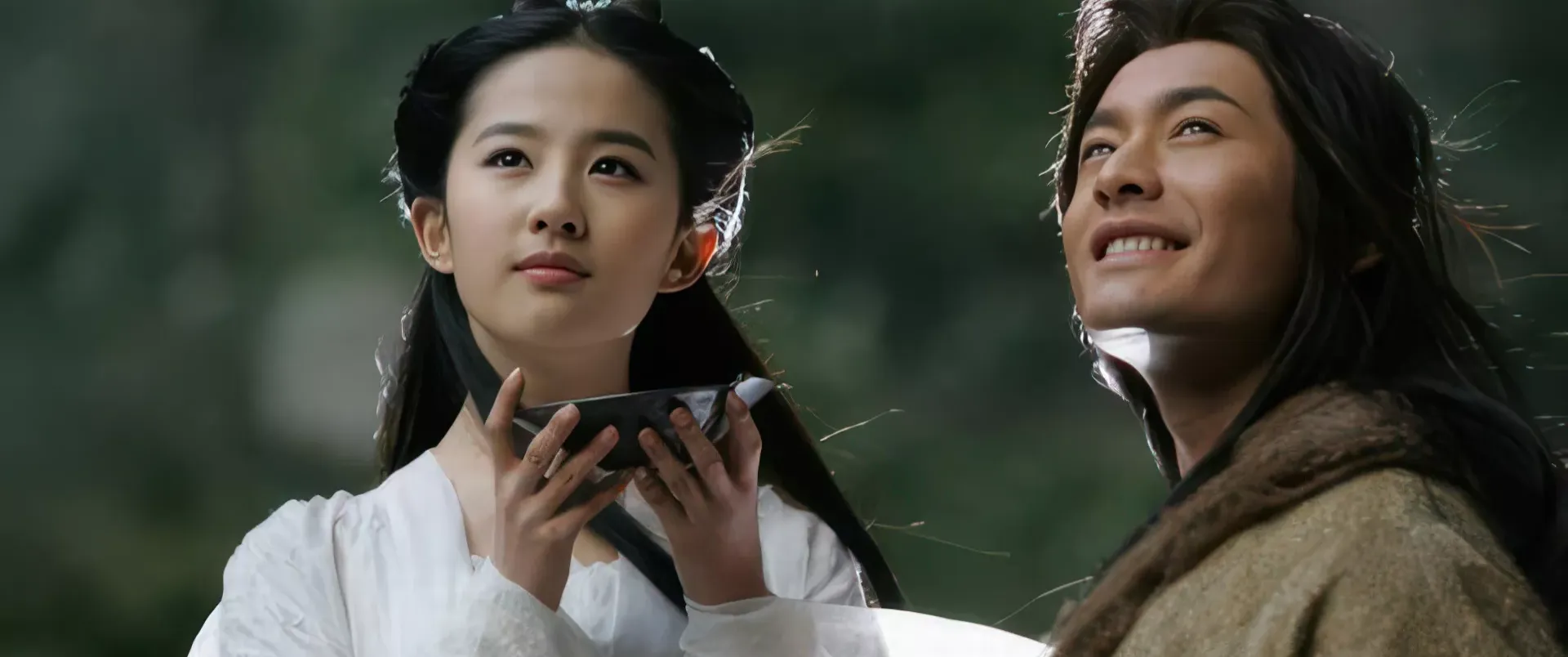
The Return of the Condor Heroes Chapter 33 – Part 1
Translation by Jenxi Seow
Night talk at Fengling1
In the first year of the Kaiqing reign of Emperor Lizong of the Great Song,2 the ninth year since Mongke3 had taken the throne as Great Khan of the Mongols, spring was in its last days in the third month, and the Fengling ferry4 on the north bank of the Yellow River was in uproar, donkeys braying and horses whinnying amid the din of voices and carts. For some days the weather had swung between cold and warm. The Yellow River had already thawed, but that day a north wind got up, the cold came down hard, snow began to fall, and the river froze over again. The ice was not thick, yet no boat could cross the water and no cart could cross the ice, so a great many travellers bound south over the river were stranded at the Fengling ferry with no way to set out. The ferry had several inns, but the southbound travellers kept pouring in. In less than half a day every inn was full, and the merchants who came later had nowhere to sleep.
The biggest inn in the town was called the Safe Crossing Inn,5 a name chosen for its promise of a safe passage over the river. Its rooms were large, so every traveller who could find no lodging elsewhere came crowding in, and it was packed fuller than any. The innkeeper talked himself hoarse and squeezed five or six guests into every room, but there was simply no place for the twenty or so left over, and they had to sit together in the main hall. The inn’s men pushed the tables and benches aside and built a great fire in the hall. Outside the north wind howled. The cold blast drove the snow in through the cracks of the door and made the fire flare up and sink by turns. It looked as though most of them would still be unable to leave the next day, and the worry showed on every brow and weighed on every heart.
Night was coming on and the snow was falling harder than ever when hoofbeats sounded, and three riders came galloping up and pulled up at the inn door. An old traveller in the hall frowned. “More guests,” he said.
Sure enough, a woman’s voice said, “Innkeeper, get two good rooms ready, large and clean.” The innkeeper smiled apologetically. “I’m so sorry, madam, but our humble inn is full to the rafters. There’s truly no room to spare.” “Very well,” said the woman, “one room, then.” “I truly am sorry,” said the innkeeper. “Guests as fine as you are the kind we’d beg to have, but today every room really is taken.” The woman flourished her riding whip and cracked it at the empty air. “Nonsense!” she snapped. “You keep an inn and you keep no rooms? Then what kind of inn is it? Can’t you tell someone to give one up? I’ll pay you extra.” And she strode straight into the hall.
At the sight of her, every eye in the room lit up. She was something over thirty, with an apricot-fair face and peach-blossom cheeks, a woman of handsome, regular beauty. She wore a fur-lined jacket of sapphire-blue brocade with a band of sable showing at the collar, and her dress was rich and costly. Behind her came a boy and a girl, both fifteen or sixteen. The boy had thick brows and large eyes and a rough, bold look. The girl was delicate, refined and lovely. Both wore fur-lined jackets of pale green satin. Around the girl’s neck hung a string of bright pearls, every one of them as big as the tip of a little finger, and they gave off a soft glow. The merchants were overawed by the three of them. Those who had been talking fell silent and simply stared.
One of the inn’s men bowed with an ingratiating smile. “Madam, you see how it is. None of these guests could find a room either. If the three of you don’t mind roughing it, I’ll ask everyone to shift along, and you can warm yourselves at the fire here and make do for one night. Tomorrow, if it turns warmer and the ice on the river melts, you may well get across.” The young woman was thoroughly out of patience, but she could see it was the truth, and she knit her brows and said nothing. A middle-aged woman sitting by the fire said, “Madam, sit down here and warm yourself. Get the cold out of you first.” “Thank you, I will,” said the beautiful young woman. The man sitting beside the middle-aged woman hastily shifted aside and cleared a generous space.
Soon after the three had sat down, the inn’s men set a low table before them, laid out bowls and chopsticks and brought the food. It was a generous spread, with both chicken and meat, and a large pot of white liquor besides. The beautiful young woman had a hearty head for drink and downed bowl after bowl, and the boy and the refined girl drank a little with her. From the way they addressed one another, the three were sisters and brother. The boy looked older than the girl, yet he called her “Elder Sister”.
They sat around the fire listening to the wind roaring outside, and for the moment no one felt like sleep.
A man with a Shanxi accent said, “This weather’s a torment. Thawing one minute, freezing the next. Heaven won’t give a man a decent day.” A short man with a Hubei accent said, “Stop cursing heaven and earth. We’ve got a warm fire to sit at and a meal in peace, so what more do you want? If you’d ever lived through the siege of Xiangyang,6 the hardest place under heaven would feel like a snug nest.”
At the words “siege of Xiangyang”, the beautiful young woman glanced at her brother and sister.
A traveller with a Guangdong accent asked, “May I ask, brother, what was it like inside besieged Xiangyang?” The man from Hubei said, “You all know well enough how savage the Mongol barbarians are, so I needn’t go into that. That year more than a hundred thousand Mongol troops stormed Xiangyang. The garrison commander, Lord Lü,7 was a muddled good-for-nothing, but by good fortune Guo daxia89 and his wife threw everything they had against the enemy…” At the words “Guo daxia and his wife”, the young woman’s face changed again. The Hubei man went on, “And the hundreds of thousands of soldiers and townsfolk in Xiangyang fought to the death to hold it, every one of them, and not a man shrank back. Take me. I’m nothing but a little pedlar with a barrow, but I hauled earth and carried stones and put my back into defending the city. This great arrow scar on my face, I got that from a Mongol barbarian.” They all looked at his face, and there under his left eye was an arrow wound as wide as the mouth of a teacup. Every one of them was moved to deep respect.
The Guangdong man said, “Our Great Song has vast lands and a teeming people. If everyone were like you, brother, the Mongol barbarians could be ten times as fierce and they’d still never take our country.” “That’s right,” said the Hubei man. “Look, the Mongol army has been attacking Xiangyang for more than ten years and never taken it, while everywhere else falls into their hands. They say dozens of countries out in the Western Regions have been wiped out by Mongol troops, yet our Xiangyang stands like a mountain. The Mongol prince Kublai10 came to the walls himself to drive on the assault, and even he could do nothing against us Xiangyang folk.” He looked mightily pleased with himself as he said it. The Guangdong man said, “The common folk will all fight the barbarians to the death. If the barbarians ever come as far as Guangdong, you’ll see us Guangdong lads give the bastards a proper fight as well.”
The Hubei man said, “Don’t fight the barbarians to the death, and you’re dead all the same. When the Mongol barbarians couldn’t break into Xiangyang, they rounded up the Han folk outside the city and beheaded them one by one below the walls. They even tied up little children, four or five, six or seven years old, and had horses drag them round and round below the walls. Before they’d gone half a circuit the children were dead. Up on the walls we could hear them crying and screaming, and it was like a knife cutting into our hearts. The barbarians thought cruelty like that would frighten us into surrendering, but the more vicious they got, the harder we held. That year the grain in Xiangyang ran out and there was no water left to drink. In the end we ate the bark off the trees and drank the foul water, and still the barbarians couldn’t get in. At last they had no choice but to pull back.” The Guangdong man said, “For more than ten years now, if Xiangyang hadn’t held out, I fear half our Great Song would be long gone.”
Everyone wanted to hear about the defence of Xiangyang, and the Hubei man told it with great colour and vigour, praising Guo Jing and Huang Rong11 as though they were gods from heaven, to an unbroken chorus of admiration.
A traveller with a Sichuan accent sighed suddenly. “Truth is, there are good officials defending cities all over the country. It’s only that the court can’t tell the loyal from the treacherous. Time and again the traitors enjoy every honour and riches, while loyal men die wronged. Never mind Lord Yue12 in the last dynasty. Take our Sichuan. The court has wrongfully put to death several great loyal servants who were defending our land.” “Who was that?” asked the Hubei man. “I’d like to hear.” The Sichuan man said, “The Mongol barbarians attacked Sichuan for more than ten years, and it was all thanks to Marshal Yu Jie13 that we held. Every soul in Sichuan revered him as a living Buddha. But who’d have thought the Emperor would listen to the traitor Ding Daquan,14 who said the Marshal was grasping at power and overbearing and who knows what? The Emperor sent him poisoned wine and forced him to kill himself, and put a feeble, useless crony of the traitors in his place as marshal. When the barbarians next attacked, northern Sichuan fell on the spot. The officers and men at the front were Marshal Yu’s old troops, and they fought to the death just the same, but that marshal knew nothing except toadying to his superiors. When it came to war he hadn’t the first idea how to deploy his men, so of course they couldn’t hold. Ding Daquan, Chen Dafang15 and their gang of traitors shielded that dog-fart of a marshal and falsely accused General Wang Weizhong,16 who had fought hard and well, of colluding with the enemy. They hauled his whole family off to the capital and beheaded General Wang.” By the time he finished, his voice was close to breaking, and everyone sighed.
The Guangdong man said hotly, “Affairs of state are all ruined by traitors like these. They say there are Three Hounds at court,17 and this traitor Ding Daquan is one of the hounds.” A fair-skinned youth who had been listening all along without a word now cut in. “Quite right. The chief traitors at court are Ding Daquan, Chen Dafang and Hu Dachang.18 The people of Lin’an19 add a dot beside the character da20 in each of their names and call them Ding Quanquan, Chen Quanfang and Hu Quanchang.” Everyone laughed at that. “From your accent, Brother,” said the Sichuan man, “you’re from the capital, from Lin’an.” “I am,” said the youth. “Then have you heard how General Wang Weizhong bore himself at his execution?” asked the Sichuan man. “I saw it with my own eyes,” said the youth. “General Wang went to his death without his face changing in the least, awe-inspiring to the last, cursing Ding Daquan and Chen Dafang for ruining the country and the people. And there was something uncanny besides.” “What?” they all asked at once.
The youth said, “General Wang was destroyed by Chen Dafang’s doing from first to last. As they bound him and carted him to the execution ground, General Wang shouted aloud in the main street that when he was dead he would take his grievance before the Jade Emperor.21 On the third day after General Wang’s death, sure enough, Chen Dafang dropped dead at home, and his head turned up high on the eaves of the Bell and Drum Tower at the east gate of Lin’an, hoisted on the end of a long pole. Not even a monkey could climb up there, let alone a man. If it wasn’t the gods and heavenly generals the Jade Emperor sent, who could it have been?” Everyone clicked their tongues in wonder. The youth said, “Everyone in Lin’an knows of this. I’m not making it up. If any of you go to Lin’an, you only have to ask.”
The Sichuan man said, “What this brother says is quite true. Only it wasn’t any god or heavenly general who killed Chen Dafang. It was a hero and a man of valour.” The youth shook his head. “Think about it. Chen Dafang was a great official at court, with household guards and troops of his own, and guarded as closely as a man can be. How could an ordinary man kill him? And to hoist the traitor’s head up on the eaves of the bell tower, a man would need to grow wings to do a thing like that.” “Remarkable men and xia of extraordinary skill do exist in this world, after all,” said the Sichuan man. “But if I hadn’t seen it with my own eyes, I’d hardly believe it myself.” The youth was astonished. “You saw him hang Chen Dafang’s head on that pole with your own eyes? How could you have seen it?”
The Sichuan man hesitated a moment, then said, “General Wang Weizhong had a son. When the General was arrested, the son was away and got clear, and the traitors at court, wanting to tear out the weeds root and all, sent troops to hunt him down. General Wang’s son was an officer too, and he knew some martial arts, but one man can’t stand against a crowd. He was on the point of being taken when a saviour appeared and, with his bare hands, beat several dozen mounted soldiers into a rout. Young General Wang told him how he and his father had fought for their country and been brought down by traitors. That daxia rode through the night to Lin’an to try to save General Wang, but in the end he came two days too late, and General Wang had already been put to death. In his rage the daxia went that same night and cut off Chen Dafang’s head. Not even a monkey could climb those eaves of the bell tower, but the daxia sprang up there with one light bound.”
Footnotes
-
风陵夜话 — Fēnglíng yè huà. Chapter title. Fengling Crossing is a ferry on the Yellow River. ↩
-
宋理宗 — Sòng Lǐzōng. (r. 1224–1264) The fourteenth emperor of the Southern Song dynasty. His reign saw the beginning of the Mongol conquest of China. See Wikipedia. ↩
-
蒙哥 — Ménggē. Möngke Khan (r. 1251–1259), the fourth Great Khan of the Mongol Empire, grandson of Genghis Khan. ↩
-
风陵渡 — Fēnglíng Dù. Historic Yellow River ferry crossing at the junction of Shanxi, Shaanxi, and Henan. See Wuxia Wiki. ↩
-
安渡老店 — Āndù Lǎodiàn. Literally “Old Inn of Safe Crossing,” a traditional Chinese inn name expressing the wish for guests to safely cross the river. ↩
-
襄阳 — Xiāngyáng. Strategic city on the Han River in Hubei Province, a Southern Song military stronghold against the Mongol invasion. See Wikipedia. ↩
-
吕文德 — Lǚ Wéndé. Song military commander responsible for the defence of Xiangyang. Historically, Lü Wende was a capable general, though Jin Yong portrays him as somewhat incompetent for narrative purposes. ↩
-
郭靖 — Guō Jìng. His name meaning “tranquillity” or “pacification”. See Wuxia Wiki. ↩
-
大侠 — dàxiá. Literally great xia. A title of respect for a renowned martial artist who upholds justice. ↩
-
忽必烈 — Hūbìliè. Kublai Khan (r. 1260–1294), grandson of Genghis Khan, who would later found the Yuan dynasty. See Wuxia Wiki. ↩
-
黄蓉 — Huáng Róng. Her name meaning “lotus” or “hibiscus”. See Wuxia Wiki. ↩
-
岳飞 — Yuè Fēi. Legendary Song dynasty general and national hero who fought against the Jurchen Jin dynasty, famously executed on false charges by the treacherous minister Qin Hui. ↩
-
余玠 — Yú Jiè. Yu Jie (d. 1253) was a Song dynasty military commander who successfully defended Sichuan against Mongol invasions, earning widespread respect. He was indeed forced to commit suicide by poison after political intrigue at court. ↩
-
丁大全 — Dīng Dàquán. Notoriously corrupt Song chancellor who rose to power through flattery of Emperor Lizong, known as one of the “Three Greats” (三犬) of the court. ↩
-
陈大方 — Chén Dàfāng. Treacherous Song court official, part of the faction that persecuted loyal generals. ↩
-
王惟忠 — Wáng Wéizhōng. Song general who fought bravely in Sichuan, falsely accused and executed on charges of treason. ↩
-
三犬 — Sān Quǎn. Literally “Three Hounds,” a pun on the “Three Greats” (三大), a mocking nickname for the three corrupt officials: Ding Daquan, Chen Dafang, and Hu Dachang. Character 大 (dà, “great”) with a dot added becomes 犬 (quǎn, “hound”). ↩
-
胡大昌 — Hú Dàchāng. Third of the “Three Hounds,” a corrupt Song court official. ↩
-
临安 — Lín’ān. Capital of Southern Song Dynasty, continued from LOCH era. See Wuxia Wiki. ↩
-
大 — dà. Character meaning “great.” Adding a dot to the top-right corner of this character turns it into 犬 (quǎn), meaning “hound” or “dog,” creating a mocking pun. ↩
-
玉皇大帝 — Yùhuáng Dàdì. Jade Emperor, the supreme deity of Chinese folk religion and Daoism, ruler of heaven. ↩