The Return of the Condor Heroes Chapter 26 – Part 5
Translation by Jenxi Seow
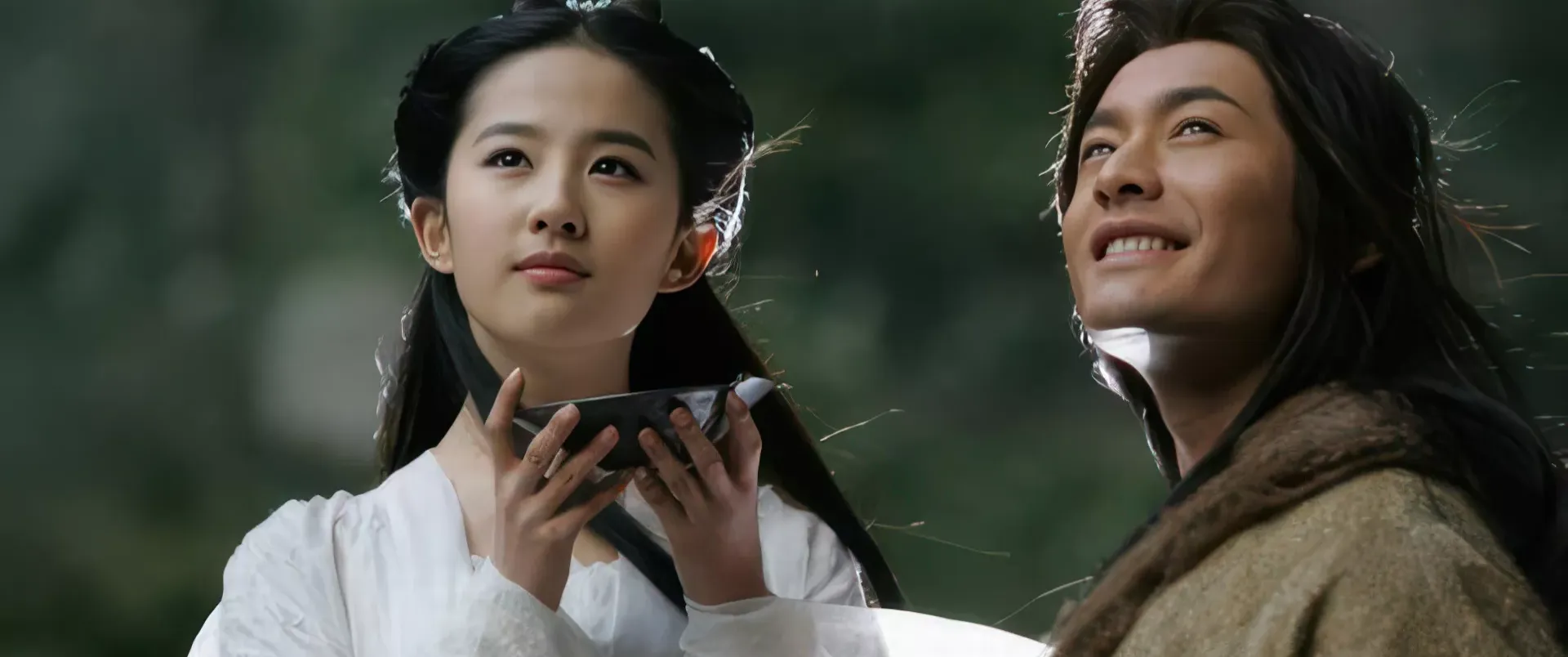
Xiaolongnü gave a soft laugh. What he said seemed perfectly right to her. Lying in his embrace, held by his left arm alone, she was utterly content. All she had asked was to see him once more before she died, and this was so good, truly so good.
State Preceptor Jinlun, Xiaoxiangzi, Yin Kexi, the Quanzhen Five Masters, the disciples… the Mongol warriors… not one of them made a sound. They stood staring at the young lovers. For that while nobody wished to lift a hand against them, and nobody dared.
There is a saying, “as though no one else were there.” Under the tigerish glare of nine great masters and countless Mongol warriors, Yang Guo and Xiaolongnü clung to each other in tender pity, treating all those powerful enemies as nothing at all, and that truly was as though no one else were there. When love reaches its height, kings and nobles are so much dung, the riches and glories of the world are beneath notice, and even life and death are held cheap. Since Yang Guo and Xiaolongnü no longer gave a thought to life or death, what did nine great masters matter? If every hero under heaven came, what then? It would be death, no more. Beside a love carved into heart and bone, what was death?
State Preceptor Jinlun and the others were certainly not afraid of the two of them, only astonished beyond measure. Xiaolongnü was gravely wounded and Yang Guo had only one arm left, and neither could possibly rise to fight again. Yet in the tender love the two shared there was, of itself, something stern and unbending, a fearless courage, that no one dared to slight.
At last Xiaolongnü could not help asking again. “Your arm… how did you lose your arm? Tell me, quickly.” A faint, bitter smile crossed Yang Guo’s face. “When an arm is cut off,” he said, “someone naturally did the cutting.”
Xiaolongnü gazed at him in sorrow. It did not occur to her to press him on whose cruel hand had done it. The misfortune had happened, and whoever had done it made no difference. Just then the wounds in her chest and back flared up again, and she knew she had not long to live. Very low, she said, “Guo’er, I want to ask one thing of you.” Yang Guo said, “Aunt, have you forgotten? In the Ancient Tomb I promised you that whatever you wanted me to do, I would do.” Xiaolongnü gave a soft, sad sigh. “That was a long, long time ago.” “For me it will always be the same,” said Yang Guo. Xiaolongnü smiled forlornly and said, very low, “I haven’t long to live. Stay with me. Watch over me until I die. Don’t go to your Guo… your Miss Guo Fu.”1
Grief and fury rose in Yang Guo together. “Aunt,” he said, “of course I’ll stay with you. What has that Miss Guo to do with me? She’s the one who cut off this arm of mine.” Xiaolongnü started. “Ah! It was her? Why would she be so cruel? Could it be… could it be because you don’t love her?” Yang Guo said bitterly, “You and I are so close. Don’t go imagining things. I love only you. In all my life I’ve never loved any other girl. As for that Miss Guo, humph…”
Yang Guo’s right arm had indeed been cut off by Guo Fu.
That day Yang Guo and Guo Fu had quarrelled in the Guo residence in Xiangyang, and the quarrel had come to blows. Unable to contain her fury, Guo Fu had snatched up the Junzi Jian2 and brought it slashing down at the crown of his head. Yang Guo had not yet recovered from the poison and was weak in every limb. Seeing the jian come, he could do nothing in his desperation but throw up his right arm to shield his face. Guo Fu struck with all the force of her wild rage, and the Junzi Jian was sharp beyond compare. Where its edge fell, Yang Guo’s right arm was cut clean through and came away.
That one stroke of a jian should come to this! Yang Guo, of course, was stunned and furious, and the pain went to his very heart, but Guo Fu was frozen with terror too. She knew she had done something that could never be undone. Seeing the blood gush like a spring from the stump of his arm, she had no idea what to do, and it never occurred to her to stop the bleeding or bind the wound. After a moment she suddenly burst out wailing, covered her face, and ran out through the door.
After a moment’s panic Yang Guo steadied himself. He reached out with his left hand and sealed the Jianzhen acupoint3 on his right shoulder, cut strips from the bedsheet and bound them tightly round his shoulder to stop the bleeding, then spread wound salve on the cut. He thought, I can’t stay here any longer. I must get out of the city at once. Bracing himself against the wall, he slowly took a few steps, but he had lost so much blood that everything went black and he nearly fainted.
Just then he heard Guo Jing’s4 voice, loud and urgent. “Tell me, quickly, what has happened to him? Has the bleeding stopped?” His voice was full of anxiety. Yang Guo had only one thought in his head. I won’t see Uncle Guo again. Whatever happens, I won’t see him. He drew a fierce breath and burst out of the room.
He ran out through the gate of the residence, took a horse, swung himself into the saddle and galloped for the city gate. The soldiers guarding the walls had all seen him rescue Guo Jing on the battlements and held him in the highest regard, and when they saw him galloping toward them they opened the gate at once.
By now the Mongol army had withdrawn more than a hundred li5 from the city. Once outside, Yang Guo kept off the main roads and rode wherever the country was wildest and most desolate. He thought, I have the Passion Flower’s deadly poison in me, yet the time is past and I’m still alive. Perhaps it’s as that Indian Divine Monk said, and sucking out the venom of the Soul-Freezing Silver Needles has fought poison with poison and prolonged my life. But the poison hasn’t gone, and sooner or later it will strike. Badly wounded as I am, I could never hold out all the way to Mount Zhongnan to find Aunt. Is it my fate to die a stranger on the road like this? He thought of his whole lonely, bitter life. Apart from the days he had spent with Xiaolongnü in the Ancient Tomb, he had known little happiness, and now the one person in the world who was family to him had left him, his body had been maimed, and his life hung by a thread. At this thought he could not keep back his tears.
He lay slumped across the horse’s back, dazed and drowsy, wanting only not to be found by Guo Jing, not to give him the chance to come and tend the wound and make amends, and not to run into the Mongol army. Anywhere else would do. Half by intent and half by chance, he drew near the desolate valley where he had fought the Wu brothers a few nights before.
At dusk, seeing knee-high grass all round and everything utterly still, he judged there was no one about, lay down in the grass and fell asleep. By now he had long since put life and death out of his mind, and he took no precautions at all against venomous insects or wild beasts. All that night the stump of his arm ached terribly. How could he sleep soundly?
The next morning he opened his eyes and sat up, and suddenly saw two centipedes lying stiff and dead on the ground less than a foot from him, striped red and black and hideous to see, their mouths smeared with blood. Yang Guo started in fright. Around the two centipedes was a great pool of blood, and after a moment’s thought he understood. His wound had bled heavily, and the poison in his blood had been deadly enough to kill two venomous creatures.
Yang Guo smiled bitterly and muttered to himself, “Who would have thought it? The poison in my blood, Yang Guo’s blood, is too much even for centipedes.” Grief, rage and bitterness welled up past bearing, and he could not help throwing back his head and laughing long at the sky.
Suddenly, from the top of a peak above, came three croaking cries. Yang Guo looked up and saw the Divine Eagle standing alone on the summit, head high and chest thrust out, fearsome and singularly ugly, and yet with a stern majesty all its own. Yang Guo was overjoyed, as if he had met an old friend. “Brother Eagle,” he called, “we meet again!”
The Divine Eagle gave a long cry and came charging straight down from the summit. Its body was heavy and its wings too short to fly, but it ran as swiftly as a fine horse, and in the blink of an eye it was at Yang Guo’s side. Seeing that he had lost an arm, it stared at him without blinking.
Yang Guo smiled bitterly. “Brother Eagle, a great disaster has befallen me, and I’ve come to throw myself on your mercy.” Whether or not it understood him, the Divine Eagle turned and walked off. Yang Guo led his horse and followed. They had gone only a few steps when the eagle turned its head and suddenly struck the horse’s belly with its left wing. The horse screamed with pain, backed away several paces and kept rearing and plunging. Yang Guo nodded. “I see. Now I’ve come to Brother Eagle’s valley I’ve no need to leave again, so what do I want with a horse?” The eagle, he thought, had truly as much understanding as any man. He let go of the reins, slapped the horse on the rump and let it go its own way, then strode off after the Divine Eagle. Badly wounded and weak as he was, he could not walk far before he had to sit and rest, and the Divine Eagle would stop and wait for him.
Walking and resting in this way, after more than a shichen6 they came once more to the stone cave where Dugu Qiubai the Sword Demon7 lay buried.
The sight of the stone grave moved Yang Guo deeply. This extraordinary predecessor, he thought, had roamed his age unchallenged, without a match under heaven, his martial skill divine and unfathomable. Judging by the way he had lived, he must have been a man whose gifts made him proud, who found it hard to get along with ordinary people, and in the end he had died alone and forgotten in this desolate valley. No tale of his name or deeds had come down in the wulin,8 and he had left no fist manuals or swordplay manuals, no disciples or followers, to pass on his peerless martial arts. His life was astonishing and enviable, and yet sad and pitiful too. The pity was that for all its uncanny wisdom the Divine Eagle could not speak, or it might have told him something of the man’s life.
He sat in the stone cave lost in thought. The Divine Eagle had already gone out and come back with two mountain hares in its beak. Yang Guo lit a fire, roasted them and ate his fill.
Many days passed in this way. His wound slowly closed and he grew stronger by the day. Whenever he thought of Xiaolongnü his chest still ached, but nothing like as unbearably as before. By nature he was restless, and spending long days in the desolate valley with only the Divine Eagle for company, he could not help growing lonely and bored.
One day, seeing how green the trees were behind the cave and how fresh and clear the mountain air, he strolled over to enjoy the scenery. After a li or so he came to the foot of a sheer cliff. It rose straight up toward the sky like an immense screen. About halfway up, more than two hundred feet from the ground, a great rock thirty or forty feet square jutted out like a platform, and on its edge he could faintly make out some carved characters. Straining his eyes upward, he saw that they were two large characters reading Jian Tomb.9
His curiosity stirred. Why should a jian have a tomb? Could Senior Dugu have broken a jian he loved and buried it here? He went up to the foot of the cliff. The rock face was bare, without a blade of grass or a shrub, sheer and smooth, with nowhere at all for a hand or foot to hold. He could not imagine how that man had climbed up there all those years ago.
Footnotes
-
郭芙 — Guō Fú. Her name meaning “lotus”. See Wuxia Wiki. ↩
-
君子剑 — Jūnzǐ Jiàn. One of a legendary pair of swords. See Wuxia Wiki. ↩
-
肩贞穴 — Jiānzhēn Xué. Acupoint on the Small Intestine meridian, located at the back of the shoulder joint. ↩
-
郭靖 — Guō Jìng. His name meaning “tranquillity” or “pacification”. See Wuxia Wiki. ↩
-
里 — lǐ. Traditional Chinese unit of distance, approximately a third of a mile or 500 metres. ↩
-
时辰 — shíchén. A traditional Chinese unit of time; one shichen equals two hours. The day was divided into twelve shichen. ↩
-
独孤求败 — Dúgū Qiúbài. Sword Demon; a peerless swordsman who sought a worthy opponent and could find none. See Wuxia Wiki. ↩
-
武林 — wǔlín. Literally martial forest. Those who actually practise, teach or study martial arts. Wulin sits inside the jianghu and is narrower than it: every member of the wulin belongs to the jianghu, but a pedlar or physician of the jianghu who never trained is no part of the wulin. See Wuxia Wiki. ↩
-
剑冢 — Jiàn Zhǒng. Burial site where Dugu Qiubai interred his swords. ↩