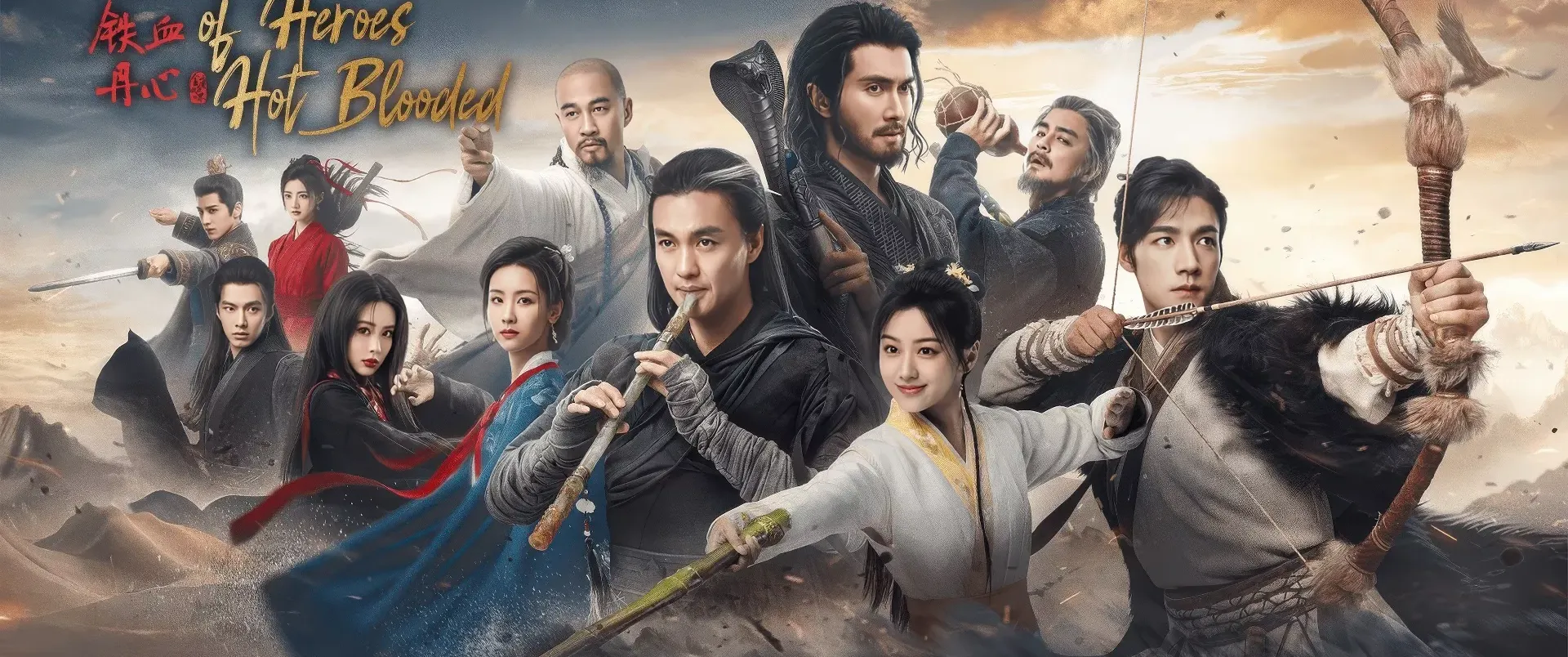
The Legend of the Condor Heroes Chapter 31 – Part 5
Translation by Jenxi Seow
Having got past Guo Jing, Yinggu thought, That was lucky! If not for this lotus pond, how could I ever have beaten off that simple boy? Heaven must mean me to have my revenge today. She quickened her step towards the temple gate and pushed at it. It was not barred, and with a creak it swung open at her touch.
This took her by surprise. Afraid of an ambush behind the door, she waited outside for a while, and only when nothing stirred within did she go in. In the main hall an oil lamp burned before the Buddha, lighting the image’s solemn, majestic face. A pang went through Yinggu’s heart. She knelt on the hassock and prayed silently.
She had prayed only a few words when two soft giggles came from behind her. At once her left hand swept back in a circle to guard against a sneak attack, her right pressed down on the hassock and sprang her into the air, and she turned lightly and deftly in mid-air and came down. A woman’s voice called out in admiration, “Beautifully done!”
She looked hard and saw a girl in a green dress with a red sash, a gold hair ring gleaming on her head, a pair of lovely eyes fixed laughingly upon her, and in her hand a glittering jade-green bamboo staff. It was Huang Rong.1
Huang Rong said, “Senior2 Yinggu, first let me thank you for saving my life.”
Yinggu said grimly, “I sent you here for healing to do harm, not to save you. Why thank me?”
Huang Rong sighed. “Where kindness ends and enmity begins is hard to tell in this world. My father kept the Old Wild Child, Zhou Botong,3 shut up on Peach Blossom Island4 for fifteen years, and even so it couldn’t bring my mother back to life.”
At the name of Zhou Botong, Yinggu shook violently and demanded harshly, “What has your mother to do with Zhou Botong?”
From her tone Huang Rong knew at once that she suspected some love affair between Zhou Botong and her mother, and that this was why her father had shut him up on Peach Blossom Island. So even after more than ten years, Yinggu had not stopped caring for the Old Wild Child, or why would she be eaten up with jealousy over nothing? Huang Rong bowed her head and said sadly, “My mother died on the Old Wild Child’s account.”
Yinggu’s suspicion grew. In the lamplight she saw how fair and soft Huang Rong’s skin was, how lovely her face, and even at the height of her own beauty she had been nothing like so pretty. If the girl’s mother had looked like her, there was no telling whether Zhou Botong’s heart might not have been stirred. She frowned and pondered.
Huang Rong said, “Don’t go imagining things. My mother was like a goddess, and Zhou Botong is as wild and stubborn as an ox. Nobody but a woman without eyes in her head would ever look twice at him.”
Yinggu knew she was being mocked, but her doubt was cleared away and she was relieved instead, though her face stayed cold and expressionless. “Well, if someone can love Guo Jing, as stupid as a pig, then someone can like a man as wild as an ox. How did the Old Wild Child bring about your mother’s death?”
Huang Rong said crossly, “You’ve insulted my shige.5 I’m not talking to you any more.” She flicked her sleeve and turned away, pretending to be angry.
Yinggu, set on getting to the bottom of it, said quickly, “All right, I won’t say it again. Your shige is very clever.”
Huang Rong stopped and turned round. “My shige isn’t clever at all. He’s just loyal and honest, and now that he and I are close, he’ll be good to me even if the sky falls. The Old Wild Child didn’t mean to kill my mother, but her death did come about because of him. In his fury my father broke both his legs and shut him up on Peach Blossom Island, but in time he came to regret it. Every wrong has its author, every debt its debtor. Whoever killed the one you love, you should go to the ends of the earth to find the real murderer and take your revenge on him. What use is it to vent your anger on someone else?”
These words struck Yinggu like a blow to the head. She stood rooted to the spot, unable to say a word.
Huang Rong went on, “My father knew he shouldn’t have vented his anger on someone else, and let the Old Wild Child go long ago…”
Yinggu, astonished and overjoyed, said, “Then I don’t need to go and rescue him?”
Huang Rong smiled. “If my father had refused to let him go, could you have rescued the Old Wild Child?”
Yinggu was silent.
After leaving Dali,6 Yinggu had gone into hiding in the Black Marsh7 and tried to find Zhou Botong. At first she could learn nothing, but later, by roundabout ways, she discovered that he was being held on Peach Blossom Island by Huang Yaoshi.8 The day Zhou Botong left her in Dali, he had gone without a thought for her, so utterly that she knew only some great upheaval could ever bring them together again, and when she learned he had been caught and imprisoned, she was torn between grief and joy: grief that the man she loved was in trouble, joy that here was her chance, for if she rescued him, how could he not be grateful? But the paths on Peach Blossom Island twisted and turned a thousand ways. Far from rescuing anyone, she was trapped there herself for three days and three nights and nearly starved, and only when Huang Yaoshi sent a mute servant to guide her was she seen off the island.
She went back to the Black Marsh and threw herself into the study of numbers.9 Now, hearing that Zhou Botong had already been set free, she felt lost, and sweet, sour, bitter and hot, every flavour of feeling welled up in her heart at once.
Huang Rong said with a smile, “The Old Wild Child does whatever I tell him. He never once says no to me. If you want to see him, come down the mountain with me now. I’ll make a match of you two, and we’ll call that my repayment for saving my life. How’s that?”
These words brought a flush to Yinggu’s cheeks and set her heart pounding.
Huang Rong was already feeling greatly relieved to see this vendetta about to turn into a happy event, when there was a sharp clap. Yinggu had struck her palms together behind her back, and her face went as cold as if a layer of frost had settled on it. She said harshly, “A yellow-haired chit like you can make him do as you say? Why should he take orders from you? Because you’re pretty? I did you no kindness, and I want no repayment from you. Get out of my way, quickly. Any more delay, and don’t blame me if I show no mercy.”
Huang Rong laughed. “Oh my, oh my, you want to kill me?”
Yinggu’s brows shot up. “And what if I do?” she said coldly. “Others may be afraid of Old Heretic Huang, but I fear nothing in heaven or on earth.”
Huang Rong said, all smiles, “Kill me if you like, it’s no great matter. But who will solve those three problems for you then?”
That day in the thatched hut in the Black Marsh, Huang Rong had written three problems on the sand floor, and Yinggu had puzzled over them day and night without getting anywhere. She had first taken up the study of numbers to rescue Zhou Botong, but any intricate and profound art, once one starts to delve into it, makes one forget food and sleep and leaves one unable to stop. She knew perfectly well that even if she could solve these problems, she would still be as far from Huang Yaoshi’s learning as earth from heaven, and it would not help her rescue anyone, yet curiosity drove her to rack her brains, and until she had worked them out she would have no peace. Now, at Huang Rong’s mention of them, the three problems sprang up clear as day in her mind, and she hesitated.
Huang Rong said, “Don’t kill me, and I’ll teach you.” She took the oil lamp from before the Buddha, set it on the floor, took out a steel needle and began scratching figures on the square floor tiles, and in no time she had worked out the first problem, the Seven Luminaries and Nine Planets Indian Written Calculation.10 Yinggu watched, dazzled and enthralled, marvelling to herself.
Huang Rong then went on to work out the second problem, the Cube Problem of Recruiting Soldiers, Paying Silver and Issuing Rice,11 which was more abstruse still. When she had written out the last figure of the answer, Yinggu could not help sighing. “There truly is no end to the ingenuity in this.” She paused, then said, “Now the third problem. In one way it is very easy, and in another it is as hard as can be. ‘There is a number of things, we know not how many. Counted in threes, two are left over. Counted in fives, three are left over. Counted in sevens, two are left over. How many things are there?’ I know the answer is twenty-three, but I only got there by trial and error. As for a method that works for any numbers at all, I have racked my brains to breaking point and cannot find one.”
Huang Rong laughed. “That’s easy enough. Count in threes and multiply the remainder by seventy. Count in fives and multiply the remainder by twenty-one. Count in sevens and multiply the remainder by fifteen. Add the three together. If the sum is not more than one hundred and five, that is the answer. Otherwise, take away one hundred and five, or a multiple of it.”
Yinggu went through it in her head, and it was exactly right. She murmured it over to fix it in her memory. “Count in threes and multiply the remainder by seventy. Count in fives…”
Huang Rong said, “No need to learn it by rote like that. I’ll recite you a poem, and then it’s easy to remember. ‘Three men walking together, seventy is rare. / Five plum trees, twenty-one sprays of blossom. / Seven children reunited at the very half-month. / Take off one hundred and five, and the answer is known.’”12
At the words “three men walking together” and “reunited at the half-month”, something in Yinggu’s heart was touched. She thought, This girl knows him, so naturally she has long known my secret shame. “Three men walking together” is a dig at me, one woman serving two men, and “reunited at the half-month” is a sneer at the mere ten days or so of love I had with him. Having once done a thing that lay on her conscience, she was suspicious of everything, and she said in a low, heavy voice, “Enough. Thank you for your instruction. ‘Hear the Way in the morning, and one may die content at evening.’13 If you chatter any more, I shall not be able to spare you.”
Huang Rong laughed. “‘Hear the Way in the morning, and one may die content at evening.’ It’s the one who hears the Way who dies. I never heard that it meant killing the one who taught it.”
Yinggu studied the layout of the meditation court and knew that Emperor Duan14 must be in the rear buildings. Seeing Huang Rong dog her steps so persistently, she was sure there was some trick behind it, and she thought, This girl may be young, but she is every bit as sly and full of tricks as her father. I mustn’t be the old midwife who swaddles the baby upside down, or the grain barge that capsizes in a ditch. She had already lost a good deal of time watching the girl calculate. With great business at hand, why was she wasting her wits on useless arithmetic? Without another word she walked on inside.
Passing round the Buddha hall, she saw only darkness ahead, without a single light. Alone in a dangerous place, she dared not charge straight in, and she raised her voice and called, “Duan Zhixing,15 will you see me or won’t you? Skulking in the dark with your head and tail tucked in, is that how a real man behaves?”
Huang Rong, close behind her, put in with a laugh, “Don’t you like it dark here? The Great Master was afraid that if too many lamps were lit, you’d take fright, so he had them put out.”
Yinggu said, “Hmph. I am fated for hell. Why should I fear mountains of blades or cauldrons of oil?”
Huang Rong clapped her hands and laughed. “Wonderful. I was just going to play a little blade-mountain game with you.” She took a tinder tube16 from her robe, shook it alight, bent down and lit a flame on the ground beside Yinggu.
Yinggu had never imagined there was a lamp right by her feet. When she looked closely, it was not really a lamp at all, just an earthenware teacup with a little clear oil in the bottom and a cotton wick soaking in it. Beside the cup stood a sharpened bamboo spike about a foot long, one end stuck in the earth and the other pointing up, very sharp. Huang Rong kept moving, lighting one after another, and in a moment the ground was like a sky full of stars, covered with lamps and bamboo spikes, a sharpened stick beside every cup.
By the time Huang Rong had finished, Yinggu had counted them all: one hundred and thirteen teacups and one hundred and thirteen bamboo spikes. She was deeply puzzled, and thought, If this is plum-blossom stake work, there should be seventy-two stakes or else a hundred and eight. What is the sense of a hundred and thirteen? And laid out so higgledy-piggledy, neither Nine Palaces nor Eight Trigrams, nor the five petals of the plum blossom. And with spikes as sharp as these, how could anyone stand on them? Ah, she must be wearing iron-soled shoes. Then she thought, The little chit has prepared for this, and here I’ll never beat her. I’ll pretend I don’t understand and just walk past.
She strode forward, but the spikes were so densely planted that it was hard to get through, so she kicked out sideways and knocked down five or six of them, saying, “What sort of trickery is this? This old woman has no time to play with children.”
Huang Rong cried in alarm, “Hey, hey, you mustn’t, you mustn’t.”
Yinggu paid no attention and went on kicking.
Huang Rong cried, “Fine, if you won’t listen to reason, I’m putting the lamps out. Quick, take a good look and memorise where the spikes are.”
Yinggu was alarmed. She thought, If several of them mean to attack me together here, they’ll have learned the positions by heart, and in the dark I’ll die on these spikes. I must get out of this deathtrap, and quickly! She drew in her breath, quickened her pace and kicked all the faster.
Huang Rong cried, “Have you no shame? Cheat!” Up came her bamboo staff to bar Yinggu’s way.
In the lamplight the dim green shadow of a staff swept across in front of her. Yinggu thought nothing of a girl still in her teens, and her left palm chopped straight at it, meaning to snap the bamboo staff with one blow.
But Huang Rong was using the Seal Formula17 of the Dog-Beating Staff Technique,18 in which the staff moves only crosswise and never attacks the enemy’s body. The bamboo staff becomes a wall of jade green across the face. So long as the enemy takes no step forward, no harm is done, but any attack meets an instant counter-blow.
Yinggu’s palm chopped down, there was a tap, and the tip of the staff jabbed the back of her hand instead. She snatched her hand back, already aching and numb.
The blow had not landed on a vital acupoint,19 but it hurt badly all the same. Yinggu had thought nothing of Huang Rong’s martial arts, and to be stung like this so suddenly left her shocked and angry both. Yet the small setback made her not rash but steadier. She would guard first and find out what kind of martial arts her opponent had before doing anything else. She thought, I once heard that the Twin Evils of Dark Wind20 were formidable, but they had learned a great many deadly skills on Peach Blossom Island first. How can this little chit have such accomplishment? Huang Yaoshi must have taught his beloved only daughter the finest arts of his whole life. Years before, she had come off very badly on Peach Blossom Island, almost losing her life there without ever setting eyes on Huang Yaoshi, and she had always been thoroughly wary of the Master of Peach Blossom Island.
What she did not know was that the Dog-Beating Staff Technique is the peerless art of the Chief of the Beggars’ Guild,21 and that even Huang Yaoshi himself, had he come, could not have broken it in a hurry.
While she stood on guard, not attacking, turning things over in her mind, Huang Rong kept up the Seal Formula to block her way, but her feet never stopped moving, flitting among the bamboo spikes like a butterfly among flowers, and in moments she had kicked out more than half of the hundred and thirteen lamps with the tip of her toe. The wonder of it was that she kicked out only the flames. Not a teacup was overturned or broken, hardly any oil was spilled, and the sharp bamboo spikes beside the lamps were not so much as touched.
Footnotes
-
黄蓉 — Huáng Róng. See Wuxia Wiki. ↩
-
前辈 — qiánbèi. Literally earlier generation. A respectful address for someone of an older generation in the wulin. See Wuxia Wiki. ↩
-
周伯通 — Zhōu Bótōng. See Wuxia Wiki. ↩
-
桃花岛 — Táohuā Dǎo. Huang Yaoshi’s island in the East China Sea. See Wuxia Wiki. ↩
-
师哥 — shīgē. Male senior, the colloquial form of shixiong. Both apprenticed to the same shifu. Shī means teacher. Gē means older brother. ↩
-
大理国 — Dàlǐ Guó. Kingdom in southwest China, modern-day Yunnan, ruled by the Bai people of the Duan Clan from 937 to 1253 CE. See Wikipedia. ↩
-
黑沼 — Hēi Zhǎo. Literally black marsh. ↩
-
黄药师 — Huáng Yàoshī. See Wuxia Wiki. ↩
-
术数 — shùshù. Literally arts of number. The traditional arts of mathematics, calculation and divination. ↩
-
七曜九执天竺笔算 — Qī Yào Jiǔ Zhí Tiānzhú Bǐsuàn. Literally seven luminaries and nine planets, Indian written calculation. The seven luminaries are the sun, moon and five visible planets; the nine planets are the Indian Navagraha, which add the two eclipse nodes. ↩
-
立方招兵支银给米题 — Lìfāng Zhāobīng Zhī Yín Jǐ Mǐ Tí. Literally the cube problem of recruiting soldiers, paying silver and issuing rice. An arithmetic problem of military supply. ↩
-
三人同行七十稀 — Sānrén tóngxíng qīshí xī. The opening line of a mnemonic verse for the ‘things whose number is unknown’ problem of the Sunzi Suanjing, the problem behind the Chinese Remainder Theorem. Seventy is the multiplier for threes, twenty-one for fives and fifteen for sevens, and one hundred and five is cast out. ↩
-
朝闻道,夕死可矣 — zhāo wén dào, xī sǐ kě yǐ. A saying of Confucius from the Analects (论语 · 里仁). Literally if one hears the Way in the morning, one may die in the evening. ↩
-
段皇爷 — Duàn Huángyé. Literally Imperial Lord Duan. See Wuxia Wiki. ↩
-
段智兴 — Duàn Zhìxīng. See Wuxia Wiki. ↩
-
火折子 — huǒzhézi. A tinder tube: rolled paper or fibre treated with saltpetre, kept smouldering in a tube and revived with a puff of breath. ↩
-
封字诀 — fēng zìjué. Literally the seal-character secret. One of the principles of the Dog-Beating Staff Technique. ↩
-
打狗棒 — Dǎgǒu Bàng. The jade-green bamboo staff carried by the Guild Chief of the Beggars’ Guild as the token of his office. See Wuxia Wiki. ↩
-
穴道 — xuédào. Acupoints, the nodes along the body’s meridians through which qi flows. See Wuxia Wiki. ↩
-
黑风双煞 — Hēifēng Shuāngshà. Literally twin evils of the dark wind. See Wuxia Wiki. ↩
-
帮主 — bāngzhǔ. Literally guild master. The head of a guild. ↩