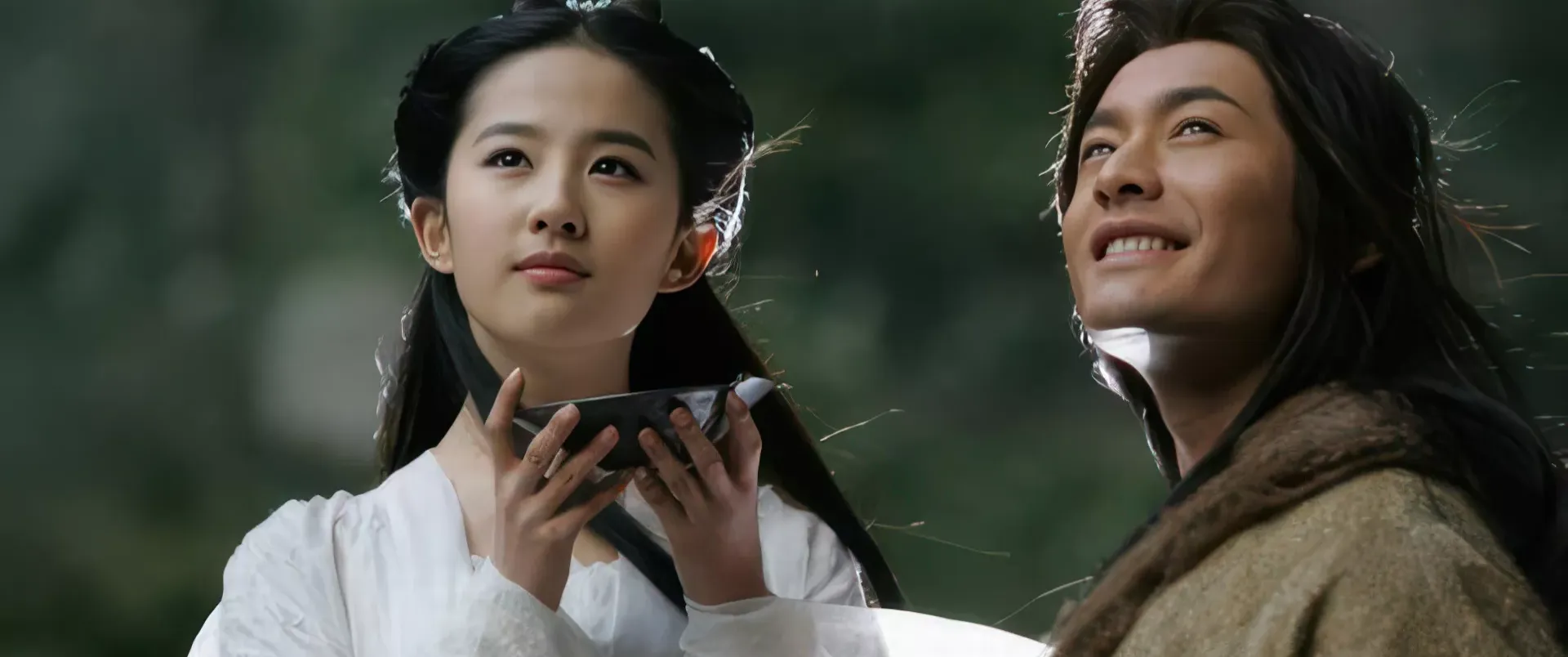
The Return of the Condor Heroes Chapter 22 – Part 2
Translation by Jenxi Seow
All at once he saw countless more soldiers ahead, coming to seize Guo Jing. He swung his long jian and shouted, “Don’t hurt my Uncle Guo!” He stabbed and slashed wildly to left and right, but everything before his eyes was a blur, a face here, a man there. He flailed his jian a while longer, then pitched from the horse. He was still shouting, “Kill me, kill me. It’s my fault. Don’t hurt Uncle Guo.” Then heaven and earth spun round, and he knew no more.
He never knew how long it was before he slowly came to. “Uncle Guo, Uncle Guo, how are you?” he shouted. “Don’t hurt Uncle Guo!” Someone beside him said gently, “Guoer, set your mind at rest. Your Uncle Guo will be well after a little rest.” Yang Guo turned his head and saw Huang Rong,1 her face full of gratitude. Behind her someone was gazing at him with tears glistening in her eyes and love and pity overflowing from them: Xiaolongnü.2 “Aunt,”3 Yang Guo cried in alarm, “how did you get here? Did the Mongols take you too? Run, run, never mind me.” Xiaolongnü said softly, “Guoer, you’ve come back. Don’t be afraid. We’re all safe and sound in Xiangyang.”
Yang Guo heaved a long sigh. His whole body felt limp and slack, as if nothing held it together, and he closed his eyes again. “He has come round,” said Huang Rong. “There’s no danger now. Stay here with him.” Xiaolongnü said she would, her eyes never leaving Yang Guo.
Huang Rong rose and was about to leave the room when she heard a faint creak on the roof. Her face changed a little, and with a wave of her left palm she put out the candle. At the sudden darkness Yang Guo sat up with a start. His wounds were only flesh wounds. He had fainted from loss of blood and from exhaustion after the savage fight. He had rested half a day since then, and Huang Rong had given him the Nine Flower Jade Dew Pills,4 the healing medicine Peach Blossom Island prepared in secret. Young and strong as he was, he had already more than half recovered. Now, sensing danger on the roof, he roused himself at once and made to get up and meet the enemy. Xiaolongnü moved in front of him, drew the Junzi Jian5 from where it hung at the head of the bed, and said in a low voice, “Don’t move. I’m here on guard.”
Someone on the roof laughed aloud. “I have come to deliver a letter,” a voice rang out. “Can it be that the Southern Dynasty’s etiquette is to receive its guests in the dark? If you have something here that cannot bear the light, suppose I wait a while and come back?” By the voice it was the State Preceptor’s disciple Huodu. “The Southern Dynasty’s etiquette,” said Huang Rong, “depends on the guest. By broad daylight we receive honoured guests who come openly and aboveboard. When the candles are out and the stars have set, we meet skulking, sneaking ill-wishers.” That left Huodu without a word to say. He sprang lightly down into the courtyard. “A letter,” he said, “for Guo daxia,6 Guo Jing.” Huang Rong opened the door. “Please come in.”
Seeing the room black as pitch, Huodu dared not step straight in. He stood outside the door. “Here is the letter. Please take it.” “You call yourself a guest,” said Huang Rong. “Why not come into the room?” Huodu sneered. “A junzi7 does not set foot in a place of danger. One must beware of arrows from the dark.” “Is there a junzi under heaven,” said Huang Rong, “who measures others by a petty man’s heart?” Huodu’s face burned. This Guild Chief Huang had a fearsome tongue, he thought. In a war of words with her he would never come out on top, and he had best keep his clumsiness out of sight. He said not a word more, but fixed his eyes on the doorway and held out the letter in both hands.
Huang Rong flicked out her bamboo staff and darted it at his face. Huodu jumped and sprang back several feet, only to find his hands empty. The letter had gone, he knew not where. Huang Rong had laid the tip of her staff on the letter and, as he leapt back, used a sticking force to draw it to her. She was near her time and her belly was swollen, and she did not wish to be seen by outsiders, so she never once showed herself to the enemy. The shock took the heart out of Huodu, and eight or nine tenths of the fire he had brought into the city went out of him at a stroke. “The letter is delivered,” he called loudly. “Until tomorrow night!”
Huang Rong thought, If you can walk in and out of Xiangyang as you please, isn’t that as good as saying there’s no one in this city? She picked up the teapot from the table and gave it a flick toward the door, and a whole pot of freshly brewed hot tea shot from the spout in a single thread.
Huodu had been on his guard all along, afraid that a hidden weapon might come flying out of the room. But the tea flew without a sound, with none of the whistle of wind that heralds an ordinary hidden weapon, and before he knew it his neck, his chest and his right hand were all splashed. It burned like fire. In his fright he let out a yelp and leapt aside. Huang Rong, standing by the door, struck before he could find his feet. Out went her bamboo staff in the “Trip” formula of the Dog-Beating Staff Technique,8 and with a thump she tripped him flat. Huodu sprang up, but in the “Trip” formula each stroke comes faster than the last. Only a man who dodged the first and got clear at once had any hope of parrying the second. He had gone down at the very first, and to scramble up and escape the second was easier said than done. His feet seemed mired in a swamp or snared in a mass of vines. Down he went, up he got, and down he went again.
Huodu’s martial skill was far from weak. In a straight fight with Huang Rong he would have come off the worse in the end, but he would not have been sent sprawling so wretchedly from the very start. It was the sudden splash of hot liquid. He took it for some deadly poison and feared for his life, wondering how hideously his skin would rot once it began to work. While he was still reeling with terror, Huang Rong struck without warning. The first stroke had already felled him, and against the second he had no chance to strike back. In the darkness he was thrown about until his nose was bruised and his eyes swollen.
By now the Wu brothers had come running at the noise. “Seize this young villain!” Huang Rong cried.
Desperation sharpened Huodu’s wits. He knew that the moment he got to his feet he would be tripped again. With a great yelp he pretended to have fallen badly, and lay on the ground without getting up. The Wu brothers both pounced to pin him down. Out shot Huodu’s iron-ribbed folding fan, tap, tap, and he had struck an acupoint in a leg of each. He shoved both of them forward at once to block Huang Rong’s bamboo staff, then sprang up onto the top of the wall. There he cupped his hands. “Guild Chief Huang,” he cried, “what formidable staffplay, and what useless disciples!”
Huang Rong laughed. “With poison water all over you, how could anyone lay a hand on you?” At those words Huodu’s heart and gall almost burst with fright, This poison water scalds the skin, and it smells of tea leaves too. What fearsome, uncanny drug can it be? Huang Rong guessed what he was thinking. “You’ve been struck by a deadly poison and don’t even know its name. To die in ignorance like that, I suppose you’d find it hard to close your eyes. Very well, there’s no harm in telling you. This poison water is called Zi-Wu Bone-Baring Tea.”9
“Zi-Wu Bone-Baring Tea?” Huodu murmured. “Just so,” said Huang Rong. “One drop on the skin, and the whole body rots till the bones show. Struck in the hour of Zi, you won’t see out the hour of Wu. Struck in Wu, you won’t see out Zi. You have six shichen left to live.10 Hurry home.”
Huodu had long known that Guild Chief Huang of the Beggars’ Guild was formidable in martial skill and that her schemes and stratagems were beyond anyone’s guessing. Her father Huang Yaoshi was a man of vast learning. His very name held the character for “medicine”, and the character for “master” besides,11 so he must be deeply versed in drugs. With her brilliance and her family’s learning, brewing this Zi-Wu Bone-Baring Tea would be as easy as turning over her hand. For a while Huodu stood frozen on top of the wall, not knowing whether to go home and await his death or to bow his head and beg her for the antidote.
Huang Rong knew Huodu was no fool. The poison-water tale could only fool him for a while. Given time, he was sure to see the holes in it. “I had no quarrel with you,” she said. “If you hadn’t spoken so insolently, you wouldn’t have thrown your life away for nothing.” Huodu heard a thread of hope in that. With no further thought for rank or pride he jumped down from the wall and bowed to the ground. “I was insolent. I beg Guild Chief Huang’s pardon.” Hidden behind the door, Huang Rong flicked a finger, and a Nine Flower Jade Dew Pill flew out. “Swallow it at once.” Huodu caught it. This was the elixir that would save his life, and he dared not dawdle. He popped it into his mouth, and a pure fragrance went straight through to his dantian,12 and his whole body felt more at ease than words could say. He bowed again. “My thanks to Guild Chief Huang for the medicine!” All his swagger was gone now. He backed slowly away until he reached the wall, and only then vaulted over it and left the city in haste.
Huang Rong watched him go and gave a little sigh. She freed the Wu brothers’ acupoints, remembering Huodu’s two jibes, “What formidable staffplay, and what useless disciples.” She had beaten the enemy by a trick, but she felt no satisfaction at all. Tripping Huodu with the Dog-Beating Staff Technique had taken only deft force, yet even that had pulled at her belly and left a dull ache inside. She sat down in a chair and steadied her breathing for a long while.
Xiaolongnü lit a candle. Huang Rong opened the letter and read:
“The First Dharma Protector of the Mongol Nation, the Great Lama Jinlun, presents his compliments to Guo daxia: Just now you honoured me with a visit, and I was granted a sight of your noble bearing, truly the consolation of a lifetime. I had hoped we might talk by candlelight through the night. Who could have thought your favour so hard to win? Am I so unworthy of your instruction that you came and went in such haste? The ancients say that some grow white-haired together and remain as strangers, while others tilt their carriage canopies in passing and are old friends at once.13 Long, long is the yearning of my heart, and deep are my thoughts of you. Tomorrow I shall return your visit. I pray you will not keep a man a thousand li14 away.”
Huang Rong was alarmed. She handed the letter to Yang Guo and Xiaolongnü to read. “The walls of Xiangyang are strong, but they cannot keep out masters of the wulin.15 Your Uncle Guo is badly wounded and I cannot put out my strength. With the enemy about to fall on us in force, what are we to do?”
Footnotes
-
黄蓉 – Huáng Róng. Her name meaning “lotus” or “hibiscus”. See Wuxia Wiki. ↩
-
小龙女 – Xiǎolóngnǚ. Literally little dragon maiden. See Wuxia Wiki. ↩
-
姑姑 – gūgu. Literally paternal aunt, used here as a term of respectful address for a young woman of the older generation. Yang Guo uses this to address Xiaolongnü, his shifu. ↩
-
九花玉露丸 – Jiǔhuā Yùlù Wán. Peach Blossom Island healing medicine. See Wuxia Wiki. ↩
-
君子剑 – Jūnzǐ Jiàn. One of a legendary pair of swords. See Wuxia Wiki. ↩
-
大侠 – dàxiá. Literally great xia. Title of the highest honour for a chivalrous martial hero. See Wuxia Wiki. ↩
-
君子 – jūnzǐ. Literally noble man. Confucian ideal of the morally cultivated man. Often mistakenly translated as “gentleman”. See Wikipedia. ↩
-
绊字诀 – bànzì jué. Literally the formula of the word “trip”. One of the core formulae of the Dog-Beating Staff Technique; it delivers a rapid sequence of strikes that repeatedly trip the opponent, each successive blow coming faster than the last. ↩
-
子午见骨茶 – Zǐwǔ Jiàngǔ Chá. Literally Zi-Wu bone-baring tea, a poison name Huang Rong invents on the spot. Zi (子) is the hour of Zi (11 p.m. to 1 a.m.) and Wu (午) the hour of Wu (11 a.m. to 1 p.m.), together suggesting a poison that kills within half a day. See Wuxia Wiki. ↩
-
六个时辰 – liù gè shíchen. Six shichen, or twelve hours: from the hour of Zi to the hour of Wu (midnight to noon), or from noon to midnight. See Wuxia Wiki. ↩
-
黄药师 – Huáng Yàoshī. His name meaning “medicine master”. See Wuxia Wiki. ↩
-
丹田 – dāntián. Literally cinnabar field. Primary energy centre below the navel, where qi is stored and cultivated. See Wuxia Wiki. ↩
-
白头如新,倾盖如故 – “Heads turned white as though still newly met, carriages tilting together as though old friends”. Classical Chinese proverb from the Records of the Grand Historian (《史记》). It means that some people can know each other until their hair turns white yet still feel like strangers, while others can meet for the first time — their carriages tilting toward each other on the road — and feel like old friends. The State Preceptor is making a literary allusion to suggest a deep, instant connection with Guo Jing, despite their brief encounter. ↩
-
里 – lǐ. Traditional Chinese unit of distance, approximately 500 metres or a third of a mile. ↩
-
武林 – wǔlín. Literally martial forest. Those who actually practise, teach or study martial arts. Wulin sits inside the jianghu and is narrower than it: every member of the wulin belongs to the jianghu, but a pedlar or physician of the jianghu who never trained is no part of the wulin. See Wuxia Wiki. ↩