The Return of the Condor Heroes Chapter 8
Translation by Jenxi Seow
The maiden in white
Yang Guo eased the window open and slipped into the room shared by the two Daoists, Ji and Pi. On the kang1 lay two bundles. He picked one up and weighed it in his hand: some twenty liang2 of silver inside. That’ll do nicely for travelling money, he thought, and tucked it into his robes. The other bundle was about four feet long and held two long jians. He drew them one at a time, snapped both with a heavy-handed twist of force, slid them back into their scabbards and tied the bundle up again. He was about to leave the room when a thought struck him. He undid his trousers and pissed a great puddle into the two Daoists’ bedding.
He heard someone climbing the wall, and knew from the sound that the two Daoists’ qinggong3 was nothing special: they could not clear the wall in one leap, but had to jump onto the top first and then spring down. At once he slipped back to his own room and eased the door shut, and the two Daoists noticed nothing at all. Yang Guo put his ear to the wall and listened for what went on next door.
He heard the two Daoists talking in low voices, and they seemed sure of victory at the next day’s contest. They were undressing and climbing onto the kang when Pi Qingxuan suddenly cried out, “Ah, what’s this wet stuff in the bedding? Ugh, it stinks. Ji shixiong,4 are you so lazy you pissed in the bed?” Ji Qingxu spat. “Pissed what?” Then he too let out a yell. “Where did some stinking cat come from to piss in here?” “Since when does a cat piss that much?” said Pi Qingxuan. “Eh? That’s odd… Hey, where’s the silver?” said Ji Qingxu. In an instant the room was in uproar, the two of them hunting high and low for the bundle with the silver in it. Yang Guo laughed to himself. Then he heard Pi Qingxuan bellow, “Attendant, attendant, is this a bandits’ inn or what? Stealing a guest’s silver in the middle of the night?”
The two of them shouted a few times before the attendant got up, bleary-eyed, to ask what was wrong. Pi Qingxuan grabbed him by the front of his shirt and accused him of running a bandits’ inn. The attendant howled to high heaven that he was wronged, and the noise brought the innkeeper, the cook and the serving boys tumbling out of bed, and then the other guests came crowding round to watch the fun. Yang Guo slipped in among the crowd. The attendant was in full spate, his tongue quick and his words pouring out in an endless torrent, until the two Daoists had nothing left to say. This attendant loved a war of words more than anything. Even with nothing doing he would go out of his way to needle people, and now someone had picked a quarrel with him, with right entirely on his side at that. He talked until the spittle flew, and the longer he went on the livelier he got. Shame turned to fury in the two Daoists, and they were ready to come to blows, but then they remembered the rules of their order: this was the foot of Mount Zhongnan,5 and how could they dare run wild here? There was nothing for it but to swallow their anger, shut the door and go to sleep. Outside their room the attendant was still nattering on.
Early next morning Yang Guo got up and went for a bowl of noodles. The talkative attendant came over to serve him, still muttering curses under his breath. “What happened to those two thieving Daoists?” Yang Guo asked with a grin. The attendant was very pleased with himself. “Damn their mothers, those two stinking Daoists wanted free food and free lodging. For the Chongyang Palace’s6 sake I’d have let that go, but they had the nerve to say we run a bandits’ inn. The two thieving Daoists sneaked off before daybreak. Hmph, I’m going straight up to the Chongyang Palace to complain. The Quanzhen Order7 has Daoists by the thousand, and which of them doesn’t keep strictly to the rules and precepts? I remember those two thieves’ faces clear as day, and I’ll pick them out for sure…” Yang Guo laughed to himself and egged him on with a few more words. Then he paid for his room and board, asked the way to Jackal-Wolf Valley and set off.
In no time he had covered more than thirty li,8 and Jackal-Wolf Valley was not far off. It was still only the start of the hour of Chen.9 Yang Guo thought, I’ll hide off to one side and see how Aunt deals with those villains. Better if she doesn’t spot me first. He remembered how he had dressed up as a farm lad to make a fool of Hong Lingbo that day, and was very pleased with himself. Why not play the same trick again? He went round to the back yard of a farmhouse and poked his head over to look. In the cattle pen a great bull was in a rage, head down and horns out, ramming the wooden rails of the pen with loud thuds. An idea came to Yang Guo. I’ll dress up as a cowherd. Aunt will never know me at first sight.
He vaulted quietly into the farmhouse. The only people inside were two small children sitting on the floor playing in the dirt, and when they saw him they were too frightened to make a sound. He found a set of farm clothes and put them on, pulled on a pair of straw sandals, rubbed a handful of earth between his palms and smeared it over his face, and went over to the pen. On the wall hung a bamboo hat and a short flute, just the things a cowherd would carry. He was delighted: with these the disguise would be all the more convincing. He took down the hat and put it on, tied a straw rope round his waist, stuck the flute into it, and opened the gate of the pen. The bull had been snorting with rage as he came near, and the moment the gate swung wide it came charging out straight at him.
Yang Guo planted his left palm on the bull’s head and sprang onto its back. It was a big, heavily muscled beast, a good seven hundred jin10 in weight, long-haired and sharp-horned, a truly magnificent animal, and in the blink of an eye it had charged out onto the high road. It was in rut and wild-tempered, and it bucked and plunged with all its strength to throw him off. Yang Guo sat tight, thoroughly pleased with himself. “Behave,” he scolded, laughing, “or you’ll be sorry.” He raised his hand and chopped the edge of his palm down on the bull’s shoulder. He had put only a fifth of his neili11 into the blow, but even that was more than the bull could bear, and it let out a great bellow of pain. It was gathering itself to rear up in fury when Yang Guo chopped down again. After a dozen and more such blows the bull dared not be stubborn any longer. Then Yang Guo found that a jab of his finger on the left of its neck turned it right, and on the right of its neck turned it left. A jab behind sent it forward, and a jab on the forehead sent it back. It went wherever he directed.
Yang Guo was overjoyed. He jabbed a finger hard into the bull’s rump, and it bolted forward, astonishingly fast, almost as fast as a galloping horse. Before long they had passed through a dense wood and come to a valley walled in on all sides by sheer mountains, exactly as the attendant had described. He jumped down from the bull’s back, let it graze on the hillside, and lay down on the ground with the tether in his hand, pretending to sleep.
The red sun crept up to the middle of the sky, and Yang Guo grew more and more uneasy, afraid that Xiaolongnü would ignore the appointment and not come at all. All around was silent, but for an occasional low from the bull. Suddenly someone clapped at the mouth of the valley, and a few answering claps came from behind the mountain to the south. Yang Guo lay on the slope with one muddy leg cocked over his knee and the bamboo hat tipped down over most of his face, leaving only his right eye showing.
After a while three Daoists came in at the mouth of the valley. Two of them were Ji Qingxu and Pi Qingxuan, whom he had seen at the inn the day before. The third, about forty and very short, must be this “Shen shishu”12 of theirs. Yang Guo peered hard at his face and had a vague memory of having seen him at the Chongyang Palace. Then two more men came hurrying from behind the mountain, one thickset and burly, the other with an old, lined face and a full head of white hair. Both were dressed as beggars: these had to be Han and Chen of the Beggars’ Guild.13 The five men came towards one another and, without a word, cupped their fists in salute, then formed a line, facing west.
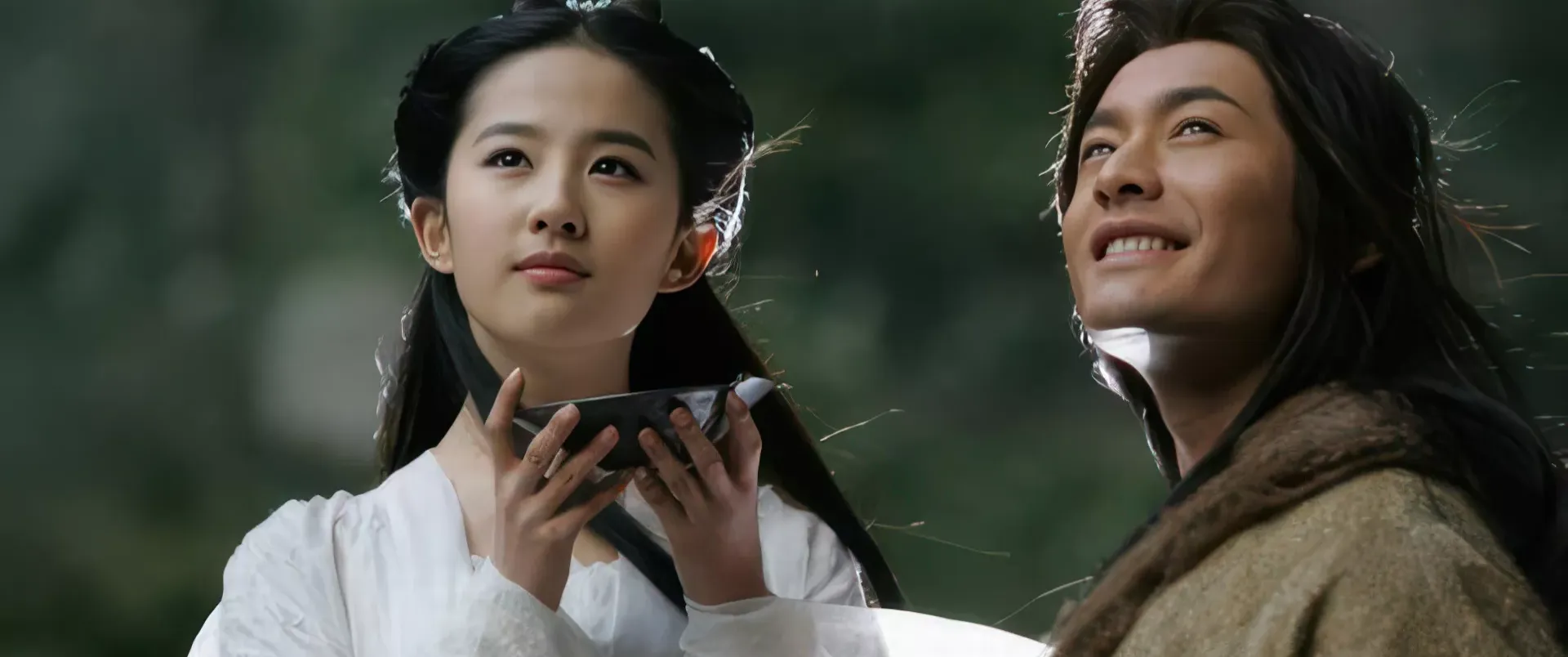
Just then the faint clip-clop of hooves came from beyond the valley mouth. The five men exchanged a glance and all turned to watch the entrance. The hoofbeats came quick and light, nearer and nearer, and black and white flashed together at the valley mouth: a black donkey came racing in, carrying a maiden dressed all in white. Yang Guo saw her from afar and went cold. It’s not Aunt! Could it be another of their helpers? The maiden rode to within a few dozen feet of the five men and reined in her donkey. She swept a cold glance over them all, her face full of contempt, as if they were beneath speaking to.
Ji Qingxu shouted, “Well, girl, who’d have thought you’d have the nerve to show up? Call all your helpers out.” The maiden gave a cold laugh and, with a swish, drew from her waist a curved dao, slender and thin as a crescent moon, its silver gleam dazzling the eye. “There are only the five of us here,” said Ji Qingxu. “When are your helpers coming? We’re not minded to wait long.” The maiden raised her dao. “This is my helper,” she said. The edge cut through the air with a low hum.
Her words startled all six of them. The five were startled that a lone girl should be so bold as to come without a single helper to fight five skilled fighters of the wulin.14 But Yang Guo was crushed with disappointment and grief. He had been certain he would find Xiaolongnü waiting here, and now this “beautiful maiden in white” had turned out to be someone else entirely. A choking surge rose suddenly in his chest, more than he could bear, and he let out a wail and burst into loud sobs.
His crying startled the six of them in turn, but when they saw it was only a cowherd on the hillside grazing his beast, none of them paid him any mind. Some country brat who had been hard done by, they supposed, having a cry. Ji Qingxu pointed at the one surnamed Han. “This is Hero Han of the Beggars’ Guild.” He pointed at the one surnamed Chen. “This is Hero Chen of the Beggars’ Guild.” Then he pointed at “Shen shishu”. “Our shishu, Daoist Elder Shen Zhifan.15 You’ve met him before.” The maiden ignored them completely. Her cold gaze swept back and forth over their five faces as though they were not there at all.
Footnotes
-
炕 – kàng. Traditional heated brick bed platform common in northern China, built with a flue system that channels heat from a cooking stove or fire underneath. ↩
-
两 – liǎng. Traditional Chinese unit of weight, one-sixteenth of a jin. Also the unit in which silver was reckoned. Approximately 37 grams in the Song dynasty. See Wuxia Wiki. ↩
-
轻功 – qīnggōng. Literally lightness skill. The martial art of body lightness; practitioners leap great heights and move with extraordinary speed. See Wuxia Wiki. ↩
-
师兄 – shīxiōng. Male senior. Both apprenticed to the same shifu. Shī means teacher. Xiōng means older brother. See Wuxia Wiki. ↩
-
终南山 – Zhōngnán Shān. Mount Zhongnan, south of Xi’an in Shaanxi, long sacred to Daoism; seat of the Quanzhen Order’s Chongyang Palace and of the Ancient Tomb. See Wuxia Wiki. ↩
-
重阳宫 – Chóngyáng Gōng. Chongyang Palace, chief temple of the Quanzhen Order on Mount Zhongnan. See Wuxia Wiki. ↩
-
全真教 – Quánzhēn Jiào. The Quanzhen Order, the Daoist order founded by Wang Chongyang and seated at the Chongyang Palace on Mount Zhongnan. Its seven senior disciples are known as the Seven Masters of Quanzhen. See Wuxia Wiki. ↩
-
里 – lǐ. Traditional Chinese unit of distance, approximately 500 metres or a third of a mile. ↩
-
辰初 – chénchū. The start of the hour of Chen, about seven in the morning. The day was divided into twelve shichen, each named for one of the Earthly Branches. See Wuxia Wiki. ↩
-
斤 – jīn. Traditional Chinese unit of weight, approximately 500 grams or 1.1 pounds. See Wuxia Wiki. ↩
-
内力 – nèilì. Literally internal power. The kinetic manifestation of qi; the fundamental energy that martial artists cultivate and wield. See Wuxia Wiki. ↩
-
师叔 – shīshū. Junior lineage uncle. Shidi or shimei of one’s shifu. Shī means teacher. Shū means father’s younger brother. See Wuxia Wiki. ↩
-
丐帮 – Gàibāng. Largest martial arts organisation in the jianghu, continued from LOCH era. See Wuxia Wiki. ↩
-
武林 – wǔlín. Literally martial forest. Those who actually practise, teach or study martial arts. Wulin sits inside the jianghu and is narrower than it: every member of the wulin belongs to the jianghu, but a pedlar or physician of the jianghu who never trained is no part of the wulin. See Wuxia Wiki. ↩
-
道长 – dàozhǎng. Daoist Elder: the courtesy title a speaker offers a Daoist. See Wuxia Wiki. ↩