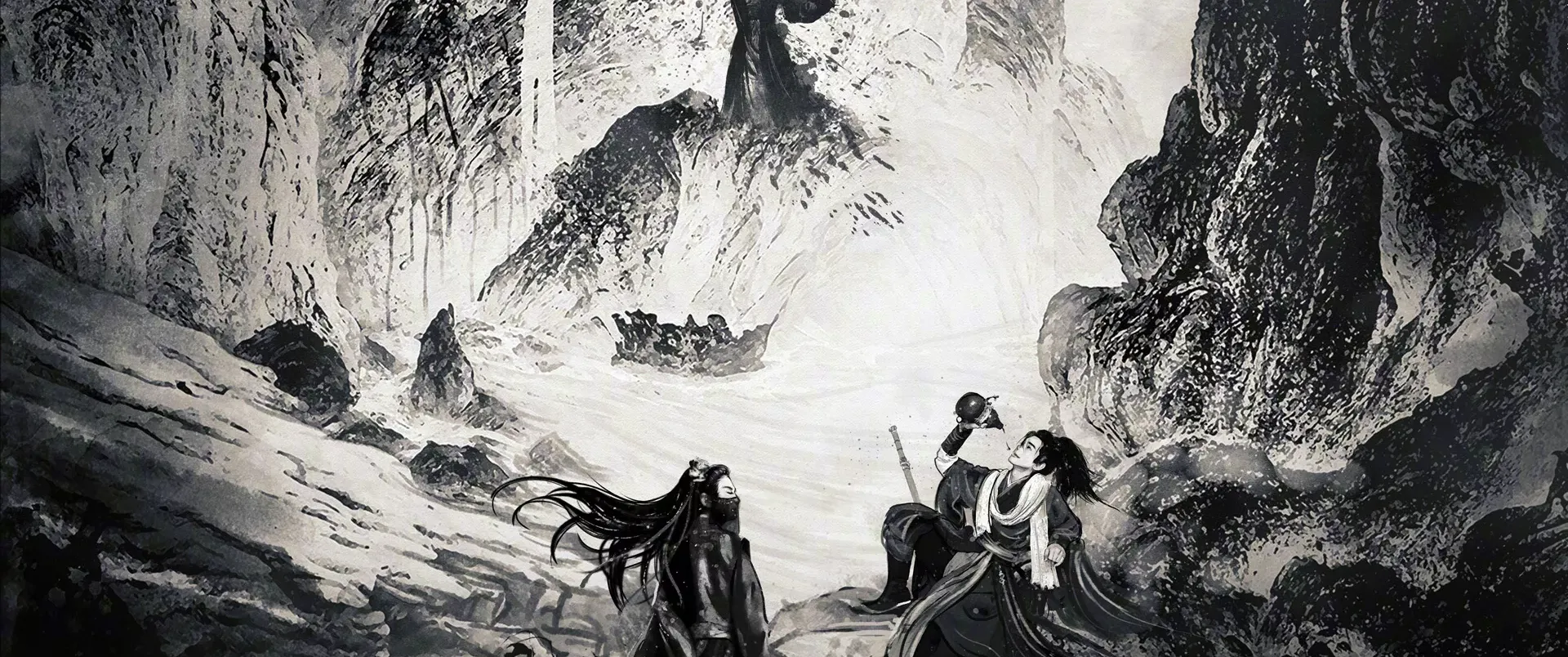
The Northern Hengshan School (simplified: 恒山派, traditional: 恆山派, pinyin: Héngshān Pài, jyutping: hang4 saan1 paai3) is a Buddhist nunnery martial arts faction located on Mount Heng in Shanxi Province, one of China’s Five Sacred Mountains. The school is a member of the Five Mountains Sword Alliance and is distinguished by its traditionally all-female membership and elegant swordplay techniques.
The school is led by the renowned Three Dings (恒山三定)—Dingxian, Dingjing, and Dingyi—three senior nuns who collectively govern the faction. Under their leadership, the school maintained its independence and traditions despite the political machinations of Zuo Lengchan and Yue Buqun during the turbulent period of the Five Mountains unification conflict.
The school’s unique character as a Buddhist nunnery creates a distinctive atmosphere emphasising compassion, non-violence, and spiritual cultivation alongside martial training. Despite their religious vows, the Hengshan nuns prove formidable warriors when defending the innocent or resisting oppression, demonstrating that compassion and martial prowess need not be mutually exclusive.
Origins and history
Founding traditions
The Northern Hengshan School’s origins are rooted in the Buddhist monastic traditions of Mount Heng, one of China’s Five Sacred Mountains and a major centre of Buddhist worship. The school developed as a martial arts institution within this religious framework, training generations of female practitioners in both spiritual cultivation and combat techniques.
The school’s connection to the Five Sacred Mountains naturally led to its membership in the Five Mountains Sword Alliance, alongside Huashan School, Songshan School, Taishan School, and the Southern Hengshan School. Despite sharing similar names (both derived from mountains named “Hengshan”), the Northern and Southern schools are entirely separate institutions with different traditions, techniques, and membership compositions.
Buddhist foundations
Unlike most martial arts schools that focus primarily on combat training, the Northern Hengshan School integrates Buddhist principles into every aspect of its curriculum. Disciples receive instruction in sutras, meditation, and ethical conduct alongside sword techniques and formation fighting. This holistic approach produces practitioners who combine martial effectiveness with spiritual depth and moral clarity.
The school’s Buddhist character influences its approach to conflict, emphasising defensive techniques and non-lethal methods where possible. However, the nuns recognise that compassion sometimes requires forceful action to protect the innocent, and they do not hesitate to employ lethal force when circumstances demand it.
All-female tradition
The Northern Hengshan School maintains a tradition of exclusively female leadership and predominantly female membership, reflecting its origins as a Buddhist nunnery. Most disciples are ordained nuns who have taken vows of celibacy and renounced worldly attachments, though the school also accepts secular female disciples who participate in martial training without taking religious vows.
Members like Zheng E and Qin Juan represent this secular contingent, serving the school loyally whilst maintaining their lay status. These secular members typically handle tasks that might be inappropriate for ordained nuns whilst receiving full martial arts instruction and participating in school activities.
This all-female tradition would be broken only under extraordinary circumstances, when Dingxian appointed Linghu Chong as her successor—the first male leader in the school’s history.
The Three Dings leadership
Dingxian — Leader and Sage
Dingxian (定闲) served as the overall leader of the Northern Hengshan School and the most senior of the Three Dings. She was renowned for her wisdom, compassion, and exceptional insight, appearing outwardly like an ordinary old nun whilst possessing profound understanding of both martial arts and human nature.
Dingxian’s leadership style emphasised thoughtful deliberation and moral clarity. She could perceive the bigger picture in complex situations and make difficult decisions that served the greater good. Her willingness to look beyond traditional orthodoxy enabled her to recognise Linghu Chong’s genuine character despite his association with the Sun Moon Holy Order, and to intercede on behalf of Ren Yingying when she was imprisoned at Shaolin Temple.
Her most momentous decision came when she appointed Linghu Chong as her successor, breaking centuries of tradition by naming a man—and one associated with the “Demon Cult”—as leader of the all-female school. This choice demonstrated her understanding that preserving the school’s true spirit mattered more than maintaining superficial traditions.
Dingjing — Martial Elder
Dingjing (定静) was one of the Three Dings and a respected elder of the Northern Hengshan School. She was responsible for training many disciples of the Yi generation and was known for her dedication to the school’s martial traditions.
Dingjing met her end during an attack orchestrated by Zuo Lengchan, who sent subordinates disguised as Sun Moon Holy Order members to assault the Three Dings. She was killed during this ambush, though Linghu Chong’s timely intervention saved Dingxian and Dingyi from the same fate.
Her death served as a grim reminder of the ruthlessness underlying the Five Mountains unification effort, demonstrating that Zuo Lengchan would stop at nothing to achieve his ambitions—including murdering respected Buddhist nuns whilst framing rival factions for the crime.
Dingyi — Martial Enforcer
Dingyi (定逸) was the most martially inclined of the Three Dings, known for her straightforward temperament and willingness to take direct action. Unlike her more contemplative sisters, Dingyi favoured decisive responses to challenges and was quick to defend the school’s honour.
Along with Dingxian, Dingyi travelled to Shaolin Temple to intercede on behalf of Ren Yingying, demonstrating that even the orthodox Northern Hengshan School could recognise injustice regardless of factional boundaries. Her willingness to challenge the powerful Shaolin establishment showed the courage that complemented her martial abilities.
Both Dingxian and Dingyi were ultimately killed by Yue Buqun during the Five Mountains Sword Schools merger ceremony on Mount Song. Yue Buqun used needles to pierce their hearts, leaving only tiny marks that made their deaths appear natural. This treacherous assassination eliminated two of the three obstacles to his plans for dominating the unified Five Mountains School.
Organisation and membership
Generational naming system
The Northern Hengshan School organises its disciples through a generational naming system based on Buddhist practice. The current leadership generation uses names beginning with “Ding” (定, meaning “stability” or “concentration”), whilst their disciples use names beginning with “Yi” (仪, meaning “deportment” or “ceremony”).
This naming convention serves both practical and spiritual purposes—it immediately identifies a disciple’s generational rank whilst reminding practitioners of Buddhist virtues they should embody. The progression from “concentration” to “deportment” suggests the school’s educational philosophy: first achieve inner stability through meditation and training, then manifest proper conduct in the world.
The Ding Generation (Leadership):
The Yi Generation (Disciples):
- Yilin (仪琳) — Known for her pure heart
- Yiqing (仪清) — Second senior, eventual successor
- Yihe (仪和) — Senior disciple
- Yiwen (仪文) — Disciple of Dingxian
- Yizhen (仪真) — Disciple of Dingjing
- Yizhi (仪质) — Disciple of Dingjing
- Yiling (仪灵) — Yi generation member
Ordained and secular members
The school distinguishes between ordained nuns who have taken full Buddhist vows and secular members who train in martial arts without religious commitment. Ordained members follow monastic regulations including vegetarianism, celibacy, and daily religious observances, whilst secular members have greater freedom in their personal lives.
Notable Secular Members:
Secular members typically handle tasks that might compromise ordained nuns’ vows or involve worldly affairs inappropriate for monastics. However, both ordained and secular members train together in martial arts and fight alongside each other when the school faces threats.
Linghu Chong’s unprecedented leadership
The appointment of Linghu Chong as leader marked an extraordinary break with tradition. As a man, former member of Huashan School, and someone publicly associated with the Sun Moon Holy Order, he seemed an impossible choice for leading a Buddhist nunnery.
However, Dingxian’s wisdom saw past these superficial obstacles. She recognised that Linghu Chong possessed the character, martial ability, and political independence necessary to protect the school from Zuo Lengchan’s ambitions and Yue Buqun’s schemes. His lack of connection to orthodox faction politics meant he would prioritise the school’s genuine interests rather than external alliances.
Linghu Chong’s leadership proved effective precisely because of his unconventional background. His mastery of the Nine Swords of Dugu and connections to both orthodox and heterodox factions gave the school powerful protection, whilst his genuine respect for the nuns’ traditions ensured he did not attempt to transform the school’s character.
Before the Five Mountains alliance ceremony, Dingxian wrote a blood letter clearly naming Yiqing as her chosen successor after Linghu Chong, ensuring the school would eventually return to female leadership whilst preserving continuity with her wishes.
Martial arts
Hengshan Swordplay
Hengshan Swordplay (恒山剑法) is the Northern Hengshan School’s signature sword technique system, characterised by elegant movements that reflect both feminine grace and Buddhist principles of non-aggression. The techniques emphasise precision, timing, and defensive capability over raw power or aggressive attack.
The style’s philosophical foundation draws from Buddhist concepts of compassion and non-violence, creating techniques designed to neutralise threats with minimal harm where possible. However, when lethal force becomes necessary, Hengshan Swordplay includes devastating techniques capable of ending threats decisively.
Signature Techniques:
- Golden Needle Crossing the Tribulation (金针渡劫) — Precision strike technique
- Returning Geese Formation — Group coordination technique
- Dharma Protector Stance — Defensive positioning
The swordplay’s elegant aesthetic reflects its Buddhist origins whilst its practical effectiveness demonstrates that spiritual cultivation enhances rather than diminishes martial capability.
Ten Thousand Flowers Sword Formation
The Ten Thousand Flowers Sword Formation (万花剑阵) represents the Northern Hengshan School’s most sophisticated group combat technique. This coordinated formation enables multiple practitioners to fight as a unified force, multiplying their collective effectiveness far beyond what individual skills would suggest.
The formation requires extensive practice to execute properly, as each participant must coordinate precisely with others whilst maintaining awareness of the overall tactical situation. Yiqing demonstrated particular mastery of this technique, using strategic thinking to direct the formation during critical moments such as the rescue mission at Longquan Sword Forge Valley.
The formation’s name evokes the beauty of massed flowers whilst its combat application creates overlapping zones of attack and defence that can overwhelm opponents through coordinated pressure rather than individual superiority.
Buddhist influence on martial philosophy
The school’s Buddhist foundation influences every aspect of its martial training, from technique selection to combat ethics. Practitioners learn to fight without hatred, to show mercy where possible, and to use violence only in defence of the innocent or when other options have been exhausted.
This philosophical framework produces warriors who remain psychologically healthy despite engaging in lethal combat—their actions stem from compassion rather than aggression, protecting their minds from the corruption that often affects martial artists who kill without moral framework.
The integration of meditation and combat training also provides practical benefits: practitioners develop exceptional focus, emotional control, and the ability to remain calm under pressure. These qualities often prove decisive in combat situations where panic or anger might otherwise lead to defeat.
History
Five Mountains unification conflict
The Northern Hengshan School found itself caught between powerful forces during the Five Mountains unification conflict. Zuo Lengchan of Songshan School sought to merge all five schools under his leadership, whilst Yue Buqun of Huashan School pursued his own ambitions within this framework.
The Three Dings opposed unification, recognising that it would effectively destroy their school’s independence and traditions. However, their relatively small martial strength made direct opposition dangerous. Zuo Lengchan responded to their resistance with characteristic ruthlessness, orchestrating the attack that killed Dingjing whilst framing the Sun Moon Holy Order.
When Linghu Chong intervened to save Dingxian and Dingyi, his actions demonstrated the unexpected assistance the school would receive from outside orthodox circles—assistance that ultimately proved more reliable than supposed allies within the Five Mountains Alliance.
Attack on the Three Dings
The coordinated attack on the Three Dings represented one of Zuo Lengchan’s most treacherous schemes. He dispatched subordinates disguised as Sun Moon Holy Order members to assault the Hengshan leaders, simultaneously eliminating opposition to unification whilst creating apparent justification for conflict with the heterodox faction.
Dingjing fell during this attack, but Linghu Chong’s timely arrival saved Dingxian and Dingyi. His willingness to protect them despite having no formal connection to their school—and despite being under suspicion for Sun Moon Order associations—impressed Dingxian deeply and influenced her later decision to name him her successor.
The attack also revealed the true nature of the unification effort: not a genuine alliance among equals but a power grab that treated member schools as obstacles rather than partners.
Dingxian’s final wisdom
Dingxian’s appointment of Linghu Chong as her successor demonstrated the profound wisdom that characterised her leadership. She recognised several crucial factors that others might have missed:
Practical Considerations:
- Linghu Chong’s martial abilities could protect the school from external threats
- His lack of factional allegiance meant he would prioritise school interests
- His connections to both orthodox and heterodox figures provided diplomatic flexibility
- His genuine respect for the school’s traditions ensured cultural continuity
Moral Recognition:
- His assistance to the school had been selfless and effective
- His character proved reliable despite external criticism
- His willingness to help Ren Yingying showed compassion transcending factional boundaries
Dingxian’s decision ultimately proved correct: under Linghu Chong’s protection, the school maintained its independence during the unification crisis and preserved its traditions for future generations.
The Five Mountains merger ceremony
At the Five Mountains merger ceremony on Mount Song, the Northern Hengshan School—now led by Linghu Chong—was one of only three schools that opposed unification, alongside Taishan School under Tianmen Taoist and Southern Hengshan School under Mo Da.
The ceremony revealed the depths of corruption within orthodox circles. Yue Buqun used the occasion to assassinate both Dingxian and Dingyi, eliminating two of the most respected voices opposing his ambitions. His method—needles that left only tiny marks—made their deaths appear natural, concealing his treachery.
Despite these losses, the Northern Hengshan School survived the unification crisis intact, with Yiqing eventually assuming leadership as Dingxian had designated. The school’s preservation demonstrated that principled resistance could succeed even against overwhelming political pressure, provided wise leadership prepared for adverse outcomes.
Behind the scenes
The Northern Hengshan School serves important thematic functions within Laughing in the Wind, exploring questions about gender, religion, and the relationship between spiritual values and martial effectiveness.
Gender and martial arts
The school’s all-female tradition challenges assumptions that martial excellence requires masculine qualities. The Hengshan nuns demonstrate that women can achieve formidable combat capabilities whilst maintaining distinctively feminine characteristics—their elegance and compassion are strengths rather than weaknesses.
Jin Yong’s portrayal avoids both dismissing female martial artists and making them carbon copies of male fighters. The Hengshan nuns fight in ways that reflect their training, values, and physical characteristics, creating a distinctive martial aesthetic that proves effective in its own right.
The appointment of Linghu Chong as leader adds complexity to this exploration. Rather than suggesting that men are necessary for effective leadership, the circumstances demonstrate that extreme situations may require unconventional solutions. Dingxian’s choice reflects practical wisdom rather than acknowledgment of male superiority, and her designation of Yiqing as ultimate successor ensures the school returns to female leadership.
Religion and violence
The Northern Hengshan School explores tensions between religious ideals of non-violence and the practical necessities of a dangerous world. The nuns’ Buddhist vows emphasise compassion and the avoidance of harm, yet they train extensively in lethal combat techniques and use them when necessary.
Jin Yong resolves this apparent contradiction through careful attention to motivation and context. The nuns fight to protect the innocent and resist oppression, not for personal gain or glory. Their violence is defensive rather than aggressive, reluctant rather than eager. This framework allows them to maintain spiritual integrity whilst acknowledging that passive acceptance of evil may itself be a moral failing.
Orthodox hypocrisy
The school’s treatment by supposed allies highlights a major theme of Laughing in the Wind: the corruption hiding behind orthodox respectability. The nuns are attacked and murdered by leaders of their own alliance—Zuo Lengchan and Yue Buqun—whilst receiving assistance from someone associated with the “Demon Cult.”
This inversion of expectations challenges readers to question easy moral categories. The orthodox factions prove more dangerous to the Hengshan nuns than the heterodox faction ever was, suggesting that proclaimed values matter less than actual behaviour in determining moral worth.
Portrayals
The Northern Hengshan School has been featured in various adaptations of Laughing in the Wind:
Television Series:
- 1984 series — Early TVB portrayal of the Three Dings
- 1996 series — Taiwanese adaptation
- 2000 series — Focus on Yilin’s character
- 2001 series — Detailed portrayal of school politics
- 2013 series — Modern reinterpretation
- 2018 series — Most recent adaptation
Most adaptations emphasise the contrast between the nuns’ gentle demeanour and their martial capabilities, whilst exploring Yilin’s character as representative of the school’s pure-hearted traditions.
See also
- Laughing in the Wind factions
- Jin Yong factions
- Five Mountains Sword Alliance
- Southern Hengshan School
- Dingxian
- Linghu Chong
- Yilin
External links
- Northern Hengshan School (Chinese) on Baidu Baike
- Mount Heng (Shanxi) on Wikipedia