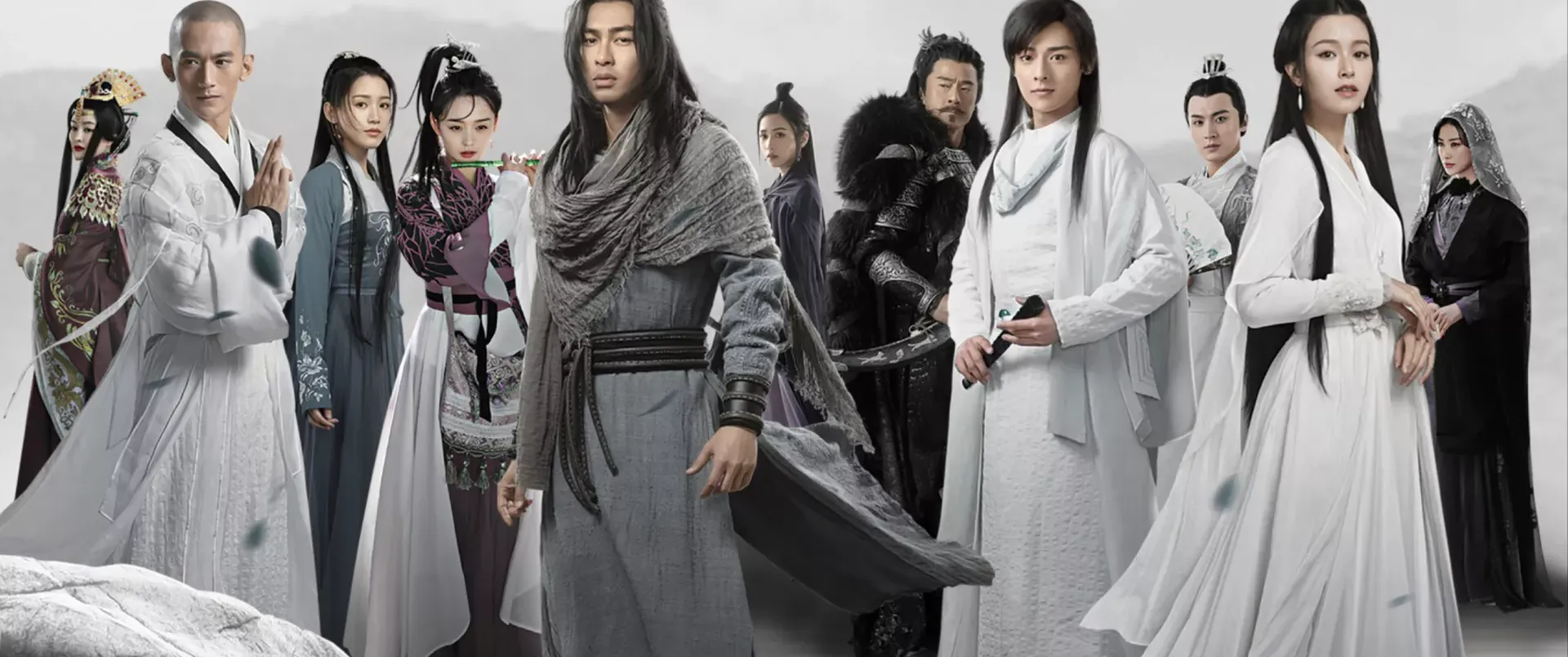
Gathering of Ten Thousand Immortals (simplified: 万仙大会, traditional: 萬仙大會, pinyin: Wànxiān Dàhuì) was a clandestine martial arts assembly organised by the Alliance of the Thirty-Six Caves and Seventy-Two Islands to overthrow Tianshan Child Granny’s despotic rule. The gathering took place on Piaomiao Peak1 in the Tianshan Mountains on the second day of the fifth month in 1093, marking the most significant rebellion attempt against Lingjiu Palace’s dominion over the unorthodox martial arts world.
Background
Thirty years of subjugation
The Alliance of the Thirty-Six Caves and Seventy-Two Islands had endured three decades under Tianshan Child Granny’s tyrannical control through the Mark of Life and Death. This mystical constraint forced the alliance leaders to deliver tribute regularly, transforming proud martial artists into reluctant vassals. The Lingjiu Palace’s dominance created a powder keg of resentment among factions that had once roamed the jianghu2 freely.
The thirty-year cycle conspiracy
Wu Laoda, recognising the cyclical nature of Tianshan Child Granny’s rejuvenation process, orchestrated an elaborate coordination system spanning three decades. Secret signals and coded messages passed between caves and islands, building toward this single moment when their oppressor would be most vulnerable. The conspiracy demonstrated remarkable patience and organisation among typically fractious unorthodox factions.
Window of opportunity
The rebellion coincided with Tianshan Child Granny’s third rejuvenation cycle, during which her martial powers temporarily diminished to those of an ordinary person. This biological vulnerability created the only feasible window for rebellion—a fact known only to the most senior alliance members who had observed previous cycles.
The secret assembly
Strategic location selection
The conspirators chose Piaomiao Peak for its natural defensive advantages and symbolic significance. The peak’s ethereal mists provided concealment, while its association with immortal cultivation resonated with the gathering’s grandiose name. The location’s remoteness ensured privacy for their treasonous discussions, yet remained accessible to leaders travelling from across the jianghu.
Coordination through coded systems
The alliance employed intricate signalling methods developed over thirty years of preparation. Poison-laced tokens, secret hand signals, and predetermined meeting points allowed over a hundred faction leaders to converge without alerting Lingjiu Palace spies. The sophistication of their communication network revealed the depth of planning behind the rebellion.
Leadership hierarchy
Wu Laoda emerged as the primary organiser, leveraging his reputation and connections to unite the disparate factions. Sang Tugong of Bilin Cave in western Sichuan and Duanmu Yuan, a prominent island leader, served as key lieutenants. The gathering represented the most comprehensive alliance of unorthodox martial artists in decades.
Unexpected intrusion
Murong Fu’s arrival
Murong Fu and his retainers stumbled upon the secret assembly while pursuing their own agenda in the Tianshan region. Their accidental discovery transformed a simple rebellion into a complex three-way confrontation, with political ambitions intersecting with revolutionary plans.
Immediate hostility
The alliance members, viewing any outsiders as potential Lingjiu Palace spies, immediately moved to eliminate the intruders. Their paranoia, justified by years of oppression, prevented any possibility of peaceful explanation or negotiation.
Martial confrontations and tactical analysis
Opening assault: Poisoned needle barrage
Sang Tugong initiated combat using his signature ox-hair needles, each coated with deadly toxins cultivated in Bilin Cave’s poisonous environment. The attack demonstrated the unorthodox factions’ preference for lethal efficiency over honourable duelling. His ground-rolling needles created a carpet of death, forcing the intruders into defensive positions.
Deng Baichuan’s defensive mastery
Deng Baichuan responded with his Stone-shattering Heaven-shaking Mixed Origin Palm, a technique combining explosive power with defensive versatility. His thunderous palm strikes scattered the incoming projectiles while creating protective air currents for his companions. The display revealed the high level of martial cultivation among Murong Fu’s retainers.
Gongye Gan’s tactical innovation
Gongye Gan demonstrated combat adaptability by overturning the alliance’s poison cauldron, creating a toxic smokescreen that disrupted their coordination. This improvised tactic showed how experienced warriors could transform environmental hazards into strategic advantages.
Stars-shifting mastery
Murong Fu showcased the legendary Stars-shifting Skill by redirecting Sang Tugong’s ground-rolling needles back at their originator. The technique’s fundamental principle—using an opponent’s force against them—proved devastatingly effective as the poisoned needles embedded themselves in Sang Tugong’s buttocks, demonstrating the skill’s capacity to turn any attack into self-destruction.
Duanmu Yuan’s mystical techniques
Duanmu Yuan employed the Five Pecks of Rice Power, a technique rooted in ancient Taoist practices. Murong Fu countered by targeting the bronze talisman essential to the technique’s operation, using his encyclopaedic martial knowledge to identify and exploit specific weaknesses in seemingly invincible abilities.
Wang Yuyan’s tactical guidance
Wang Yuyan provided crucial strategic analysis, guiding Duan Yu through the theoretical applications of Lingbo Steps. Her extensive martial knowledge, combined with Duan Yu’s natural talent, enabled him to navigate the chaotic battlefield using footwork techniques derived from the Book of Changes.
Strategic developments
Murong Fu’s recruitment attempt
Mid-battle, Murong Fu revealed his true ambitions by attempting to recruit the alliance members for his restoration plans. His political acumen recognised the value of controlling numerous unorthodox factions, even as combat raged around him. This calculated opportunism demonstrated his willingness to exploit any situation for political gain.
Power dynamics revealed
The confrontations established a clear hierarchy of martial abilities. Murong Fu’s superior cultivation and tactical knowledge dominated the alliance members, while his retainers proved equally capable against multiple opponents. The battle effectively demonstrated why the Murong family commanded respect throughout the jianghu.
Alliance coordination breakdown
The unexpected combat disrupted the alliance’s carefully planned coordination. Leaders found themselves fighting individual battles rather than executing their rehearsed rebellion strategy, revealing the fragility of their thirty-year conspiracy when faced with unforeseen circumstances.
Xuzhu’s intervention and resolution
The crucial rescue
Xuzhu arrived at the critical moment, carrying the weakened Tianshan Child Granny away from the battlefield. His intervention revealed the gathering’s true purpose to all participants, effectively ending both the rebellion and the combat with the alliance members.
Failed revolution
The rebellion collapsed with Tianshan Child Granny’s rescue, leaving the alliance members exposed and vulnerable. Their years of planning crumbled in moments, demonstrating how individual actions could derail even the most elaborate conspiracies.
Continued subjugation
The alliance members returned to their former status as reluctant vassals, their brief taste of rebellion serving only to reinforce their powerlessness. The Mark of Life and Death remained their binding chain, with no prospect of future liberation until Xuzhu eventually mastered the Tianshan Six Yang Palms.
Consequences and aftermath
Immediate repercussions
The failed rebellion left the alliance more tightly controlled than before, with Lingjiu Palace likely implementing additional security measures. The exposure of their thirty-year conspiracy eliminated any element of surprise for future resistance efforts.
Xuzhu’s transformation begins
The event marked the beginning of Xuzhu’s unexpected journey from humble monk to martial arts master. His connection to Tianshan Child Granny would ultimately lead to his inheritance of her position and the liberation of the alliance members.
Murong Fu’s political calculations
Murong Fu’s encounter with the alliance revealed both his ambitions and his methods, establishing him as a significant political player in the jianghu. His willingness to exploit others’ desperation for his own ends foreshadowed his later machinations.
Power vacuum implications
The gathering’s failure maintained the existing power structure, preventing a potential reorganisation of unorthodox martial arts factions that could have altered the jianghu’s political landscape significantly.
Behind the scenes
Literary significance
The Gathering of Ten Thousand Immortals serves multiple narrative functions in Demi-Gods and Semi-Devils. Jin Yong uses the event to demonstrate how individual destiny can interfaction with political movements, as Xuzhu’s accidental involvement transforms both his personal journey and the fate of over a hundred martial arts factions.
Thematic exploration
The failed rebellion exemplifies Jin Yong’s recurring theme that organised resistance often fails while individual moral action succeeds. The alliance’s elaborate planning proves futile, while Xuzhu’s spontaneous compassion ultimately achieves their liberation goals through different means.
Character development catalyst
The event serves as a crucial turning point for multiple characters. Xuzhu begins his transformation from passive monk to active protagonist, Murong Fu reveals his political ambitions, and Duan Yu gains practical combat experience under Wang Yuyan’s guidance.
Martial arts philosophy
Jin Yong uses the confrontations to contrast different approaches to martial arts mastery. The alliance members represent crude, poison-based techniques, Murong Fu embodies refined, scholarly martial arts, and Xuzhu will eventually achieve power through Buddhist compassion rather than ambition.
Historical parallels
The gathering’s structure and failure echo historical peasant rebellions in Chinese history, particularly those that collapsed due to external intervention or internal contradictions. Jin Yong’s academic background in history informs his realistic portrayal of revolutionary movements.
Narrative pacing
The event provides necessary action and conflict while advancing multiple plot threads simultaneously. It efficiently establishes character relationships, demonstrates martial arts abilities, and sets up future developments without feeling forced or artificial.
See also
- Jin Yong events
- Demi-Gods and Semi-Devils events
- Alliance of the Thirty-Six Caves and Seventy-Two Islands – The organizing faction
- Wu Laoda – Primary organizer of the gathering
- Sang Tugong – Bilin Cave leader who initiated the attack
- Tianshan Child Granny – The target of the rebellion
- Mark of Life and Death – The control mechanism
- Lingjiu Palace – Seat of power of Tianshan Child Granny
External links
Footnotes
-
缥缈峰 – Piāomiǎo Fēng. Piaomiao Peak in the Tianshan Mountains, known for its ethereal appearance and strategic location. See Wikipedia. ↩
-
江湖 – jiānghú. The world of martial arts. A sub-society involving all who are related to the martial arts scene. What is jianghu? ↩