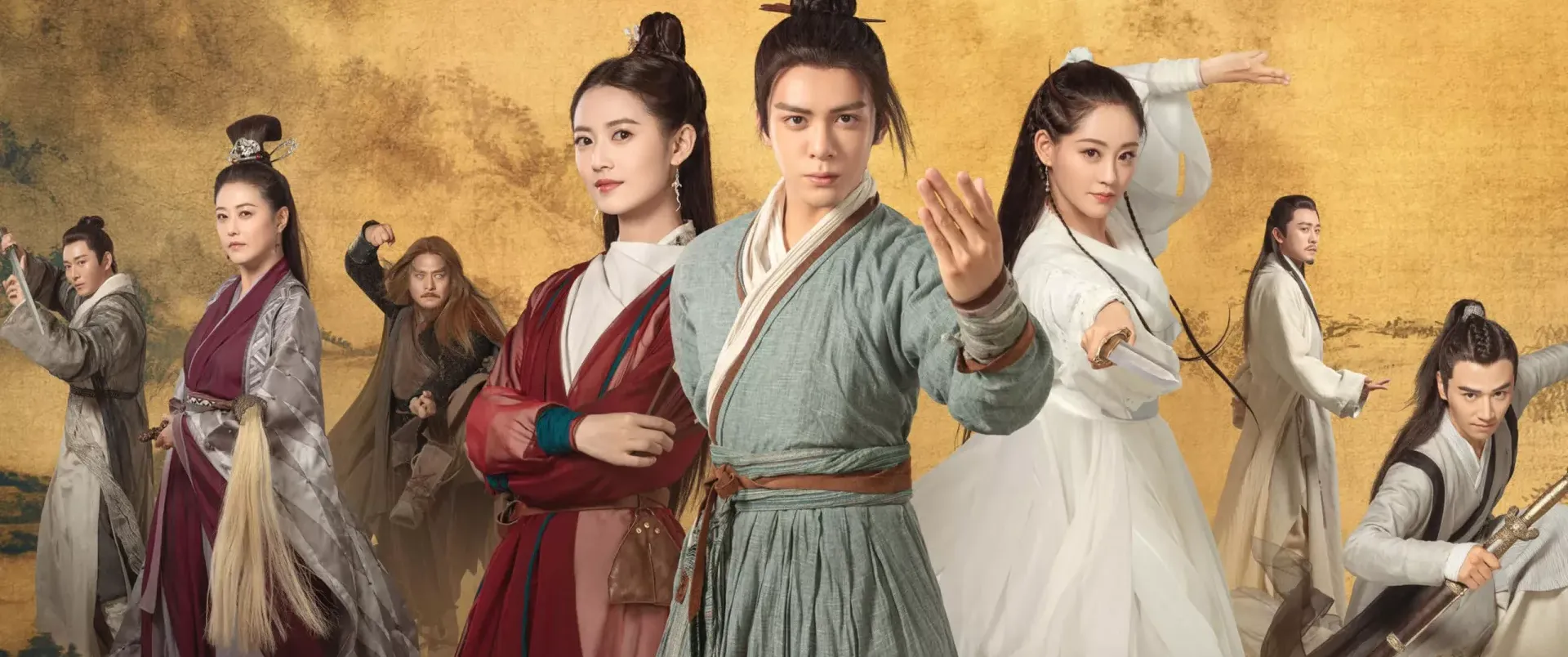
Fan Yao (simplified: 范遥,traditional: 範遙,pinyin: Fàn Yáo, jyutping: faan6 jiu4), also known as Kutoutuo (苦头陀), was the Ming Order Right Envoy and sworn brother of Yang Xiao. Together they were celebrated throughout the jianghu as the Carefree Immortals (逍遥二仙), renowned for their exceptional martial prowess and unconventional methods. Fan Yao undertook one of the most remarkable infiltration missions in wuxia literature, disfiguring his own face and posing as a disfigured, mute toutuo (头陀,Buddhist ascetic) to penetrate the Prince of Ruyang’s residence, where he remained for nearly twenty years gathering intelligence on the Yuan court’s schemes against the orthodox jianghu. Zhang Wuji, the third Ming Order Patriarch, regarded Fan Yao as the most versatile martial artist among the organisation’s leadership, capable of imitating techniques from numerous sects with uncanny accuracy.
Early life and career
Little is recorded of Fan Yao’s origins before his ascent to prominence within the Ming Order. What is known suggests he emerged during the tumultuous final decades of Yuan Dynasty rule, when Han resistance movements operated in the shadows of Mongol occupation. His martial arts foundation appears to have been exceptionally broad, drawing from both orthodox and unorthodox lineages, which would later prove instrumental in his infiltration work.
Fan Yao rose to become the Right Envoy of the Ming Order, second only to the Patriarch in the organisation’s hierarchy. This position placed him alongside Yang Xiao, the Left Envoy, as one of the two highest-ranking officers beneath the Patriarch Yang Dingtian. The bond between Fan Yao and Yang Xiao transcended mere comradeship: they became sworn brothers, united by shared purpose and mutual respect for each other’s abilities. Their partnership earned them the epithet “Carefree Immortals”, a reference both to their martial excellence and their reputation for operating beyond conventional constraints.
A defining moment in Fan Yao’s early career was his unrequited love for Daiqisi, who would later become known as the Purple Mantle Dragon King (紫衫龙王). Daiqisi was celebrated as the foremost beauty of her generation within the jianghu, and Fan Yao’s devotion to her was widely acknowledged. However, Daiqisi ultimately chose to marry Han Qianye, the Golden Lion, one of the Four Kings of the Ming Order. Rather than harbouring bitterness, Fan Yao accepted this outcome with characteristic grace, maintaining his friendship with both Daiqisi and Han Qianye throughout subsequent decades. This emotional maturity would prove essential to his later sacrifices.
When Patriarch Yang Dingtian mysteriously disappeared during a confrontation with the notorious Cheng Kun, the Ming Order descended into factional chaos. The Four Kings departed to pursue their own paths, the Five散人 (Five Scatterers) could not agree on succession, and the organisation teetered on the brink of collapse. Fan Yao, however, suspected that Cheng Kun’s involvement extended beyond mere personal vendetta: he believed the monk was collaborating with the Yuan court to systematically eliminate Han resistance leaders. This suspicion would shape the next two decades of Fan Yao’s life.
Infiltration of the Prince of Ruyang’s residence
Fan Yao’s decision to infiltrate the Prince of Ruyang’s residence ranks among the most extreme acts of dedication in wuxia literature. Recognising that conventional intelligence-gathering would never penetrate the heavily guarded Mongol stronghold, he resolved to transform himself into someone who could enter without suspicion. The method he chose was as brutal as it was brilliant.
Fan Yao deliberately disfigured his own face beyond recognition, scorching his features until his original appearance was utterly obliterated. He then shaved his head and assumed the guise of a toutuo, a Buddhist ascetic who had taken vows of silence and wandering. To complete the disguise, he posed as mute, communicating only through gestures and written notes when absolutely necessary. He adopted the name Kutoutuo (苦头陀), literally “Bitter Ascetic”, a moniker that reflected both his apparent suffering and his supposed devotion to religious austerities.
Before presenting himself at the Prince’s residence, Fan Yao travelled to the Western Regions, where he performed public martial arts displays designed to attract attention. His demonstrations showcased techniques from multiple schools, creating the impression of a wandering martial artist seeking patronage. These performances achieved their intended effect: a Mongol noble, impressed by Kutoutuo’s abilities, recommended him to the Prince of Ruyang’s household as a potential martial arts instructor.
Once inside the residence, Fan Yao maintained his disguise with extraordinary discipline for nearly twenty years. He never spoke, never revealed his true identity, and never compromised his mission despite the psychological toll of living as a stranger in enemy territory. His primary assignment was to serve as martial arts instructor to Zhao Min, the Prince’s beloved daughter, who displayed exceptional aptitude for martial arts from childhood. Through Zhao Min, Fan Yao gained intimate knowledge of the Yuan court’s strategic planning, military deployments, and schemes against the orthodox martial arts sects.
The success of Fan Yao’s infiltration cannot be overstated. He became one of Zhao Min’s most trusted advisors, accompanying her on critical missions including the infamous Wan’an Temple operation. Throughout this period, he walked a razor’s edge: any slip would have meant not only his own death but the exposure of the Ming Order’s intelligence network. Yet he never wavered, driven by loyalty to his sworn brother Yang Xiao and commitment to the Han resistance cause.
Wan’an Temple and revelation
The Wan’an Temple incident marked the climax of Fan Yao’s infiltration and his dramatic return to the Ming Order. By this point, Zhao Min had orchestrated the capture of leaders from the six major orthodox sects, imprisoning them in Wan’an Temple and forcing them to ingest the Ten Fragrance Softening Powder (十香软筋散), a poison that neutralised their neili. Her objective was to compel these sects to renounce their orthodox status and submit to Yuan authority.
Fan Yao, still disguised as Kutoutuo, accompanied Zhao Min throughout the operation. When Zhang Wuji and Yang Xiao arrived to rescue the imprisoned masters, Fan Yao seized an opportunity to test the young patriarch’s abilities. On a hillock outside the temple, he engaged Zhang Wuji in a martial arts exchange, employing techniques from various sects to probe Zhang Wuji’s adaptability and skill. Satisfied that Zhang Wuji possessed the competence necessary to lead the Ming Order through its current crisis, Fan Yao finally revealed his true identity to his old comrades.
The revelation stunned Yang Xiao and the other Ming Order members. The disfigured, mute Kutoutuo they had encountered as an enemy agent was in fact their long-lost Right Envoy, who had sacrificed his appearance and spent two decades in enemy territory for their cause. The emotional weight of this moment was compounded by Fan Yao’s explanation of his mission and the intelligence he had gathered on Cheng Kun’s collaboration with the Yuan court.
To secure the antidote for the Ten Fragrance Softening Powder from Lu Zhangke, leader of the Huashan School, Fan Yao devised a clever deception. He falsely claimed that Miejue, the abbess of Emei Order, had been his lover in youth, and that Zhou Zhiruo, Miejue’s disciple, was their daughter. This fabrication, while embarrassing to Fan Yao, succeeded in pressuring Lu Zhangke to surrender the antidote, saving the lives of the imprisoned zhangmens. The lie would later cause complications when Zhou Zhiruo and others sought clarification of their supposed relationship, but Fan Yao accepted this burden as necessary for the greater good.
Later events
Following the Wan’an Temple rescue, Fan Yao resumed his duties as Ming Order Right Envoy, working alongside Zhang Wuji to reorganise the fractured organisation. He participated in the mission to Shaolin Temple, where he joined Yan Yuan in digging a tunnel to rescue Kongwen, the abbot who had been wrongly imprisoned by the monastery’s leadership. This operation demonstrated Fan Yao’s continued willingness to undertake dangerous assignments for the sake of justice and alliance-building between the Ming Order and orthodox sects.
At the Slayer of the Lion Festival, a grand martial arts gathering convened to address the threat posed by the Mongol forces, Fan Yao fought Kongzhi, a senior monk of Shaolin. Their duel was interrupted when Kongzhi proposed a formal rematch at Wan’an Temple on the Mid-Autumn Festival. Neither party ultimately attended this scheduled duel, as the pressing concerns of resisting Yuan occupation took precedence over personal martial arts contests. This outcome reflected the shifting priorities of the jianghu during this period: individual honour became secondary to collective survival and resistance.
Fan Yao’s later years left little trace in the surviving record. What is clear is that he continued to serve the Ming Order through the tumultuous period of Yuan collapse and the rise of the Ming Dynasty. His intelligence work and martial arts expertise would have been invaluable during this transitional era, though later accounts do not spell out these subsequent events in detail.
Martial arts
Fan Yao’s martial arts abilities distinguished him as one of the most versatile fighters in the jianghu of his time. Unlike specialists who master a single lineage, Fan Yao cultivated an encyclopaedic knowledge of techniques from numerous schools, both orthodox and unorthodox. This breadth made him uniquely adaptable in combat, capable of responding to any opponent with appropriate countermeasures.
His signature capability was imitation: Fan Yao could observe a technique once and reproduce it with remarkable fidelity. During his confrontation with Zhang Wuji on the hillock, he demonstrated swordplay from the Kunlun School, Emei, Wudang, and other major sects, shifting between styles seamlessly. This talent proved essential during his infiltration, as it allowed him to maintain credibility as a wandering martial artist without revealing any single school’s secret techniques.
Fan Yao’s neigong cultivation was equally formidable. Though the specifics of his neigong (internal work) are not detailed, his ability to sustain his disguise for twenty years while operating in hostile territory suggests exceptional control over his physiological functions. He could suppress his true energy signature, mask his breathing patterns, and maintain the physical bearing of a much older, ascetic monk.
Zhang Wuji, himself a martial arts prodigy who had mastered the Nine Yang Divine Art and Qiankun Dag Nuoyi, explicitly stated that Fan Yao was the best choice among the Ming Order leadership to face unknown opponents. This endorsement from one of the most formidable fighters of his generation speaks to Fan Yao’s reputation for adaptability and tactical brilliance. His fighting style combined orthodox fundamentals with unorthodox applications, making him unpredictable and dangerous even to masters of superior raw power.
Personal life
Fan Yao’s personal life was marked by restraint and unfulfilled longing. His love for Daiqisi remained constant throughout his life, even after her marriage to Han Qianye. Unlike some who grow bitter from unrequited love, Fan Yao maintained respectful friendships with both Daiqisi and Han Qianye, never allowing his personal feelings to compromise their working relationships within the Ming Order.
The psychological toll of his twenty-year infiltration must have been immense. Living as Kutoutuo required Fan Yao to suppress not only his speech but his entire personality, reducing himself to a functional instrument of intelligence-gathering. That he emerged from this ordeal with his sanity intact and his loyalty unbroken testifies to extraordinary mental discipline. The silence he maintained suggests a man who had made peace with solitude as the price of his mission.
Little is known of Fan Yao’s ultimate fate. He presumably continued to serve the Ming Order through the transition from Yuan to Ming rule, though the later fate of the Ming Order as an organisation is itself uncertain in the record. Whether he found peace in retirement, continued clandestine service, or died in the cause remains unclear.
Legacy
Fan Yao’s legacy within the jianghu is complex and somewhat obscured by the secrecy that surrounded his infiltration work. Among the Ming Order leadership, he is remembered as a model of loyalty and self-sacrifice, one whose two decades of service in enemy territory exceeded the demands of ordinary duty. His partnership with Yang Xiao as the Carefree Immortals remains celebrated in Ming Order lore, representing the ideal of sworn brotherhood transcending personal differences.
Within the broader jianghu, Fan Yao’s contributions were necessarily less visible. The intelligence he gathered and the schemes he thwarted remained classified, known only to those with need-to-know access. This invisibility was, of course, precisely the point: effective intelligence work leaves no public record of its successes, only the absence of the disasters that were prevented.
Behind the scenes
Disambiguation
For the Taiwanese wuxia author Fan Yao (范瑶), see Fan Yao (author).
Themes and analysis
Fan Yao does not appear as a writer or scholar within the narrative. His character is defined through action rather than text, embodying themes of sacrifice, loyalty, and identity that run throughout The Heavenly Sword and the Dragon Sabre. Jin Yong uses Fan Yao to explore the question of what one is willing to surrender for a greater cause.
The theme of disfigurement and hidden identity recurs throughout Jin Yong’s works, but Fan Yao’s case is distinctive in its voluntariness. Unlike characters who are scarred by enemies or accident, Fan Yao chose his own mutilation as a strategic necessity. This choice elevates him from victim to agent, transforming physical destruction into an instrument of resistance. His scarred face becomes a symbol of the hidden costs of political struggle, the unseen sacrifices that enable collective survival.
Fan Yao also embodies the tension between individual desire and collective duty. His unrequited love for Daiqisi represents personal longing, while his infiltration mission represents complete subordination of self to cause. That he pursues both with equal commitment suggests a character who refuses to compartmentalise his humanity, even as he undertakes inhuman sacrifices.
In literary terms, Fan Yao occupies an important position in Jin Yong’s gallery of tragic heroes. He shares characteristics with other characters who sacrifice personal happiness for greater causes, yet his story is distinctive in its emphasis on physical transformation and long-term psychological endurance. His eventual reunion with the Ming Order provides narrative closure, but the scars he bears: literal and metaphorical, remain as permanent reminders of his ordeal.
See also
- Ming Order: The organisation Fan Yao served as Right Envoy
- Yang Xiao: Sworn brother and fellow Carefree Immortal
- Daiqisi: The Purple Mantle Dragon King, whom Fan Yao loved
- Zhang Wuji: Third Patriarch of the Ming Order
- Zhao Min: Taught martial arts by Fan Yao during his infiltration
- Cheng Kun: The antagonist whose schemes Fan Yao investigated
- Han Qianye: The Golden Lion, husband of Daiqisi
- Prince of Ruyang: Target of Fan Yao’s infiltration mission
- The Heavenly Sword and the Dragon Sabre: Principal work in which Fan Yao appears