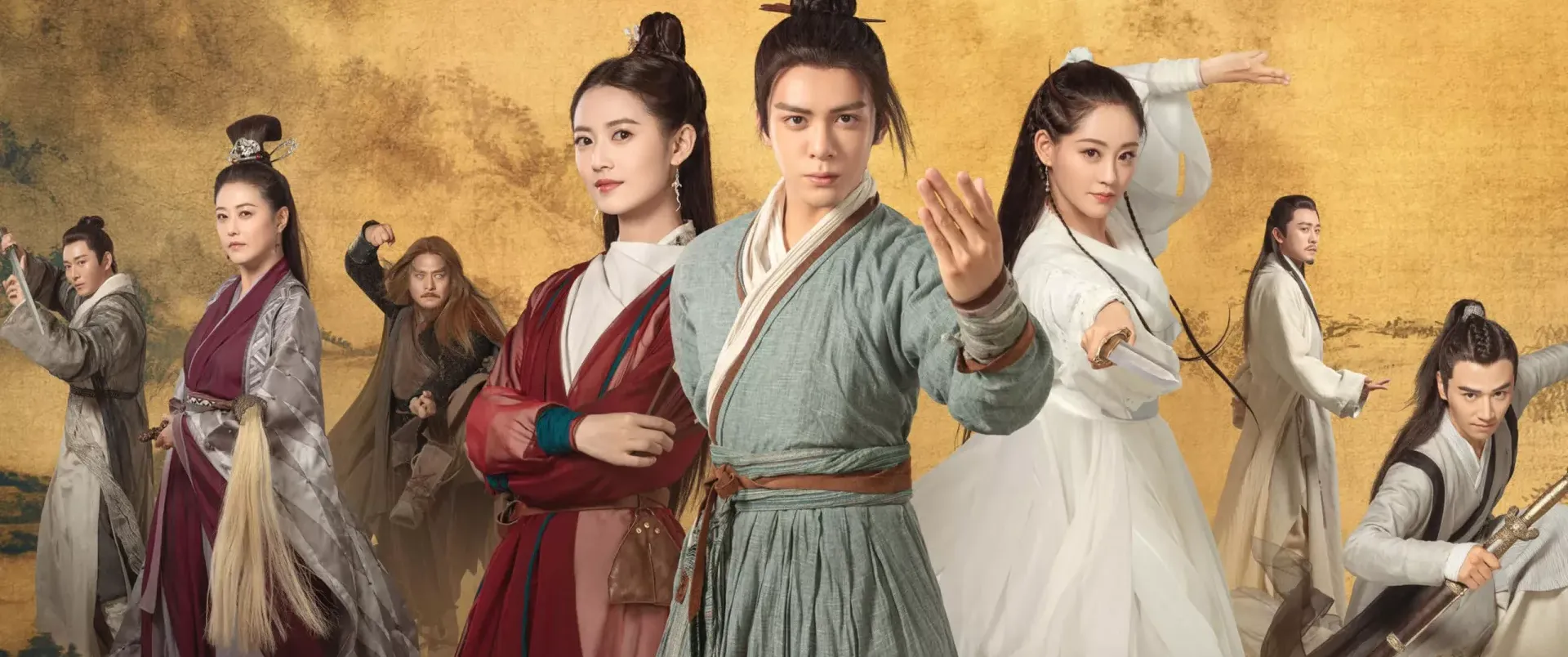
Wuse (simplified: 无色, traditional: 無色, pinyin: Wúsè, jyutping: mou4 sik1), also known as Wuse Chanshi (无色禅师), was the chief monk of the Luohan Hall (罗汉堂, Arhat Hall) at Shaolin Temple during the late Southern Song Dynasty. He was present when Jueyuan died and heard part of the Nine Yang Manual (九阳真经) that Jueyuan recited, which he used to create the Shaolin Nine Yang Skill (少林九阳功). This skill, along with the Wudang and Emei versions created by Zhang Junbao and Guo Xiang, became one of the three major Nine Yang techniques in the jianghu.
Biography
Position at Shaolin Temple
Wuse served as the chief monk of the Luohan Hall (罗汉堂首座) at Shaolin Temple during the late Southern Song Dynasty. This was one of the most important positions in the temple, responsible for training and managing the temple’s martial arts disciples. Along with the abbot Tianming Chanshi (天鸣禅师) and the chief monk of the Bodhidharma Hall, Wuse was part of the temple’s leadership core.
Encounter with Guo Xiang
During The Return of the Condor Heroes, when Guo Xiang came to Shaolin Temple searching for Yang Guo, she met Wuse and they engaged in a brief exchange. Wuse demonstrated his deep understanding of martial arts and his ability to recognise different fighting styles, demonstrating his broad knowledge of the jianghu.
Jueyuan’s death and the Nine Yang Manual
When Jueyuan was protecting his disciples Zhang Junbao (later known as Zhang Sanfeng) and Guo Xiang from the Shaolin monks, he exhausted his neili and was dying. Before his death, Jueyuan recited the complete Nine Yang Manual from memory.
Wuse, along with Zhang Junbao and Guo Xiang, was present and heard Jueyuan’s recitation. However, due to their different temperaments and understanding, each person absorbed different aspects of the teaching:
- Zhang Junbao focused on the soft, yielding aspects, which later formed the foundation of Wudang martial arts
- Guo Xiang absorbed elements that emphasized both hardness and softness, contributing to the creation of Emei martial arts
- Wuse heard a third portion, which he used to create the Shaolin Nine Yang Skill
Creation of the Shaolin Nine Yang Skill
Based on the portion of the Nine Yang Manual that he heard from Jueyuan, Wuse developed the Shaolin Nine Yang Skill. This neili technique became one of Shaolin’s most important martial arts foundations, helping to maintain Shaolin’s position as one of the premier martial arts schools in the jianghu.
However, because Wuse only heard a portion of the complete manual, the Shaolin Nine Yang Skill was incomplete compared to the original Nine Yang Manual. The same was true for the Wudang and Emei versions—each school had only a portion of the complete manual, which is why Zhang Wuji’s discovery of the complete manual more than ninety years later was so significant.
Martial arts abilities
Shaolin Nine Yang Skill
Wuse’s creation of the Shaolin Nine Yang Skill, based on the portion of the Nine Yang Manual he heard from Jueyuan, became one of the foundational neili techniques of the Shaolin Order. This skill, while incomplete compared to the original manual, was still extremely powerful and helped maintain Shaolin’s reputation as a premier martial arts school.
Broad knowledge of martial arts
Wuse demonstrated a deep understanding of various martial arts styles and techniques, able to recognise different fighting methods and their origins. This knowledge was likely accumulated through his position as chief monk of the Luohan Hall, where he would have had extensive exposure to different martial arts practitioners and techniques.
Relationships
With Jueyuan
Wuse was a fellow monk at Shaolin Temple with Jueyuan, though Jueyuan was an obscure librarian monk while Wuse held a prominent position as chief monk of the Luohan Hall. Wuse was present at Jueyuan’s death and heard his recitation of the Nine Yang Manual, which allowed him to preserve a portion of this knowledge for Shaolin.
With Guo Xiang
Wuse met Guo Xiang when she came to Shaolin Temple searching for Yang Guo. They engaged in a brief exchange, during which Wuse demonstrated his knowledge and understanding of martial arts.
Behind the scenes
Legacy and significance
Wuse’s role in preserving a portion of the Nine Yang Manual was crucial for the development of Shaolin martial arts. His creation of the Shaolin Nine Yang Skill, along with the Wudang and Emei versions, demonstrated how the same source material could be interpreted differently based on each practitioner’s understanding and temperament.
The fact that three different schools each developed their own version of the Nine Yang technique from partial knowledge of the original manual shows how knowledge can be preserved even when incomplete, and how different interpretations can lead to distinct but related developments.
Connection between novels
Wuse appears in both The Return of the Condor Heroes and The Heavenly Sword and the Dragon Sabre, serving as a bridge between the two novels. His role in preserving the Shaolin portion of the Nine Yang Manual connects the events of The Return of the Condor Heroes with the later developments in The Heavenly Sword and the Dragon Sabre, where the complete manual is finally rediscovered by Zhang Wuji.
See also
- Jueyuan — The monk who transmitted the Nine Yang Manual
- Zhang Junbao — Jueyuan’s disciple who created the Wudang Nine Yang Power
- Guo Xiang — Jueyuan’s disciple who created the Emei Nine Yang Power
- Shaolin Nine Yang Skill — The technique Wuse created
- Nine Yang Manual — The original manual
- Zhang Wuji — The person who discovered the complete manual