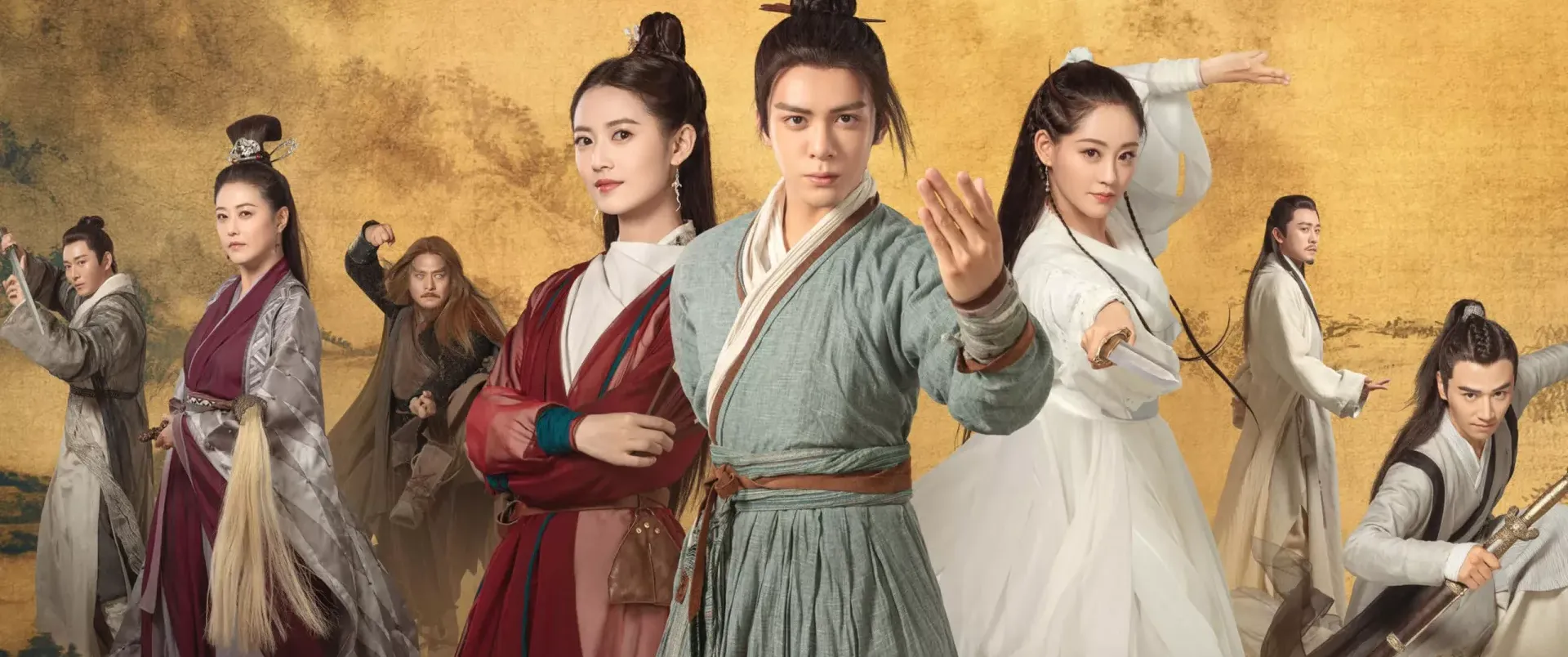
Wu Jingcao (simplified: 吴劲草, traditional: 吳勁草, pinyin: Wú Jìngcǎo, jyutping: ng4 ging6 cou2) was a master blacksmith who served as the leader of the Gold Banner Faction (锐金旗) of the Ming Order after the death of Zhuang Zheng. He was renowned for his unparalleled skill as a swordsmith and was instrumental in reforging the Dragon-slaying Sabre. However, he refused to repair the Heavenly Sword that had killed Zhuang Zheng, demonstrating his loyalty to his predecessor.
Biography
Early life and background
Wu Jingcao originally came from a blacksmith family and had learnt the art of forging metal into sabres and swords. After joining the Ming Order, he rose through the ranks of the Gold Banner Faction, eventually becoming its leader following Zhuang Zheng’s death.
Battle at Bright Peak
During the Six Major Factions’ attack on Bright Peak, Wu Jingcao fought alongside Zhuang Zheng and the Gold Banner Faction in defence of the Order’s headquarters. When Miejue of the Emei Order killed Zhuang Zheng using the Heavenly Sword, Wu Jingcao witnessed the death of his leader and many of his brothers.
During the battle, Wu Jingcao’s left arm was severed by the Heavenly Sword. Despite this grievous injury, he continued to command his forces and fight, demonstrating his unyielding spirit and determination.
After the battle, Zhang Wuji used his Nine Yang Divine Skill (九阳神功) to treat Wu Jingcao’s injuries, saving his life. Wu Jingcao survived the battle, though he had lost his left arm.
Succession as Gold Banner Faction Leader
After Zhuang Zheng’s death, Wu Jingcao succeeded him as the leader of the Gold Banner Faction. Under his leadership, the faction developed new battle formations based on their painful experience fighting the Emei Order. They trained an elite team of five hundred men, each equipped with arrows, javelins, and short hatchets, selected from over twenty thousand members and rigorously trained.
Reforging the Dragon-slaying Sabre
During the Slaying Lion Heroes Assembly at Shaolin Temple, Zhou Zhiruo broke both the Heavenly Sword and the Dragon-slaying Sabre by striking them against each other to reveal the secrets hidden within. After the secrets were recovered, Zhang Wuji asked if the weapons could be repaired.
Wu Jingcao volunteered to attempt the repair, and Yang Xiao confirmed that Wu Jingcao’s skill as a swordsmith was unparalleled in the world. With Zhang Wuji’s approval, Wu Jingcao began the complex task of reforging the legendary weapons.
The forging process
Wu Jingcao required the assistance of Xin Ran, the leader of the Fire Banner Faction, to provide the necessary fire for the forging process. The two coordinated their efforts, with Xin Ran’s faction providing the blast furnace and fuel.
Using only his remaining right arm, Wu Jingcao demonstrated exceptional skill and concentration. He arranged a dozen swords and sabres by his side and watched the fire carefully, testing its strength with different blades as the fire changed colour. When the fire turned from blue to white—the optimal temperature for forging—he quickly grabbed steel pliers with his left hand and joined the broken pieces of the Dragon-slaying Sabre in the fire.
Wu Jingcao worked bare-chested, oblivious to the sparks that landed on his body, completely focused on the task. When two Fire Banner members fainted from pumping the bellows, Xin Ran and the deputy flag leader took over, using their neili to create a powerful blast of air that made the fire blaze high.
The blood sacrifice
As the forging reached its critical moment, Wu Jingcao shouted, “Brother Gu, do it!” The deputy leader of the Gold Banner Faction rushed forward with a naked blade and stabbed Wu Jingcao in the chest. Blood spurted from Wu Jingcao’s chest onto the Dragon-slaying Sabre, creating blue smoke as it met the fire.
This act followed an ancient legend about the master craftsmen Gan Jiang and Mo Xie, who had to jump into the furnace before an extremely sharp weapon could be forged. By allowing his blood to drip on the blade, Wu Jingcao followed this master artisan custom.
After this sacrifice, Wu Jingcao retreated several steps and sat down on the ground, holding the successfully reforged Dragon-slaying Sabre in his right hand. The two broken pieces had been fused together into one piece.
Zhang Wuji examined the wound and found it was shallow and not life-threatening. He immediately applied medicine and bandaged it, asking why Wu Jingcao had subjected himself to such pain. Wu Jingcao replied that it was merely a superficial wound and not worth the leader’s concern.
When Zhang Wuji tested the reforged sabre by cutting two spears, it cut through them smoothly as if they were made of mud, demonstrating that the weapon had been successfully restored to its former sharpness.
Refusal to repair the Heavenly Sword
After successfully reforging the Dragon-slaying Sabre, Wu Jingcao took the two broken pieces of the Heavenly Sword. As he held them, his mind wandered to the moment when Zhuang Zheng and dozens of his brothers had lost their lives under this sword. He could not restrain his tears.
“Jiaozhu,” he said, “This Sword has killed my Brother Zhuang. It has killed not a few of my good brothers. Wu Jingcao hates this Sword to the bone. I can’t fix it. I am ready to accept responsibility for this offense.” His tears poured down like rain.
Zhang Wuji responded, “That only shows Brother Wu’s ‘yi qi’ [loyalty, code of brotherhood]. What offense are you talking about?” He took the two pieces of the broken sword and returned them to the Emei Order.
Personality & traits
Exceptional craftsmanship
Wu Jingcao’s skill as a swordsmith was described as unparalleled in the world. His ability to reforge the legendary Dragon-slaying Sabre demonstrated his mastery of the blacksmith’s art and his deep understanding of metallurgy. His willingness to follow the ancient tradition of blood sacrifice showed his commitment to achieving perfection in his craft.
Unyielding spirit
Despite losing his left arm during the battle at Bright Peak, Wu Jingcao continued to fight and command his forces. His determination and courage in the face of grievous injury demonstrated his unyielding spirit and his commitment to the Ming Order’s cause.
Loyalty and brotherhood
Wu Jingcao’s refusal to repair the Heavenly Sword demonstrated his deep loyalty to Zhuang Zheng and the brothers who had died under that weapon. His tears and his statement that he hated the sword “to the bone” showed the depth of his feelings and his commitment to the code of brotherhood (义气, yi qi).
His loyalty extended beyond personal relationships to the principles of honour and remembrance. By refusing to repair the weapon that had killed his leader and comrades, he demonstrated that some things are more important than technical skill or orders.
Professional dedication
Wu Jingcao’s complete focus on the forging process, working bare-chested and oblivious to sparks landing on his body, demonstrated his professional dedication. His careful attention to the fire’s colour changes and his precise timing showed his expertise and his commitment to achieving the best possible result.
Relationships
With Zhuang Zheng
Wu Jingcao’s relationship with Zhuang Zheng was one of deep loyalty and respect. Zhuang Zheng’s death at the hands of Miejue using the Heavenly Sword had a profound impact on Wu Jingcao, who refused to repair that weapon out of loyalty to his predecessor’s memory.
With the Gold Banner Faction
As the leader of the Gold Banner Faction, Wu Jingcao commanded the respect of his subordinates. He led the faction’s development of new battle formations based on their experience at Bright Peak, demonstrating his leadership and his commitment to improving the faction’s capabilities.
With Zhang Wuji
Wu Jingcao’s relationship with Zhang Wuji was one of loyalty and service. Zhang Wuji saved Wu Jingcao’s life by treating his injuries after the battle at Bright Peak, and Wu Jingcao served him faithfully as the Order’s leader. However, Wu Jingcao’s refusal to repair the Heavenly Sword showed that his loyalty to his brothers sometimes took precedence over obedience to orders.
With Xin Ran
Wu Jingcao worked closely with Xin Ran, the leader of the Fire Banner Faction, to reforge the Dragon-slaying Sabre. Their collaboration demonstrated the effective coordination between the different banners of the Ming Order and their mutual respect for each other’s expertise.
Behind the scenes
Character significance
Wu Jingcao represents the importance of craftsmanship, loyalty, and the code of brotherhood in the wuxia tradition. His refusal to repair the Heavenly Sword, despite having the skill to do so, demonstrates that technical ability must sometimes yield to principles of honour and remembrance.
His successful reforging of the Dragon-slaying Sabre demonstrates the continuation of legendary craftsmanship traditions and the importance of preserving these skills. His use of the ancient blood sacrifice tradition connects his work to the deeper cultural and mythological traditions that underpin the wuxia genre.
Role in the narrative
Wu Jingcao’s reforging of the Dragon-slaying Sabre is crucial to the narrative, as it restores one of the novel’s most important weapons to functionality. His refusal to repair the Heavenly Sword demonstrates the lasting impact of the conflict at Bright Peak and the deep personal costs of that battle.
His character also provides insight into the organisational structure and capabilities of the Ming Order, showing how different factions contribute their specialised skills to support the Order’s overall mission.
See also
- Zhuang Zheng — Wu Jingcao’s predecessor as Gold Banner Faction leader
- Dragon-slaying Sabre — The weapon Wu Jingcao successfully reforged
- Heavenly Sword — The weapon Wu Jingcao refused to repair
- Miejue — The Emei Order leader who killed Zhuang Zheng using the Heavenly Sword
- Xin Ran — The Fire Banner Faction leader who assisted Wu Jingcao
- Gold Banner Faction — The faction Wu Jingcao led
- Ming Order — The organisation Wu Jingcao served