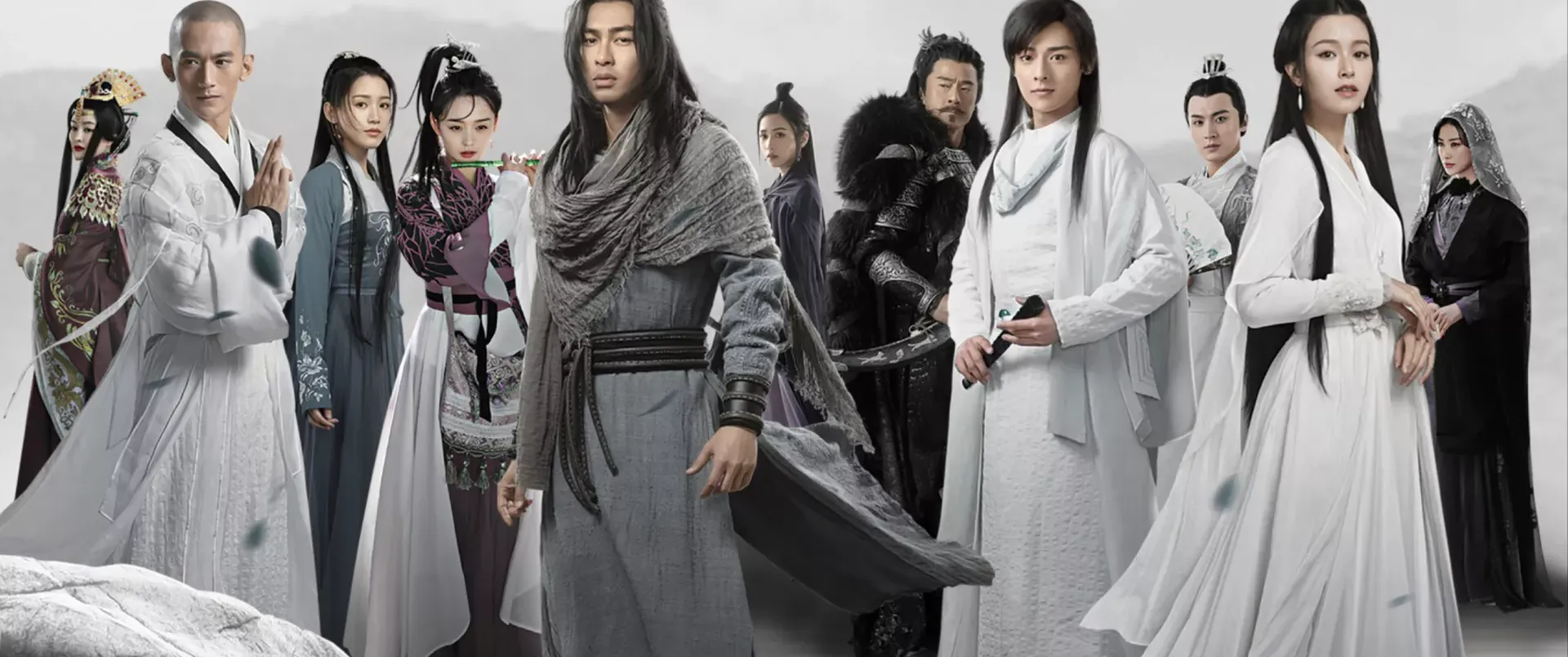
Spirit Blades of Six Meridians (simplified: 六脉神剑, traditional: 六脈神劍, pinyin: Liùmài Shénjiàn, jyutping: Luk6 Mak6 San4 Gim3) was the supreme martial art of the Dali Kingdom’s Duan family, revered as one of the most formidable techniques in the jianghu. This legendary finger technique projected invisible blades of concentrated neili (internal force) through the six primary meridians of the hands, creating sword qi that could strike opponents without physical contact.
Overview
The Spirit Blades of Six Meridians represented the pinnacle of the Duan family’s martial arts heritage, building upon the foundation of their signature One Yang Finger technique. Unlike conventional swordplay that required physical weapons, this technique transformed cultivated neili into invisible sword qi, creating what practitioners described as “formless blades with tangible force.”
The technique derived its power from channelling neili through six specific meridians in the hands: the Hand Taiyin Lung Meridian, Hand Yangming Large Intestine Meridian, Hand Shaoyin Heart Meridian, Hand Shaoyang Triple Warmer Meridian, Hand Jueyin Pericardium Meridian, and Hand Taiyang Small Intestine Meridian. Each meridian produced a distinct sword path with unique characteristics, ranging from overwhelming power to subtle precision.
The Spirit Blades of Six Meridians is not a true sword, but rather uses the power of One Yang Finger transformed into sword qi. It has substance but no form, and can be called an invisible qi sword. Once mastered, the practitioner’s fingers could project cultivated qi like an invisible qi sword. Whether sweeping or pointing, the technique could injure opponents. The sword qi possessed substance without form, emerging with lightning speed and devastating power. The six paths could be used in combination, allowing practitioners to kill with invisible qi, making it exceptionally mysterious and unmatched among sword techniques, earning the name “invisible qi sword”.
Masters of this art could project sword qi that moved as swiftly as lightning, capable of penetrating armour, severing weapons, and striking acupoints from considerable distances. Unlike acupoint-striking techniques that merely disabled opponents, the Spirit Blades of Six Meridians could achieve direct killing and piercing effects, making it far more powerful than conventional point-striking methods. The invisible nature of the blades made them exceptionally difficult to defend against, as opponents could neither see nor predict their trajectories. In skilled hands, the six blades could be deployed simultaneously or in rapid succession, creating a devastating offensive that few martial artists could withstand. Even the peerless Qiao Feng had to show caution when facing this technique, demonstrating its formidable reputation throughout the jianghu.
The technique’s profound connection to traditional Chinese medical theory distinguished it from other martial arts. Practitioners required intimate knowledge of meridian pathways, acupoint locations, and qi circulation patterns. This integration of healing knowledge with combat application made the Spirit Blades of Six Meridians both a destructive weapon and, paradoxically, a tool for understanding the body’s energy systems.
The Spirit Blades of Six Meridians was paired with the Tendon-transmuting Sutra as one of the two great divine techniques of the jianghu. Both techniques required profound neili reserves to master, and those who achieved complete mastery were considered virtually invincible. This legendary status made the technique the object of intense desire among martial artists throughout the jianghu, attracting numerous attempts to steal or acquire the scripture.
History
Origins and creation
The Spirit Blades of Six Meridians was created by Duan Siping, the founding emperor of the Dali Kingdom. Drawing upon his mastery of the One Yang Finger and his profound understanding of meridian theory, Duan Siping developed this supreme technique as the ultimate expression of the Duan family’s martial arts philosophy. He recorded the complete training methods in the Spirit Blades of Six Meridians Scripture, a treasured manual that became the most closely guarded secret of Tianlong Temple.
The technique’s creation represented centuries of accumulated martial wisdom from the Duan family lineage, refined through Buddhist philosophical principles and Daoist qi cultivation methods. Duan Siping recognised that whilst the One Yang Finger provided an excellent foundation, its single-point projection limited its tactical applications. By extending the technique across all six primary hand meridians, he created a comprehensive offensive system that could adapt to any combat situation.
The scripture contained six detailed diagrams, each mapping the precise acupoint sequence for one meridian path. The illustrations consisted of intersecting straight lines, circles, and curves that represented qi flow patterns and striking vectors. These cryptic diagrams required not only technical understanding but also profound insight into energy cultivation principles to decipher properly.
Tianlong Temple guardianship
Following Duan Siping’s death, the Spirit Blades of Six Meridians Scripture was entrusted to Tianlong Temple, the Duan family’s ancestral Buddhist sanctuary. The technique became the temple’s most precious treasure, available only to ordained monks of the Duan lineage. This restriction ensured that the technique remained within the family whilst emphasising its spiritual dimensions over purely martial applications.
The tradition of keeping the technique within the temple reflected the Duan family’s unique relationship with Buddhism. Unlike typical royal families who viewed martial arts primarily as tools of political power, the Duan rulers recognised that supreme martial ability required spiritual cultivation. By restricting Spirit Blades training to those who had renounced worldly attachments, they ensured the technique would be wielded with wisdom and restraint.
This restriction meant that even high-ranking members of the Duan family, such as Duan Zhengchun, remained unaware that the Spirit Blades of Six Meridians Scripture was stored at Tianlong Temple. The secrecy surrounding the scripture’s location protected it from both external threats and internal family conflicts, ensuring that only those who had fully committed to the Buddhist path could access the technique.
Over generations, the immense difficulty of mastering all six meridian paths led to a practical compromise. Most Tianlong Temple monks could barely manage to learn a single meridian path, requiring such profound neili reserves that even advanced practitioners found the full technique beyond their capabilities. The temple’s senior monks—including Kurong, Benyin, Benguan, Bencan, Benxiang, and Emperor Duan Zhengming—each specialised in a single meridian path, collectively maintaining the complete tradition.
As Master Benyin lamented: “According to the original intent of the Spirit Blades of Six Meridians, one person should wield all six blade paths simultaneously. However, in these declining times, with martial arts in decay, no one can cultivate neili sufficiently profound and dense. We can only divide the six paths among six practitioners.”
Attempts to acquire the technique
The technique’s legendary reputation as one of the two great divine techniques of the jianghu attracted covetous attention from numerous martial artists. The Xiaoyao Order masters Wuyazi and Li Qiushui made multiple attempts to acquire the scripture, as did Murong Bo and Murong Fu of the Gusu Murong clan. All these attempts failed, demonstrating both the temple’s security and the technique’s near-mythical status in the jianghu.
Jiumozhi’s attempted theft
The most serious threat came from Jiumozhi, the National Preceptor of the Tubo Kingdom, who sought to add this supreme skill to his already formidable arsenal. Jiumozhi arrived at Tianlong Temple demanding the scripture, threatening violence if the monks refused. His mastery of the Flaming Sabre and profound neili cultivation made him a nearly unstoppable force.
Faced with this threat, the six temple masters demonstrated the Spirit Blades of Six Meridians in combat against Jiumozhi, each wielding their specialised meridian path. The display revealed both the technique’s devastating power and the limitations of the divided approach. Whilst individually formidable, the six separate practitioners lacked the overwhelming advantage that a single master wielding all six paths simultaneously would possess. Nevertheless, their combined efforts proved sufficient to temporarily halt Jiumozhi’s advance.
Recognising that Jiumozhi would eventually breach the temple’s defences, Abbot Kurong made the painful decision to destroy the scripture. Using his profound One Yang Finger skill, he projected neili to ignite the precious manual, reducing centuries of accumulated martial wisdom to ashes. This act of destruction prevented the technique from falling into the hands of someone who might use it for conquest or personal gain, preserving the Duan family’s honour even at tremendous cost.
Duan Yu’s complete mastery
The destruction of the physical scripture appeared to doom the Spirit Blades of Six Meridians to extinction. However, fate intervened through Duan Yu1 (simplified: 段誉, traditional: 段譽, pinyin: Duàn Yù), a young member of the Duan royal family who had been present during Jiumozhi’s attack. Despite his lifelong aversion to martial arts and complete lack of formal training, Duan Yu possessed an extraordinary photographic memory that allowed him to perfectly recall all six diagrams from the burning scripture.
Duan Yu’s subsequent mastery of the technique occurred under extraordinary circumstances. He had previously, through a series of accidents, absorbed the complete neili reserves of the Xiaoyao Order’s masters through the Beiming Power—accumulating over two hundred years’ worth of cultivated energy in his body. This vast reservoir of neili, combined with his memorised knowledge of all six meridian paths, made him theoretically capable of wielding the complete Spirit Blades technique.
However, Duan Yu’s complete lack of martial arts foundation created an unusual problem. Despite possessing enormous neili reserves, he had never learnt proper qi circulation methods or energy control techniques. As a result, his manifestation of the Spirit Blades remained erratic and unreliable. The blades would only emerge during moments of extreme danger when his survival instincts unconsciously triggered the technique. This unpredictability made Duan Yu simultaneously one of the most dangerous combatants in the jianghu when the technique activated, yet helpless when it failed to respond to his conscious control.
This ironic situation—a martial arts prodigy who could not reliably use his abilities—demonstrated that even supreme techniques required proper foundational training. Duan Yu’s experiences illustrated that raw power alone, without understanding or discipline, created as many problems as it solved.
Requirements
Foundational prerequisites
Mastery of the Spirit Blades of Six Meridians demanded exceptional preparation across multiple dimensions. The foremost requirement was achieving at least Fourth Grade proficiency in the One Yang Finger, the Duan family’s ancestral technique. This level of achievement indicated not merely technical competence but profound understanding of finger-based qi projection principles. Practitioners needed to demonstrate perfect control over single-point energy emission before attempting the more complex multi-meridian pathways.
The neili requirements proved even more daunting. Cultivating sufficient neili to power even a single meridian path required decades of dedicated neigong practice. The original design intended for one practitioner to wield all six paths simultaneously, which demanded neili reserves so vast that Master Benyin declared them impossible to achieve “in these declining times.” The historical precedent established by Duan Siping himself suggested that only those with near-limitless energy cultivation could hope to manifest the technique’s full potential.
Physical and mental demands
Beyond energy cultivation, practitioners required comprehensive understanding of human anatomy from both martial and medical perspectives. The technique’s foundation in meridian theory meant students needed to memorise the pathways of all twelve primary meridians, the locations of hundreds of acupoints, and the relationships between different energy channels. This knowledge extended beyond rote memorisation to intuitive understanding—practitioners must sense qi flow patterns within their own bodies before projecting energy externally.
The mental discipline required proved equally demanding. Projecting formless sword qi whilst maintaining perfect accuracy demanded exceptional focus and visualisation abilities. Practitioners needed to simultaneously track multiple targets, calculate optimal striking angles, and modulate energy output—all whilst maintaining the complex hand positions required for each meridian path. The cognitive load of wielding multiple blades concurrently exceeded most martial artists’ mental processing capabilities.
Physical conditioning, whilst less emphasised than energy cultivation, remained crucial. The fingers and hands needed strengthening to withstand the intense neili channelling without suffering internal damage. Practitioners also required exceptional fine motor control to maintain the subtle hand positions that guided qi through specific meridian pathways. Any deviation in finger placement could redirect energy flows incorrectly, resulting in wasted energy or, worse, self-inflicted meridian damage.
Training hazards
The path to mastery carried significant risks. Improper qi circulation whilst attempting the technique could cause qi deviation, leading to severe internal injuries or mental instability. The immense energy requirements meant that practitioners frequently exhausted themselves during training, leaving their bodies vulnerable to illness and their meridians susceptible to damage. This explains why even Tianlong Temple’s senior monks limited themselves to single meridian paths—the physiological toll of attempting complete mastery proved too dangerous for all but the most exceptional individuals.
The technique also presented unique psychological challenges. Its tremendous power tempted practitioners toward arrogance and aggression, potentially corrupting those without proper moral foundation. This concern partly motivated the Duan family’s decision to restrict access to ordained monks who had committed to Buddhist principles of compassion and restraint. The requirement for spiritual cultivation alongside martial training served as both philosophical ideal and practical safety mechanism.
Techniques
The Spirit Blades of Six Meridians comprised six distinct sword paths, each deriving from a different hand meridian and exhibiting unique characteristics. Masters could deploy these paths independently or in combination, creating tactical flexibility unmatched by conventional martial arts.
Shaoshang Sword
少商剑 – Shǎoshāng Jiàn
The Shaoshang Sword channelled qi through the Hand Taiyin Lung Meridian,2 flowing from the Zhongfu3 acupoint through Tianfu,4 Chize,5 Kongzui,6 Lieque,7 Jingqu,8 Taiyuan,9 and Yuji10 before projecting from the Shaoshang11 acupoint at the thumb. This path embodied overwhelming force and majestic power, with sword qi that possessed “the momentum of shattering rocks and shaking heavens, of tempests arriving with great force.”
Practitioners wielded this blade through both hands simultaneously, doubling its already formidable power. The Shaoshang Sword excelled at breaking through robust defences and overwhelming opponents through sheer force. Its straightforward, powerful nature made it ideal for opening attacks or breaking enemy formations. The blade’s connection to the lung meridian gave it particularly strong yang characteristics, manifesting as brilliant, visible energy that inspired both awe and terror in opponents.
Shangyang Sword
商阳剑 – Shāngyáng Jiàn
The Shangyang Sword utilised the Hand Yangming Large Intestine Meridian,12 progressing from Yingxiang13 through Futu,14 Tianding,15 Jianyu,16 Quchi,17 Shousanli,18 Yangxi,19 and Hegu20 to project from the Shangyang21 acupoint at the index finger. This path was characterised as “ingenious, nimble, and difficult to fathom,” emphasising unpredictable angles and deceptive trajectories.
Both hands could deploy this blade, creating cross-angled attacks that confounded enemy defences. The Shangyang Sword specialised in precision strikes against vital points, exploiting openings in opponents’ guards through unexpected vectors. Its agile nature made it invaluable for countering faster opponents or targeting specific acupoints to disable rather than kill. Skilled practitioners could bend the blade’s trajectory mid-flight, creating curved sword paths that circumvented shields and defensive techniques.
Zhongchong Sword
中冲剑 – Zhōngchōng Jiàn
The Zhongchong Sword channelled energy through the Hand Jueyin Pericardium Meridian,22 flowing from Tianchi23 through Tianquan,24 Quze,25 Ximen,26 Jianshi,27 Daling,28 and Laogong29 before projecting from the Zhongchong30 acupoint at the middle finger. This path embodied “grand opening and closing, with majestic and powerful momentum,” emphasising sweeping movements and area control.
Practitioners wielded this blade through both hands, creating wide-ranging attacks that controlled battlefield space. The Zhongchong Sword excelled at engaging multiple opponents simultaneously or denying enemy movement through sustained energy projection. Its connection to the pericardium meridian gave it strong protective qualities, allowing practitioners to create defensive barriers of sword qi whilst maintaining offensive pressure. The blade’s sweeping nature made it particularly effective against group attacks or when fighting in open spaces.
Guanchong Sword
关冲剑 – Guānchōng Jiàn
The Guanchong Sword utilised the Hand Shaoyang Triple Warmer Meridian,31 progressing from Sizhukong32 through Ermen,33 Yifeng,34 Jianliao,35 Tianjing,36 Zhigou,37 Waiguan,38 Yangchi,39 Zhongzhu,40 and Yemen41 to project from the Guanchong42 acupoint at the ring finger. This path was characterised as “achieving victory through clumsy and stagnant ancient simplicity,” emphasising endurance and grinding attrition over flashy technique.
Both hands could deploy this blade, creating persistent pressure that wore down opponents over time. The Guanchong Sword specialised in extended combat, maintaining steady output without dramatic power spikes. Its connection to the triple warmer meridian gave it exceptional stability, allowing practitioners to sustain projection longer than other paths. This blade proved invaluable in defensive situations or when facing opponents with superior speed but inferior endurance. Its deceptively simple appearance often led enemies to underestimate its effectiveness, creating opportunities for surprise victories.
Shaochong Sword
少冲剑 – Shǎochōng Jiàn
The Shaochong Sword channelled qi through the Hand Shaoyin Heart Meridian,2 flowing from Jiquan43 through Qingling,44 Shaohai,45 Lingdao,46 Tongli,47 Yinxi,48 Shenmen,49 and Shaofu50 before projecting from the Shaochong51 acupoint at the right hand’s little finger. This path embodied “light agility and swift speed,” emphasising rapid-fire attacks and overwhelming tempo.
Unlike the other paths that could utilise both hands, the Shaochong Sword projected only from the right little finger, creating a unique single-point focus. This blade specialised in piercing attacks that struck with incredible speed, often hitting vital points before opponents could react. Its connection to the heart meridian gave it strong yang characteristics focused on pure offensive power. The blade’s swiftness made it ideal for assassinating key targets or breaking enemy momentum through sudden, decisive strikes.
Shaoze Sword
少泽剑 – Shǎozé Jiàn
The Shaoze Sword utilised the Hand Taiyang Small Intestine Meridian,52 progressing from Tinggong53 through Quanliao,54 Tianrong,55 Tianchuang,56 Jianzhongshu,57 Bingfeng,58 Tianzong,59 Naoshu,60 Xiaohai,61 Zhizheng,62 Yanglao,63 Wangu,64 and Houxi65 to project from the Shaoze66 acupoint at the left hand’s little finger. This path was characterised as “appearing and disappearing unpredictably, with exquisitely subtle transformations,” emphasising deceptive feints and phantom strikes.
Like the Shaochong Sword, the Shaoze Sword projected only from the left little finger, creating asymmetric tactical options. This blade specialised in misdirection and psychological warfare, creating multiple phantom projections that confused enemy perception. Its connection to the small intestine meridian gave it unique properties of transformation and adaptation, allowing the blade to change trajectories mid-flight or split into multiple simultaneous strikes. Skilled practitioners could create the illusion of dozens of blades from a single projection, overwhelming opponents’ ability to distinguish real threats from feints.
Notable practitioners
Duan Siping
Duan Siping (simplified: 段思平, traditional: 段思平, pinyin: Duàn Sīpíng), the founding emperor of the Dali Kingdom, created the Spirit Blades of Six Meridians and remained its only complete master for generations. His profound understanding of meridian theory, combined with decades of neili cultivation and mastery of the One Yang Finger, enabled him to manifest all six blade paths simultaneously with perfect control. Historical records suggested that Duan Siping could deploy the technique effortlessly, switching between different meridian combinations to adapt to any combat situation whilst maintaining sustained projection for extended periods.
Tianlong Temple masters
Six senior monks of Tianlong Temple maintained the tradition during the Song dynasty period, each specialising in a single meridian path due to the immense neili requirements:
Kurong (simplified: 枯荣, traditional: 枯榮, pinyin: Kūróng) mastered one meridian path and served as the temple’s abbot. His profound Buddhist cultivation and decades of martial arts practice made him one of the most respected martial artists in the southern regions.
Benyin (simplified: 本因, traditional: 本因, pinyin: Běnyīn), Benguan (simplified: 本观, traditional: 本觀, pinyin: Běnguān), Bencan (simplified: 本参, traditional: 本參, pinyin: Běncān), Benxiang (simplified: 本相, traditional: 本相, pinyin: Běnxiàng), and Benchen (simplified: 本尘, traditional: 本塵, pinyin: Běnchén; formerly Emperor Duan Zhengming) each mastered their respective meridian paths. Their collective demonstration against Jiumozhi showcased both the technique’s formidable power and the practical limitations of the divided approach.
Duan Yu
Duan Yu (simplified: 段誉, traditional: 段譽, pinyin: Duàn Yù) became the second practitioner after Duan Siping to possess knowledge of all six meridian paths, though his mastery remained incomplete. After accidentally absorbing vast neili reserves through the Northern Darkness Divine Art, Duan Yu possessed sufficient energy to theoretically wield the complete technique. His photographic memory of the scripture’s diagrams provided him with the technical knowledge, but his complete lack of martial arts foundation and inability to consciously control qi circulation created severe limitations.
During moments of extreme danger, Duan Yu’s survival instincts would unconsciously trigger the technique, manifesting sword qi of devastating power. These involuntary activations allowed him to defeat formidable opponents on multiple occasions. He twice defeated Murong Fu using the Spirit Blades—first at Shaolin Temple beneath Mount Shaoshi67 (少室山 – Shǎoshì Shān), and again at Mantuo Manor68 (曼陀山庄 – Màntuó Shānzhuāng). After witnessing the technique’s power firsthand, Murong Bo praised it as “the number one swordplay in the world.” Duan Yu also used the technique to force Jiumozhi into retreat and, in a remarkable display of its versatility, employed it in a drinking contest with Qiao Feng69 (乔峰 – Qiáo Fēng), the renowned chief of the Beggars’ Guild, emerging victorious despite Qiao Feng’s legendary tolerance for alcohol.
However, the technique’s unreliability meant Duan Yu could never depend upon it strategically, creating a paradox where he possessed supreme martial ability without the agency to wield it effectively. This unpredictability made him simultaneously one of the jianghu’s most dangerous fighters when the technique activated and completely helpless when it failed to respond.
Behind the scenes
Literary significance
The Spirit Blades of Six Meridians represents Jin Yong’s sophisticated integration of traditional Chinese medicine theory into martial arts fiction. The technique’s foundation in actual meridian pathways and acupoint locations demonstrates the author’s extensive research into Chinese medical classics, particularly the concepts outlined in the Huangdi Neijing70 (Yellow Emperor’s Inner Canon). This grounding in legitimate medical theory lends verisimilitude to the fantastical premise of projecting sword qi through finger points.
Within Demi-Gods and Semi-Devils, the technique serves multiple narrative functions. It establishes the Duan family’s martial arts supremacy whilst highlighting their Buddhist philosophical foundation through the restriction of access to ordained monks. The technique’s extreme difficulty reinforces themes about the declining state of martial arts in the “latter days,” with even supreme masters unable to achieve what previous generations accomplished routinely.
Duan Yu’s complicated relationship with the technique explores themes of power without wisdom and ability without control. His involuntary mastery creates dramatic tension whilst serving as metaphor for natural talent that lacks cultivation or discipline. The contrast between his vast potential and practical helplessness critiques martial arts culture’s obsession with raw power over genuine understanding.
Cultural impact
The Spirit Blades of Six Meridians has become one of Jin Yong’s most iconic martial arts techniques, frequently referenced in Chinese popular culture and adapted across numerous film and television productions. Its visual spectacle—invisible sword qi striking from a distance—provides dramatic appeal whilst the meridian theory foundation satisfies audiences seeking martial arts realism.
The technique’s connection to traditional Chinese medicine has contributed to popular interest in meridian theory and acupoint knowledge. Many readers have reported seeking out information about the actual meridians referenced in the technique, creating educational value beyond mere entertainment. This cultural impact demonstrates how wuxia fiction can serve as gateway to deeper engagement with traditional Chinese knowledge systems.
In modern martial arts discourse, “六脉神剑” has become shorthand for finger-based qi projection techniques more broadly. The phrase appears in discussions of acupoint sealing and other internal martial arts, though such usage often conflates fictional techniques with historical practices.
Translation considerations
The technique’s Chinese name “六脉神剑” poses significant translation challenges. Literal renderings like “Six Meridian Divine Sword” fail to capture the technique’s formless nature, potentially misleading readers into expecting physical weapons. Alternative translations including “Six Meridian Spirit Blades,” “Six Channel Divine Swords,” and “Six Vessels God Swords” each emphasise different aspects of the technique.
WuxiaSociety’s choice of “Spirit Blades of Six Meridians” prioritises several considerations. “Spirit Blades” captures both the technique’s formless nature (spirit suggesting non-physical essence) and its cutting power (blades indicating offensive capability). Placing “Six Meridians” in the possessive construction emphasises the technique’s foundation in meridian theory over simply describing six separate swords. The plural “Meridians” clarifies that multiple energy channels are involved, whilst “Blades” allows for flexible interpretation of the technique’s manifestation.
The term “神剑” (shénjiàn) presents particular difficulty. Whilst “divine sword” is literally accurate, it carries religious connotations in English that don’t align with the technique’s Buddhist-Daoist medical foundation. “Spirit blade” better captures the sense of refined, elevated martial technique without implying supernatural origins.
Individual meridian sword names follow similar principles, prioritising acupoint accuracy over poetic translation whilst maintaining readability for English audiences unfamiliar with Chinese medical terminology.
See also
- Demi-Gods and Semi-Devils martial arts
- Duan Yu—primary practitioner who mastered all six meridian paths
- One Yang Finger—foundational technique required for learning Spirit Blades
- Dali Kingdom—homeland of the Duan family
- Tianlong Temple—guardian of the Spirit Blades scripture
External links
- Spirit Blades of Six Meridians (Chinese) on Chinese Wikipedia
- Spirit Blades of Six Meridians (Chinese) on Baidu Baike
Footnotes
-
段誉 – Duàn Yù. Prince of Dali Kingdom and reluctant martial artist. ↩
-
手太阴肺经 – Shǒu Tàiyīn Fèi Jīng. Hand Taiyin Lung Meridian. ↩ ↩2
-
中府 – Zhōngfǔ. Acupoint on the chest. ↩
-
天府 – Tiānfǔ. Acupoint on the upper arm. ↩
-
尺泽 – Chǐzé. Acupoint at the elbow crease. ↩
-
孔最 – Kǒngzuì. Acupoint on the forearm. ↩
-
列缺 – Lièquē. Acupoint on the wrist. ↩
-
经渠 – Jīngqú. Acupoint on the wrist. ↩
-
太渊 – Tàiyuān. Acupoint at the wrist pulse point. ↩
-
鱼际 – Yújì. Acupoint at the base of the thumb. ↩
-
少商 – Shǎoshāng. Acupoint at the thumb. ↩
-
手阳明大肠经 – Shǒu Yángmíng Dàcháng Jīng. Hand Yangming Large Intestine Meridian. ↩
-
迎香 – Yíngxiāng. Acupoint beside the nose. ↩
-
扶突 – Fútū. Acupoint on the neck. ↩
-
天鼎 – Tiāndǐng. Acupoint on the neck. ↩
-
肩髃 – Jiānyú. Acupoint on the shoulder. ↩
-
曲池 – Qūchí. Acupoint at the elbow. ↩
-
手三里 – Shǒu Sānlǐ. Acupoint on the forearm. ↩
-
阳溪 – Yángxī. Acupoint on the wrist. ↩
-
合谷 – Hégǔ. Acupoint between thumb and index finger. ↩
-
商阳 – Shāngyáng. Acupoint at the index finger. ↩
-
手厥阴心包经 – Shǒu Juéyīn Xīnbāo Jīng. Hand Jueyin Pericardium Meridian. ↩
-
天池 – Tiānchí. Acupoint on the chest. ↩
-
天泉 – Tiānquán. Acupoint on the upper arm. ↩
-
曲泽 – Qūzé. Acupoint at the elbow. ↩
-
郄门 – Xīmén. Acupoint on the forearm. ↩
-
间使 – Jiānshǐ. Acupoint on the forearm. ↩
-
大凌 – Dàlíng. Acupoint at the wrist. ↩
-
劳宫 – Láogōng. Acupoint at the centre of the palm. ↩
-
中冲 – Zhōngchōng. Acupoint at the middle finger. ↩
-
手少阳三焦经 – Shǒu Shǎoyáng Sānjiāo Jīng. Hand Shaoyang Triple Warmer Meridian. ↩
-
丝竹空 – Sīzhúkōng. Acupoint at the temple. ↩
-
耳门 – Ěrmén. Acupoint by the ear. ↩
-
翳风 – Yìfēng. Acupoint behind the ear. ↩
-
肩髎 – Jiānliáo. Acupoint on the shoulder. ↩
-
天井 – Tiānjǐng. Acupoint at the elbow. ↩
-
支沟 – Zhīgōu. Acupoint on the forearm. ↩
-
外关 – Wàiguān. Acupoint on the forearm. ↩
-
阳池 – Yángchí. Acupoint at the wrist. ↩
-
中渚 – Zhōngzhǔ. Acupoint on the back of the hand. ↩
-
液门 – Yèmén. Acupoint between fingers. ↩
-
关冲 – Guānchōng. Acupoint at the ring finger. ↩
-
极泉 – Jíquán. Acupoint in the armpit. ↩
-
青灵 – Qīnglíng. Acupoint on the upper arm. ↩
-
少海 – Shǎohǎi. Acupoint at the elbow. ↩
-
灵道 – Língdào. Acupoint on the forearm. ↩
-
通里 – Tōnglǐ. Acupoint on the forearm. ↩
-
阴郄 – Yīnxī. Acupoint on the forearm. ↩
-
神门 – Shénmén. Acupoint at the wrist. ↩
-
少府 – Shǎofǔ. Acupoint on the palm. ↩
-
少冲 – Shǎochōng. Acupoint at the little finger. ↩
-
手太阳小肠经 – Shǒu Tàiyáng Xiǎocháng Jīng. Hand Taiyang Small Intestine Meridian. ↩
-
听宫 – Tīnggōng. Acupoint by the ear. ↩
-
颧髎 – Quánliáo. Acupoint on the cheekbone. ↩
-
天容 – Tiānróng. Acupoint on the neck. ↩
-
天窗 – Tiānchuāng. Acupoint on the neck. ↩
-
肩中俞 – Jiānzhōngshū. Acupoint on the shoulder blade. ↩
-
秉风 – Bǐngfēng. Acupoint on the shoulder blade. ↩
-
天宗 – Tiānzōng. Acupoint on the shoulder blade. ↩
-
臑俞 – Nàoshū. Acupoint on the shoulder. ↩
-
小海 – Xiǎohǎi. Acupoint at the elbow. ↩
-
支正 – Zhīzhèng. Acupoint on the forearm. ↩
-
养老 – Yǎnglǎo. Acupoint on the forearm. ↩
-
腕骨 – Wàngǔ. Acupoint at the wrist. ↩
-
后谿 – Hòuxī. Acupoint on the side of the hand. ↩
-
少泽 – Shǎozé. Acupoint at the little finger. ↩
-
少室山 – Shǎoshì Shān. Mount Shaoshi, location of Shaolin Temple. ↩
-
曼陀山庄 – Màntuó Shānzhuāng. Mantuo Villa, Wang Yuyan’s residence. ↩
-
乔峰 – Qiáo Fēng. Chief of the Beggars’ Guild, renowned for his martial prowess and drinking ability. ↩
-
黄帝内经 – Huángdì Nèijīng. Foundational text of traditional Chinese medicine. See Wikipedia. ↩