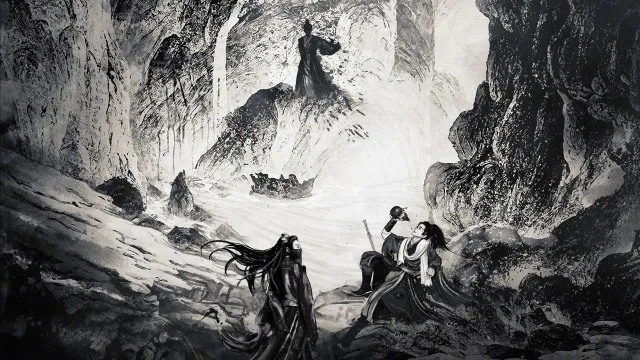
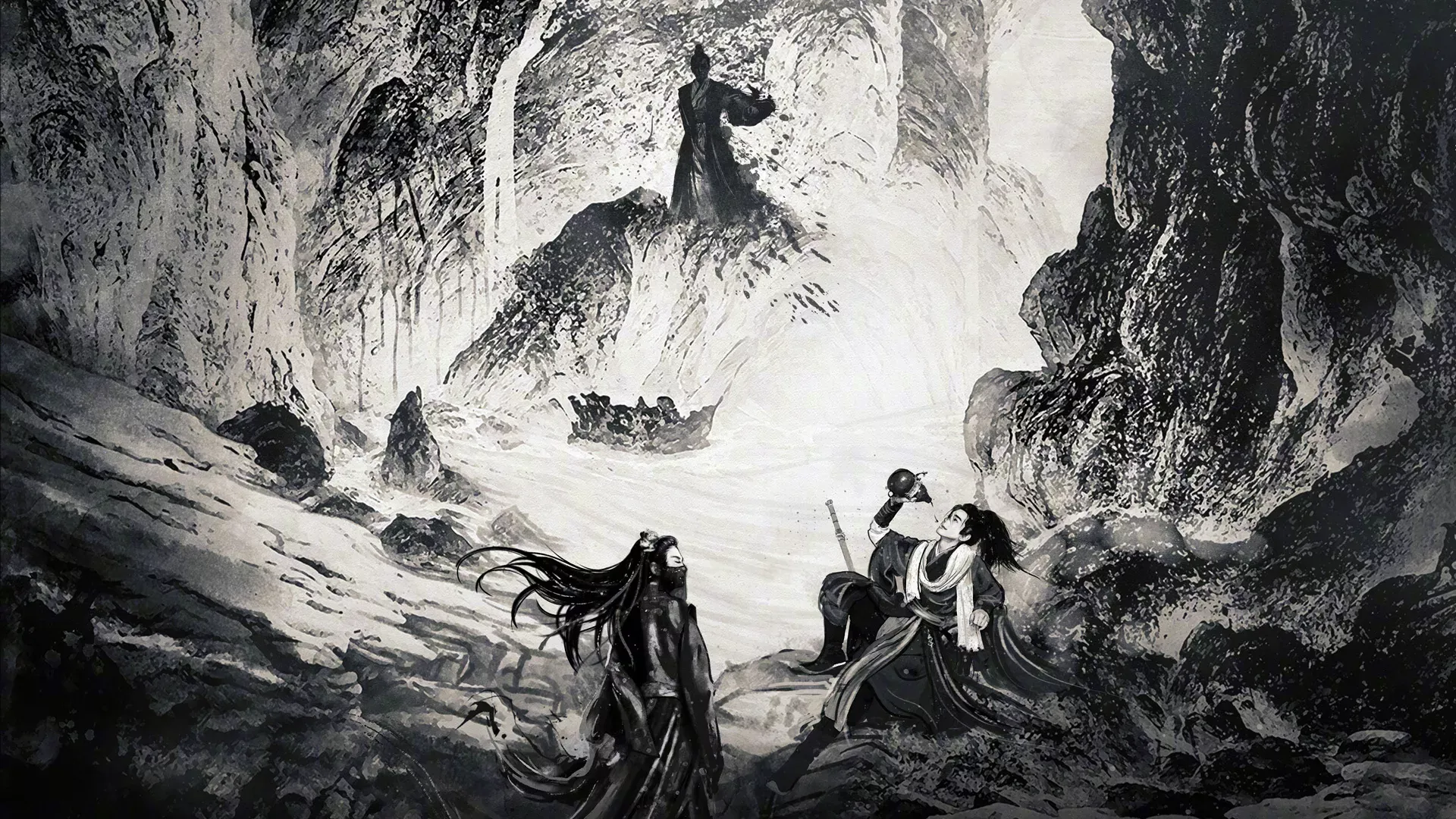
Mo Da (simplified: 莫大, traditional: 莫大, pinyin: Mò Dà, jyutping: mok6 daai6), known by the epithet “Night Rain over Xiao and Xiang” (潇湘夜雨 — Xiāoxiāng Yèyǔ), was the reclusive leader of the Hengshan School. A strong master among the orthodox schools, his strength among the Five Mountains was second only to Zuo Lengchan. Mo Da was known for his mysterious movements, exceptional swordplay, and musical talent, though he rarely displayed his abilities openly.
Biography
Reclusive leadership
Mo Da led a reclusive lifestyle, rarely involving himself in school affairs and living like a wandering cloud and wild crane. Although he had little interaction with his junior brother Liu Zhengfeng, when Liu Zhengfeng was pursued by the Songshan School, Mo Da came to his aid.
Mo Da was described as tall and thin with a sallow complexion, wearing a blue cloth long robe that had been washed until it appeared blue-white, presenting a rather destitute appearance. His weapon was a thin sword that could be hidden within an erhu, and the jianghu saying “sword hidden in qin, sword emits qin sound” (琴中藏剑,剑发琴音) was a perfect description of his martial arts throughout his life.
Saving Liu Zhengfeng and Qu Yang
Mo Da’s second appearance demonstrated his exceptional skill. Using the “Hundred Transformations Thousand Illusions Hengshan Cloud Mist Thirteen Forms” (百变千幻衡山云雾十三式) with a thin, narrow long sword, he instantly killed Fei Bin, one of the Songshan School’s Thirteen Grandmasters known as “Great Songyang Hand,” outside Hengshan City. This allowed his junior brother Liu Zhengfeng and Sun Moon Order elder Qu Yang to die peacefully, while also saving the lives of Linghu Chong and Yilin, and avenging the young girl Qu Feiyan. However, Mo Da came and went without a trace—before Fei Bin had even fallen dead, Mo Da had already quietly departed.
Later encounters
After meeting Linghu Chong following the battle at Longquan Sword Forge Valley, the two drank wine together and became friends. Mo Da advised Linghu Chong to go to Shaolin Temple to rescue Ren Yingying and promised to protect the Hengshan School’s female disciples in Linghu Chong’s place.
Due to the fact that Mo Da’s grandmaster and grand-uncle had perished in battle against the Sun Moon Order’s Ten Elders on Mount Hua’s summit, Mo Da’s master was relatively young. Although he had learnt the five paths of Hengshan Five Divine Swords—Furong, Zigai, Shilin, Tianzhu, and Zhurong—he only knew the general outline and had not received proper instruction from his master. When Yue Lingshan demonstrated the Five Divine Swords at Mount Song, Mo Da was quite surprised.
Later, Mo Da also gazed at the Hengshan School’s senior sword techniques carved on the stone wall of the Cliff of Reflection. Linghu Chong wished to meet with him but did not have the opportunity.
Survival and final appearance
After the events at Mount Hua’s Cliff of Reflection, Mo Da disappeared, and Linghu Chong once thought he had died in the chaotic battle. Three years later, Mo Da quietly visited Plum Manor, where Linghu Chong and Ren Yingying were married. He silently played “Phoenix Seeking Phoenix” (凤求凰) outside the window as congratulations, delighting Linghu Chong. Mo Da departed before finishing the song, becoming the only original Five Mountains Sword School leader to survive to the end of the novel.
Personality & traits
Mo Da was described as thin as a consumptive ghost, and his erhu playing of “Night Rain over Xiao and Xiang” was mournful and desolate, making it difficult to hold back tears. However, his music was overly sorrowful and not particularly refined in musical terms. Because of this, Liu Zhengfeng, who was skilled in music, had a different temperament and was not particularly close to him. This led to rumours in the jianghu that the two were at odds, though this was not actually the case.
Mo Da was reclusive and loved music, rarely involving himself in school affairs and living a carefree, wandering lifestyle. Despite his reclusive nature, he maintained his principles and would come to the aid of his school members when necessary.
Martial arts abilities
Hundred Transformations Thousand Illusions Hengshan Cloud Mist Thirteen Forms
This was one of the Hengshan School’s three great secret techniques, incorporating magic tricks into martial arts. The thirteen forms were strange and varied, with countless changes, displaying considerable power.
Returning Wind Falling Goose Sword
It was said that Mo Da could strike nine sword thrusts in a single move, swift and fierce beyond belief.
Hengshan Five Divine Swords
Mo Da had learnt the five paths of the Hengshan Five Divine Swords, though he had not received complete instruction. The techniques included Furong, Zigai, Shilin, Tianzhu, and Zhurong.
Relationships
Mo Da’s relationship with Liu Zhengfeng was that of senior and junior brothers. Although they had little interaction due to their different temperaments regarding music, Mo Da still came to Liu Zhengfeng’s aid when he was pursued by the Songshan School, demonstrating that their relationship was not as strained as rumours suggested.
His relationship with Linghu Chong developed into friendship after their meeting at Longquan Sword Forge Valley. Mo Da recognised Linghu Chong’s character and provided guidance and assistance when needed.
Behind the scenes
Mo Da represents the archetype of the reclusive master who possesses great power but chooses to live simply and avoid worldly affairs. His character demonstrates that true mastery does not require public recognition or constant display of abilities.
Literary significance
Mo Da serves as a contrast to the power-hungry leaders who dominate the novel. He was a strong martial artists yet chose to live a reclusive life, demonstrating that true greatness does not require worldly authority. His survival to the end of the novel makes him the only original Five Mountains Sword School leader to remain, symbolising the preservation of traditional values in a world consumed by ambition.
Portrayals
Mo Da has been portrayed in various adaptations of Laughing in the Wind:
Laughing in the Wind
See also
- Laughing in the Wind characters
- View complete list
- Liu Zhengfeng – Mo Da’s junior brother
- Hengshan School – Mo Da’s faction
- Hengshan Swordplay – Mo Da’s signature techniques
External links
- Mo Da (Chinese) on Chinese Wikipedia