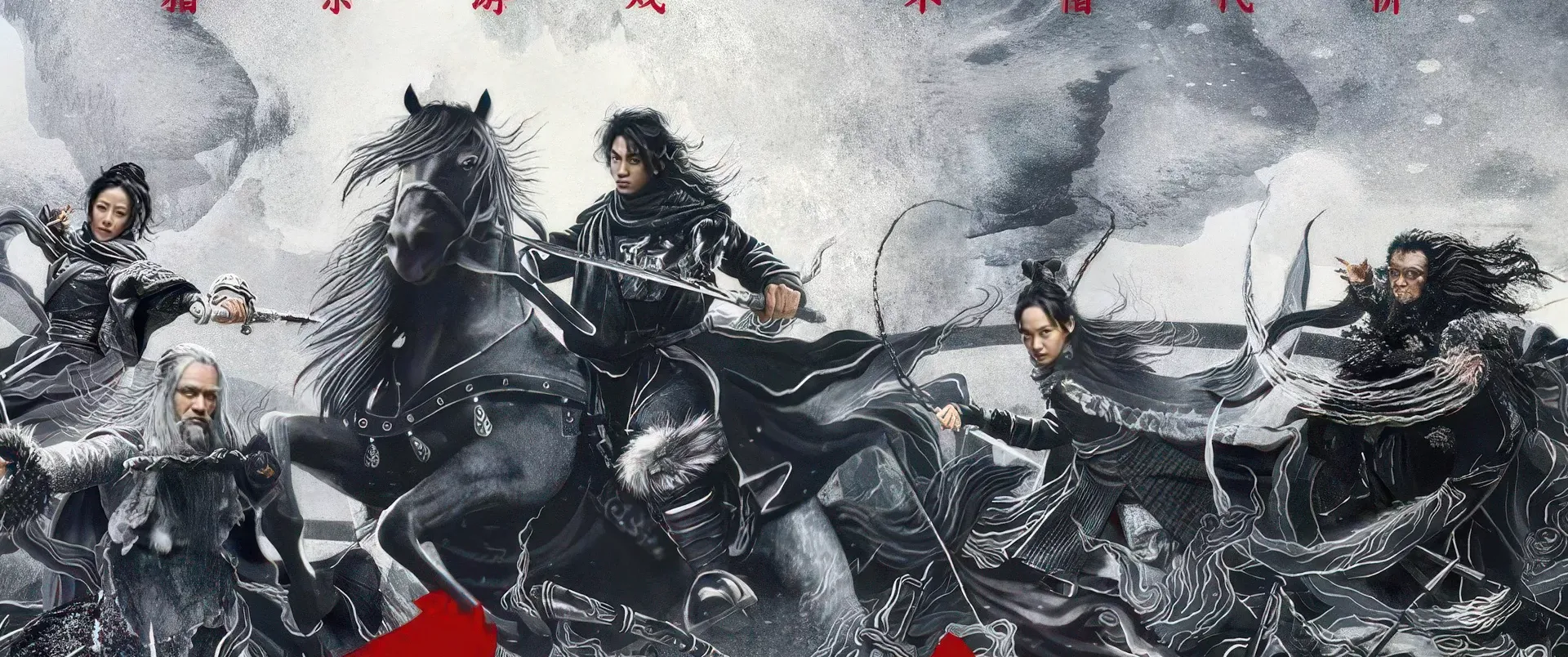
Flying Fox of the Snowy Mountain Chapter 6 – Part 3
Translation by Jenxi Seow
Hu Fei smiled and spat a yellow pill from his mouth. “My father died by the schemes of others. If I did not guard against such things, would I not be a fool? This pill wards off poison and keeps all harm at bay. But having heard your words just now, miss, it seems I have been narrow-minded after all.” With that he poured himself a cup of wine and drank it dry.
Miao Ruolan said, “There is nothing on this mountain to accompany the wine, which is a poor welcome for our guest. I have a narrow capacity for drink and cannot join you as custom demands. The ancients used the Han histories to accompany their wine. I have a Han qin1 here. If you wish, I shall play a piece to aid the drinking, though I fear it may offend your refined ears.”
Hu Fei said gladly, “I should be delighted to hear your playing.”
Qiner, without waiting for her mistress to say more, had already gone into the inner room and brought out an ancient qin. She placed it upon the table and lit a fresh stick of incense in the burner. Miao Ruolan stretched forth her fair wrist and tuned the strings, xianweng, xianweng,2 then began to play and sing softly:
“Hard is the morrow, parched the lip and dry. Today we revel; let us all be merry. We have climbed the famous peaks, where lingzhi3 grows thick. The immortal Wang Qiao offers a pill of life.”
When she had sung thus far, the qin’s notes still lingered, but the verse was done.
Hu Fei in his youth had known much hardship. He had devoted himself to martial arts and read little. Later, of his two fair confidantes, one had taken vows as a nun and the other had perished saving his life. In his grief and despair, he had felt that all his martial skill had brought him nothing but sorrow. What should a man do in this world? He could think of no answer. He had sought a master but found none, and so turned to books instead. For some years now he had bent himself to study. Though no great scholar, he had read enough to understand the classics. He recognised the song she had sung, the Shan Zai Xing,4 a banquet piece exchanged between host and guest in ancient times, and seldom performed since the Han and Wei. He had not expected that coming up this mountain to avenge his father’s death, he should meet with so ancient a custom. Of the eight lines she had sung, the first four urged the guest to drink his fill, and the last four wished him long life. He himself had just taken the pill against poison, and her song had spoken of lingzhi and the immortal’s pill, a neat double meaning.
He tapped the table lightly and chanted in reply:
“I mourn my sleeves too short, my hands know only cold. Ashamed I am no Ling Zhe, who could repay Zhao Xuan.”
The meaning was this: the host had treated him with such courtesy that he was ashamed he had nothing worthy to give in return. In the Spring and Autumn period, a man named Ling Zhe had gone hungry, and Zhao Xuan had given him meat and wine, even letting him carry food home to his mother. Later, when Zhao Xuan fell into danger, Ling Zhe had fought to the death to save him.
Miao Ruolan, hearing that he too had answered in the verses of the Shan Zai Xing, was greatly pleased. She thought, This man is skilled in both letters and martial arts. If my father knew Uncle Hu had left such a descendant, he would be overjoyed. She sang on:
“The moon has set, Shen lies askew, the Northern Dipper slants low. An old friend stands before the gate; so glad to see him, I forget to eat.”
The meaning was that though the hour was late, the guest had come, and her joy was such that she had forgotten her meal.
Hu Fei chanted in turn:
“Days of joy are few; days of sorrow, all too many. What shall we do to banish care? Play the zither and sing over wine. The Eight Masters of Huainan knew the secret: no labour, no fuss. They yoked six dragons to their chariot and played among the clouds.”
The last four lines wished the host immortality and long life, echoing the first song she had sung.
When Hu Fei had finished, he drained his cup and stood with cupped fists. Miao Ruolan stilled the strings and rose. The two faced one another and exchanged formal bows.
Hu Fei set his cup upon the table. “Since the host has not yet returned, I shall call again tomorrow.” He strode into the western wing, lifted Ping Asi onto his back, gave Miao Ruolan a slight bow, and walked out of the hall. Miao Ruolan saw him to the door. His figure flashed once at the cliff’s edge, then he caught the rope and slid down the peak.
She gazed at the snow-covered mountains, lost in thought. Qiner said, “Young Mistress, what are you thinking of? Come inside. You will catch cold.”
Miao Ruolan said, “I am not cold.”
Qiner urged her twice more before Miao Ruolan at last turned slowly back towards the manor.
When she entered the great hall, she found it filled with people. The crowd, who had hidden themselves so thoroughly that not a trace remained, had suddenly reappeared from somewhere. They all rose at once and clamoured: “Has he gone?” “What did he say?” “When will he come back?” “Did he come up the mountain to take revenge?” “Who is he after?”
Miao Ruolan despised these men in her heart. In the hour of danger they had all fled, leaving a lone young woman to face the threat. She said coolly, “He said nothing at all.”
Baoshu said, “I do not believe it. You sat with him in the hall for so long. Surely you spoke of something.”
Miao Ruolan was not by nature one for mischief, but her spirits were high and her heart light and drifting. She felt inclined to tease. Seeing their strange expressions, she said, “House Brother Hu said he came up this mountain to avenge his father’s death, but unfortunately his enemy has gone into hiding. He is waiting below the mountain now. When one person tries to leave, he kills one. When two try, he kills two.”
The crowd shuddered. They thought, There is no food on the mountain, and that fearsome fiend guards the way down. What shall we do?
Miao Ruolan said, “House Brother Hu also said that everyone on this mountain bears a grudge against him, some deep, some shallow. He distinguishes clearly between kindness and injury. Deep debts he repays heavily, shallow debts lightly. He does not wish to harm the innocent by mistake. He asked me to enquire on his behalf: why have you all come to this cold and desolate place beyond the passes? Is it to join forces and harm him?”
All save Baoshu answered in one voice, “We have never heard of the Flying Fox of the Snowy Mountain before. What grudge could we have against him? Far less would we join forces to harm him.”
Miao Ruolan turned to Tao Baisui. “Uncle Tao, there is one thing I do not understand, and I should like to ask.”
Tao Baisui said, “Please speak, miss.”
Miao Ruolan said, “Just now that Fourth Master Ping said that Uncle Hu Yidao had asked Great Master Baoshu to convey three matters to my father. Yet when my father spoke of these events, he never once mentioned it. Uncle Tao, you once said you knew the reason behind this. Would you tell me?”
Tao Baisui said, “Even if you had not asked, I was about to speak.” He pointed at Ruan Shizhong, Yin Ji, Cao Yunqi and the rest. “These heroes of the Tianlong School have falsely accused my son of killing my kinsman by marriage, Tian Guinong. Hmph!” His voice was naturally loud, and now, fired by indignation, it rang yet louder. “I shall tell the whole tale from the beginning, and ask you all to judge fairly between right and wrong.”
Yin Ji said, “Excellent, excellent. We have long wished to hear the story from Stronghold Chief5 Tao.”
Footnotes
-
琴 – qín. An ancient Chinese zither with seven strings, prized for its refined and melancholy tone. ↩
-
仙翁 – xiānwēng. The traditional syllables for the sound of a qin being tuned, the open strings plucked in turn; not words addressed to anyone. ↩
-
芝草 – zhīcǎo. Lingzhi; the “herb of spiritual potency,” a fungus regarded in Chinese tradition as a symbol of longevity and immortality. ↩
-
善哉行 – Shàn Zāi Xíng. An ancient banquet song dating from the Han dynasty, used between host and guest to exchange blessings. ↩
-
寨主 – zhàizhǔ. Stronghold chief; the leader of a fortified camp or bandit fastness. ↩