Gan Nineteenth Sister Chapter 3 – Part 4
Translation by Jenxi Seow
Before long the three of them emerged from the front courtyard—one elder, two youths—transformed into the very picture of peasant woodcutters: straw sandals, rain-capes of woven rushes, every inch the look of mountain folk. Xie Shan had tucked an umbrella under one arm; within it were concealed his paired weapons, the Wenchang Brushes.1 Fang Gang and Liu Yong each bore a bundle of firewood on a carrying pole, blades hidden among the faggots. In the courtyard they exchanged final words of parting and set off.
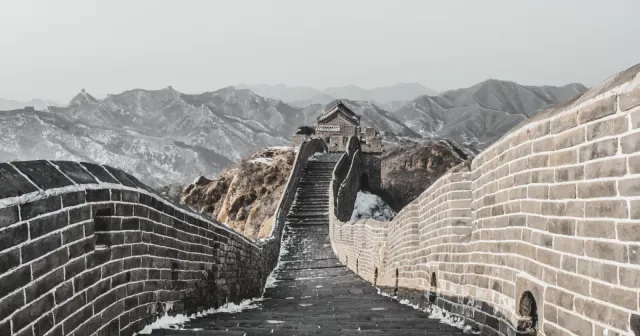
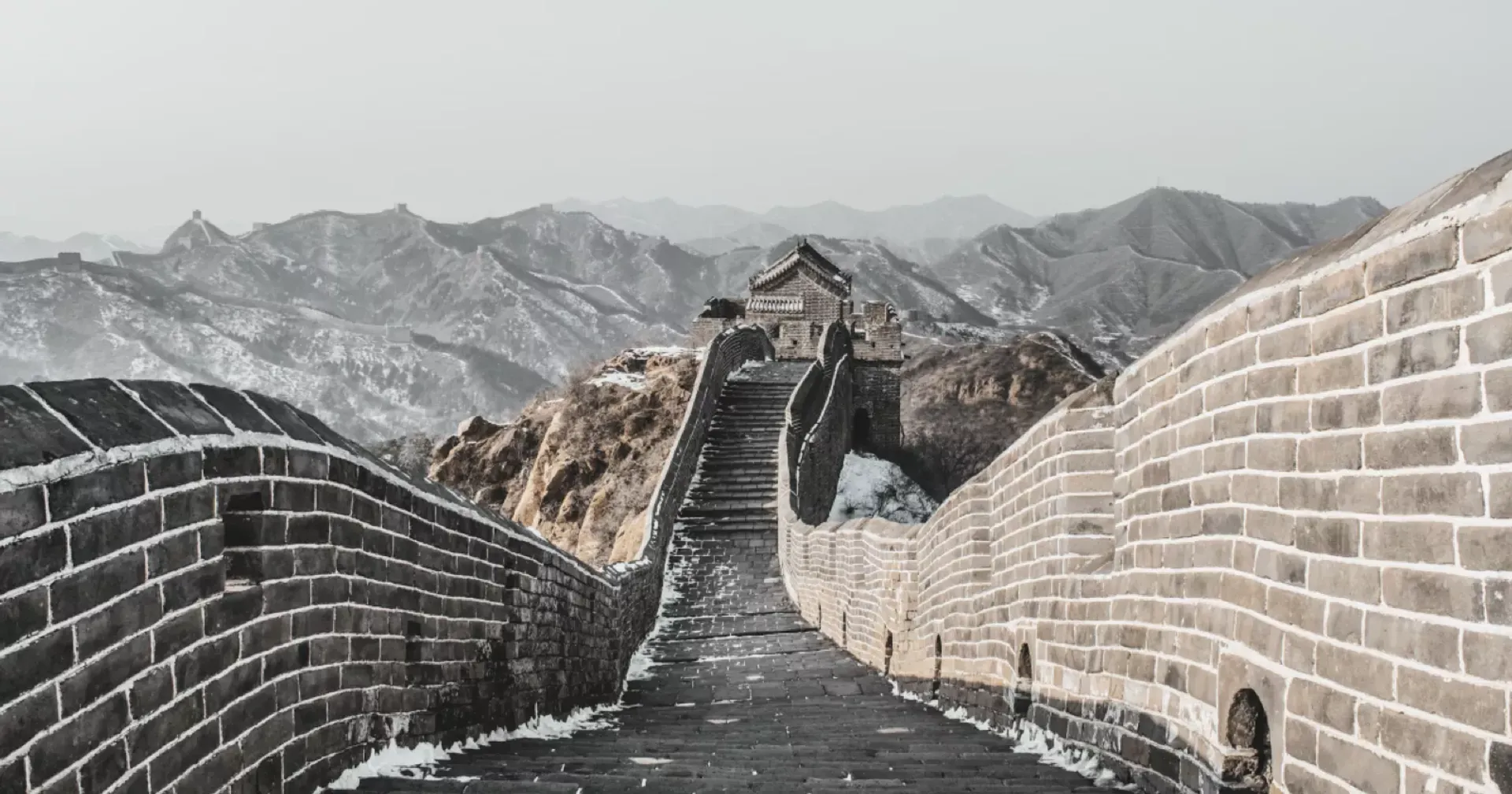
Beyond the gate, the sky hung low and dark. The snow was light but unrelenting, drifting down in a ceaseless whisper. In every direction stretched an endless world of white.
Xie Shan signalled for the two disciples to halt, then gathered his qi and drew a long, steadying breath. He launched himself forward in the Treading Snow Without Trace2 qinggong, covering thirty feet in a heartbeat. He scanned the surroundings, then returned.
His passage left only the shallowest prints in the snow—all but invisible unless one looked with care, and soon to vanish beneath the steadily falling flakes.
The Yueyang School sat with its back against the mountain and its face toward the lake, flanked on either side by fallow fields. To the left ran a row of tall bamboo, guiding the eye along a winding path. That path led eventually to the post road—the great artery from which all lesser tracks radiated outward like the spokes of a wheel. Any traveller bound north or south must pass along it. In other words, to reach the post road was to be halfway to safety.
The Yueyang School was the sole great edifice in this stretch of country. Roads led away from each of its four gates, and though a handful of homesteads lay scattered about, none was near. In weather like this, not a living soul stirred.
Xie Shan had chosen to leave by the left gate. Having surveyed the terrain, he turned to Fang Gang and Liu Yong. “The three of us will pass as father and sons. Should anyone inquire, we are mountain folk who live by selling firewood—bound for the market to trade our wood for rice.” The two disciples murmured agreement.
“Should anything go amiss,” Xie Shan added, “neither of you is to draw a weapon without my command. If need be, fall back at once.”
He waved them forward. The three advanced several paces, then turned to follow the line of bamboo.
The snow was light, but the wind cut like a blade. It swept in from the vast expanse of Dongting Lake to the left, howling across the open snowfields before hurling itself into the dense stand of bamboo with a sound like rushing water. Where it forced its way between the stalks, each gust stung like a thousand needles, and the shaken snow fell in a glittering cascade of silver.
Xie Shan led; Fang Gang and Liu Yong followed. Not a word passed between them as they pressed onward through the driving wind. After some tens of paces, there it was: the thatched pavilion, rising from amid the bamboo. Just as Yin Jianping had described, two white-clad figures sat within, bent over a game of weiqi. Their robes were cut wide and loose, white as fresh snow, save for a border of yellow piping along the collars, hems, and lapels—a singular and striking fashion. Upon the stone table, beside the weiqi board, stood a small silver incense burner fashioned in the shape of a crane.
Both men appeared to be around thirty years of age. Most curiously, each wore a thin strip of black beard upon his chin.
Fang Gang and Liu Yong froze at the sight of the two figures, halting in their tracks.
Xie Shan gave a low grunt. “Eyes forward. Keep walking.”
The two disciples mastered their alarm and fell back into step. With Xie Shan still in the lead, they continued past the pavilion at a distance of some fifteen or twenty feet.
One of the white-clad men suddenly ceased his play and rose, stretching his arms in a lazy, leisurely yawn. Xie Shan feigned blindness and walked on. The two disciples’ hearts hammered all the harder, and they dared not so much as glance toward the pavilion.
The standing figure called out with a laugh, “Well now! Remarkable, Old Ding—you and I have been sitting here half the day and haven’t seen a single soul pass by. This is a first. How novel.”
He raised a hand and beckoned. “Come, come! You three, over here. I have a question for you.”
Xie Shan affected a look of bewildered surprise, glanced left and right as though uncertain he was being addressed, then replied in a thick Hunan country accent, “Was the gentleman calling us?”
The white-clad man narrowed his eyes and smiled. “Who else? Come, come!”
Xie Shan gave a foolish chuckle, then—without moving his lips—projected his voice directly into the ears of his two companions:3 “Do nothing rash. Follow my lead.”
The three of them approached the pavilion.
At that very moment, the second white-clad man—the one still seated—produced a fire-striker and snapped it alight. His purpose was not to smoke. Instead, he touched the flame to the silver crane-shaped incense burner on the stone table. It was evident that the tail section of the crane was designed to accept a fuel source, for the instant the flame caught, a thin curl of white smoke began to issue from the crane’s beak.
From somewhere on his person the seated man drew a flat case, opened it, removed something, and placed it in his mouth. He handed another to his standing companion.
Xie Shan, leading Fang Gang and Liu Yong toward the pavilion, caught sight of this and halted with instinctive wariness. But he was a step too late. A strange, pungent sweetness struck his nostrils. He opened his mouth to cry a warning to his disciples, but before the words could form, Fang Gang let out an agonised scream and stumbled outward, his legs buckling beneath him.
Xie Shan’s long experience served him well. In the instant the white-clad man had struck flint to burner, he had sensed that something was badly wrong—yet never had he imagined the poisonous fumes could spread with such ferocious speed and potency. The moment he grasped the situation, all pretence of disguise was abandoned. He bellowed a single word—“Back!”—and struck out with his left palm, driving it hard into Fang Gang’s spine.
“Struck” was perhaps not the word. It was more a shove of tremendous force. Fang Gang, who had been on the verge of collapse, was launched a good ten feet through the air, crashing down into the snow behind them. In that same instant, the second disciple Liu Yong also perceived the danger. He had inhaled only the barest wisp of the fumes, yet even that was enough to produce a dreadful sensation of suffocation. Without waiting for Xie Shan’s command, he flung himself sideways.
Xie Shan’s martial power was deep indeed. At the first hint of the poison, he had sealed his own breath through neigong. Even as he drove Fang Gang clear, he kicked off the ground and vaulted to the right.
Three men scattered in three directions, swift as a flash of lightning. Yet even so, they could not outrun their fate.
Liu Yong’s body had barely left the ground—his feet not yet touching down—when a sharp cry rang out from the pavilion: “Strike!” A wide sleeve swept outward and two points of cold light shot from the white-clad man’s hand.
Though Liu Yong was listed as a disciple of the Yueyang School, his martial skills were far from negligible. Even in mid-air, his ears caught the whistle of hidden weapons slicing toward him. He threw himself into a backward somersault. In his headlong retreat he had cast aside his bundle of firewood, but he still held the carrying pole, and as his body spun, he swept it out in a level arc. It met the first projectile with a sharp crack—yet the missile was not deflected. It embedded itself deep in the wood. It was a white weiqi stone. In the same heartbeat, the second stone punched through his straw rain-cape and buried itself in his abdomen. Liu Yong fell without even seeing who had killed him—struck down by a single go stone.
In that same breath of time, Xie Shan had landed and spun to face his attackers. His left palm lashed outward, meeting the weiqi stone hurtling toward his face. Though the force of his palm could not deflect the projectile outright, it was enough to wrench it from its course. The stone whistled past his cheek, close enough to slice the air against his skin.
A shadow flickered before him. The white-clad man who had spoken first now stood in his path. “Old fool!” he said, his voice cold as a winter grave. “You court your own death.”
A hand like a withered talon—gaunt, skeletal, claw-like—shot toward Xie Shan’s face.
The terror in Xie Shan’s heart was beyond reckoning. He had set out with every caution, yet the enemy had ensnared him before he had taken twenty steps from the gate. Grief and fury kindled within him, and with a roar he drove his palm forward to meet the claw.
The two bodies clashed and sprang apart like swallows in flight.
In that single exchange, Xie Shan recognised that his opponent’s martial power was at least the equal of his own. He dared not pause for an instant. Bending his right knee, he spun like a whirlwind and rolled clear, putting a good ten feet between them. The white-clad man appeared briefly startled by the strength of Xie Shan’s palm, but recovered at once and let out a long, ringing laugh. In the same moment, the second white-clad man launched himself from the pavilion, soaring into the air like a white crane. The two of them moved as though they had rehearsed every step, closing on Xie Shan in a pincer so swift it seemed choreographed.
Within the Yueyang School, Xie Shan’s martial power was surpassed only by the zhangmen himself, and his palm techniques stood above those of either Duan Nanxi or Kong Song. Yet the treacherous poison had stolen into his lungs at the very outset, and now his reserves were failing.
The two white-clad men were of a height and dressed alike—distinguishable only in that one was somewhat stout and the other lean, one round-faced with heavy brows, the other possessed of a pair of peculiarly long, rabbit-like ears. In skill, however, both were first-rate. In this sudden pincer, they moved with dazzling speed. Two ox-ear daggers4 flicked from their sleeves in near-perfect unison, thrusting simultaneously at Xie Shan’s chest and spine.
Yet Xie Shan was no ordinary fighter.
Like a great wild goose unfurling its wings, he brought both Wenchang Brushes to bear at once. Iron tips met dagger points with a sharp, chiming ring, and the two white-clad men broke away like startled hares. Xie Shan swayed, one knee striking the snow. He held his ground, both brushes levelled at his assailants.
Footnotes
-
文昌笔 – Wénchāng Bǐ. Literally Wenchang’s brushes, named after Wenchang, the God of Literature. A pair of short iron rods wielded like judge’s pens—close-quarter stabbing weapons favoured by martial artists who prize speed and precision over reach. See Wuxia Wiki. ↩
-
踏雪无痕 – tàxuě wúhén. Literally treading snow without trace. A celebrated qinggong technique that allows the practitioner to move so lightly across snow that only the faintest impressions are left behind, soon to be covered by fresh snowfall. See Wuxia Wiki. ↩
-
A neigong technique for transmitting one’s voice directly to a specific listener without others overhearing, requiring precise control of qi and breath. See Wuxia Wiki. ↩
-
牛耳尖刀 – niú’ěr jiāndāo. Literally ox-ear tip daggers. Short, leaf-shaped blades wider at the base and tapering to a keen point, designed for close-quarter concealment and rapid deployment from the sleeve. See Wuxia Wiki. ↩