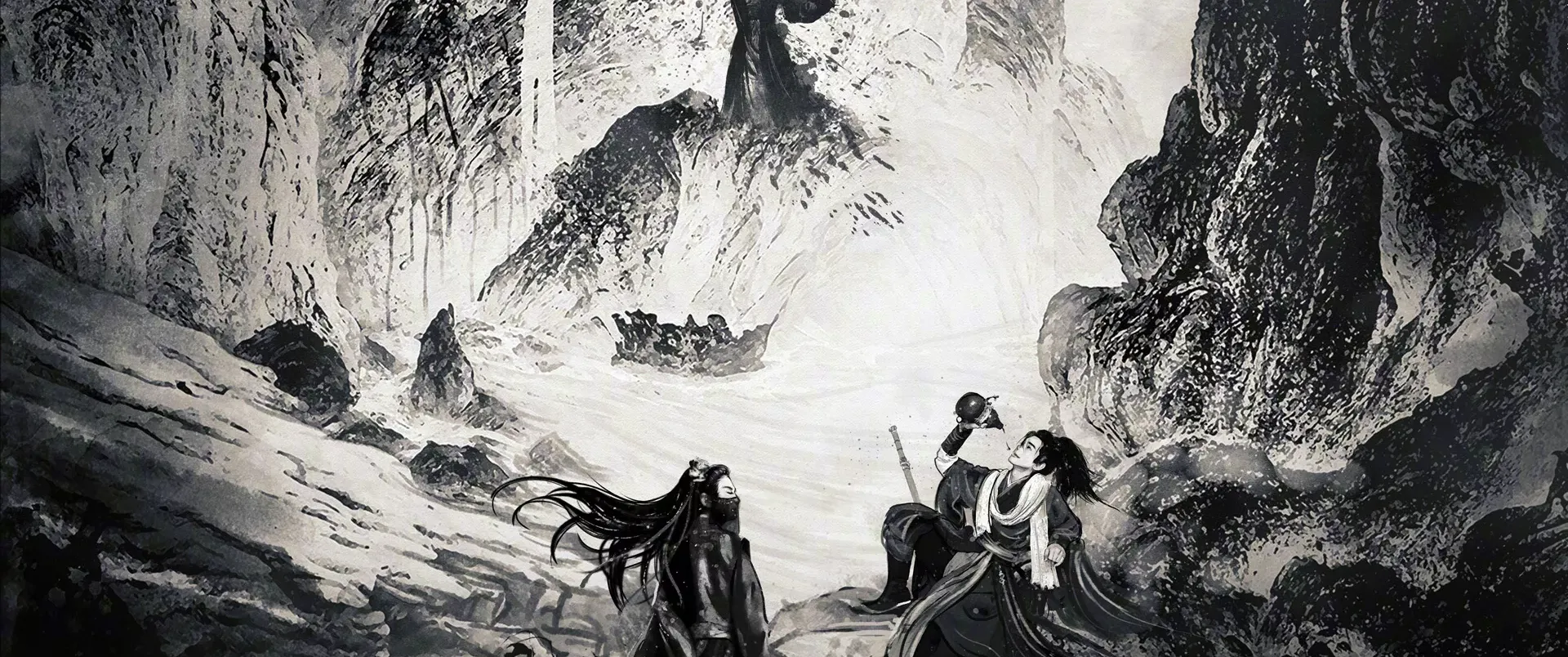
Feng Qingyang (simplified: 风清扬, traditional: 風清揚, pinyin: Fēng Qīngyáng, jyutping: fung1 cing1 joeng4) was a reclusive master swordsman from the Huashan School’s Sword Faction who had withdrawn from worldly affairs and lived in seclusion near the Cliff of Reflection. He was the martial uncle of Yue Buqun and Ning Zhongze, and a respected martial artists in the jianghu, recognised even by Ren Woxing as one of the three and a half people he most admired.
Biography
The Sword-Qi conflict
Feng Qingyang belonged to the Sword Faction of the Huashan School during the period when the school was divided between the Sword Faction and Qi Faction. When the two factions prepared for their decisive conflict, the Qi Faction conspired to remove Feng Qingyang from the equation. They arranged a false marriage in Jiangnan, tricking him into travelling south to attend what he believed was his own wedding ceremony.
By the time Feng Qingyang discovered the deception and returned to Mount Hua, the Sword-Qi conflict had already concluded with the Sword Faction’s defeat and the deaths of most Sword Faction masters. Deeply ashamed and filled with regret, Feng Qingyang chose to withdraw from the jianghu entirely, sealing his sword and vowing never to involve himself in jianghu affairs again. He lived in seclusion near the Cliff of Reflection for decades, leading many in the martial arts world to believe he had died.
Teaching Linghu Chong
Feng Qingyang broke his self-imposed isolation when he encountered Linghu Chong during the latter’s punishment on the Cliff of Reflection. Initially appearing only briefly—once when Yue Lingshan demonstrated the Jade Maiden Sword Nineteen Forms, where Feng Qingyang tested Linghu Chong’s swordplay under moonlight before disappearing without a word—he later formally emerged to teach Linghu Chong.
When Tian Boguang came to force Linghu Chong down the mountain, Feng Qingyang recognised Linghu Chong’s pure character and natural sword talent. Despite his vow to avoid Huashan School members, he agreed to teach Linghu Chong the legendary Nine Swords of Dugu, a technique that emphasised breaking all sword techniques rather than following fixed forms.
Feng Qingyang’s teaching philosophy emphasised that techniques were dead but people were alive. He taught Linghu Chong that the highest level of swordplay was to move from having techniques to having no techniques, that fingers could be swords, and that one should not be constrained by fixed patterns. He emphasised anticipating opponents’ weaknesses before they appeared and attacking those weaknesses immediately when they became visible.
Later involvement
After teaching Linghu Chong, Feng Qingyang maintained his reclusive lifestyle but remained aware of jianghu events. He sent the Six Immortals of the Peach Valley to deliver a message to Fangzheng of the Shaolin Order, informing him that the Sun Moon Order planned to attack Mount Heng School and requesting assistance. This demonstrated that despite his withdrawal, Feng Qingyang still cared about maintaining balance in the martial arts world.
Personality & traits
Feng Qingyang was described as a white-bearded old man in a blue robe, with a depressed expression and a face like gold paper. His voice was low and his demeanour melancholy, as if containing infinite sadness, yet his tone carried natural authority. Jin Yong described him in the afterword as a “disheartened, ashamed, and regretful hermit.”
Despite his reclusive nature, Feng Qingyang maintained his principles and refused to be bound by sectarian prejudices. He despised Yue Buqun’s doctrine that “focusing on sword techniques is a heretical path,” recognising it as empty dogma. His teaching emphasised understanding fundamental principles over memorisation, perfectly suiting Linghu Chong’s intuitive approach to learning.
Values and principles
Feng Qingyang embodied the Daoist ideal of naturalness and non-attachment. He had moved beyond the Sword-Qi factional divide, having cultivated both internal and external skills during his decades of seclusion. His philosophy emphasised that one must learn but never allow what one has learnt to become a constraint, and that treating any teaching as absolute dogma was the greatest bondage of all.
Martial arts abilities
Nine Swords of Dugu
Feng Qingyang was the master of the Nine Swords of Dugu, a legendary technique created by the “Sword Demon” Dugu Qiubai. This technique consisted of nine forms: the General Formula, Breaking Sword Form, Breaking Sabre Form, Breaking Spear Form, Breaking Whip Form, Breaking Rope Form, Breaking Palm Form, Breaking Arrow Form, and Breaking Qi Form.
The technique’s philosophy was that “all that has form can be broken,” and when mastered completely, it could make one invincible under heaven. Feng Qingyang had spent decades perfecting this art, achieving a level of mastery that even Chongxu of the Wudang Order admitted he could not think of a way to counter.
Huashan Swordplay
As a member of the Huashan School’s Sword Faction, Feng Qingyang had mastered all the school’s traditional sword techniques. His decades of seclusion had allowed him to transcend the factional divide, achieving mastery of both swordplay and neili cultivation.
Relationships
Feng Qingyang’s relationship with Linghu Chong was that of a master and student who became close friends despite their age difference. He recognised Linghu Chong’s pure nature and natural talent, providing him with martial arts techniques that matched his temperament. Their relationship demonstrated that true teaching transcended formal hierarchies and sectarian boundaries.
His relationship with Fangsheng of the Shaolin Order was one of mutual respect. Feng Qingyang had once saved Fangsheng’s life, and when Fangsheng saw Linghu Chong using the Nine Swords of Dugu, he immediately recognised it as the technique of his benefactor.
Behind the scenes
Feng Qingyang represents the ideal of the master who chooses seclusion over worldly power, yet still influences events through his teachings. His character embodies the Daoist philosophy of wuwei (non-action) and naturalness, demonstrating that true mastery comes from understanding principles rather than accumulating techniques.
Literary significance
The character serves as a contrast to the power-hungry figures who dominate the novel. Feng Qingyang had achieved the highest level of martial arts mastery yet chose complete withdrawal, demonstrating that true greatness does not require worldly recognition or authority. His teaching of Linghu Chong represents the transmission of wisdom from one generation to the next, preserving martial arts knowledge while allowing the student to develop their own understanding.
Cultural impact
Feng Qingyang’s name has become associated with exceptional teaching ability and strategic thinking. Chinese entrepreneur Jack Ma, founder of Alibaba, chose “Feng Qingyang” as his corporate alias, explaining that he admired Feng Qingyang’s role as a teacher who cultivated talent without seeking personal recognition, and his philosophy of “no techniques defeating techniques.”
Portrayals
Feng Qingyang has been portrayed by numerous actors in film and television adaptations of Laughing in the Wind:
Laughing in the Wind
- 1984 series – Lau Kong
- 1985 series – Chuan Yuan
- 1996 series – Bao Fang
- 2000 series – Yu Wenzhong
- 2001 series – Yu Cheng Hui
- 2013 series – Leung Kar-yan
See also
- Laughing in the Wind characters
- Linghu Chong – Feng Qingyang’s student
- Huashan School – Feng Qingyang’s faction
- Nine Swords of Dugu – Feng Qingyang’s signature technique
External links
- Feng Qingyang on Wikipedia
- Feng Qingyang (Chinese) on Chinese Wikipedia