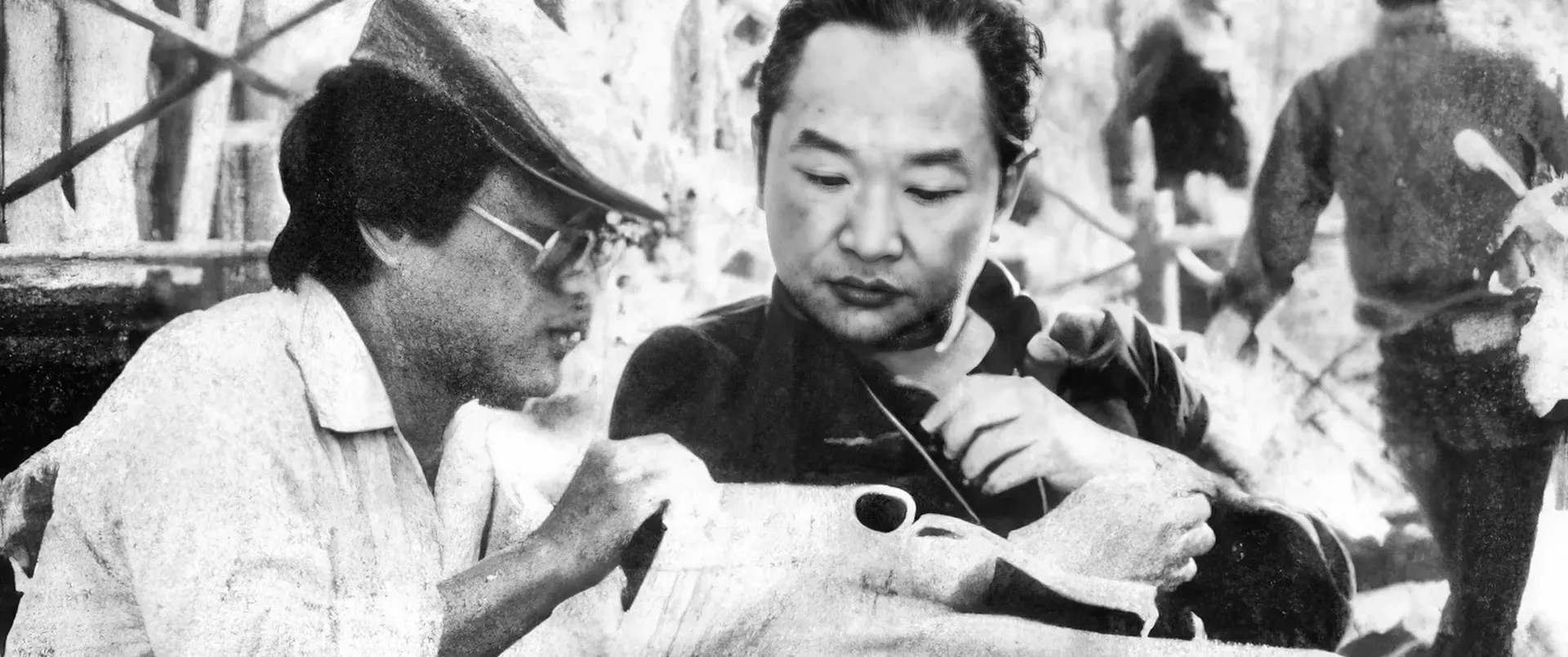
Ding Qing (Chinese: 丁情,pinyin: Dīng Qíng, 1954–2018), born Jiang Qinglong (蒋庆隆), was a wuxia novelist based in Taipei, Taiwan, best known as the most distinguished disciple and adopted son of Gu Long. Writing under the pen names Ding Qing, Xiao Huanglong (小黄龙), and Huang Xiaolong (黄小龙), he transitioned from a career in Taipei, Taiwan’s film industry to wuxia fiction in the mid-1980s. His works, often published jointly under both his and Gu Long’s names, include That Sword’s Romance (《那一剑的风情》), Rage Sword Wild Flower (《怒剑狂花》), and Border Town Blade Sound (《边城刀声》), which stand as authorised continuations of Gu Long’s literary universe.
Ding Qing occupies a unique position in wuxia history: neither purely imitator nor wholly independent creator, he served as Gu Long’s literary executor during the master’s final years, ghostwriting portions of the Lu Xiaofeng series and later producing sanctioned sequels that extended Gu Long’s characteristic style into new narratives.
Early life
Jiang Qinglong was born in 1954 and grew up in Taipei, Taiwan, in circumstances he would later describe as difficult and marked by family hardship. In his memoir My Shifu, Gu Long the Daxia (《我的师父古龙大侠》), he recalled a childhood where formal education took secondary place to survival, a background that would later fuel both his outsider perspective and his affinity for Gu Long’s own rebellious literary persona.
Before entering the world of wuxia fiction, Jiang worked in Taiwan’s film industry during the 1970s and early 1980s, adopting the stage names Xiao Huanglong (Little Yellow Dragon) and Huang Xiaolong. He directed and worked on various productions, though he later characterised this period as one of professional struggle and personal turbulence. The film industry’s demands, combined with his own admitted tendencies toward excess and financial imprudence, left him searching for a more sustainable creative outlet.
It was during this period of professional uncertainty that Jiang’s path intersected with Gu Long’s. By the early 1980s, Jiang had become a regular presence in Gu Long’s household, eventually residing there for extended periods. This proximity would prove transformative for both men: Gu Long gained a trusted companion during a period of declining health and increasing isolation, while Jiang found both mentorship and a new artistic direction.
Career
The relationship between Ding Qing and Gu Long transcended the conventional master-disciple dynamic. Gu Long, whose health had deteriorated significantly by the early 1980s due to chronic alcoholism and liver complications, found in Jiang a kindred spirit: someone who shared his irreverent attitude toward convention, his appreciation for the margins of society, and his belief that authentic experience mattered more than formal education.
According to Ding Qing’s own account, his initial attempts at writing proved awkward and uncertain. When he expressed hesitation about ghostwriting for Gu Long, the master provided what Ding Qing later termed the “secret of imitation”: rather than attempting to replicate Gu Long’s style through conscious effort, he should write from his own familiar experiences and use the language he naturally spoke. Gu Long’s instruction was characteristically direct: “Write more about what you know, what you often say or hear.”
This apprenticeship took on urgency as Gu Long’s physical condition worsened. By the mid-1980s, Gu Long’s hand injuries and chronic pain made the physical act of writing increasingly difficult. Ding Qing began serving as his amanuensis, transcribing Gu Long’s oral compositions and occasionally filling in gaps where the master’s energy failed. The most notable example of this collaboration was The Divine Sword’s Smile (《神剑一笑》), part of the Lu Xiaofeng series, which was dictated by Gu Long and transcribed by Ding Qing, with minor additions authorised by the master himself.
In 1985, Gu Long formally encouraged Ding Qing to begin publishing under his own name, telling him: “This may not be an era for accepting disciples, but I believe you have learned much. Write, while I still have the strength, while you are young and rich in imagination.” It was at Gu Long’s insistence that Jiang Qinglong adopted the pen name Ding Qing.
Collaborative works with Gu Long (1985–1986)
Ding Qing’s early works were published jointly under both his and Gu Long’s names:
- That Sword’s Romance (《那一剑的风情》, 1985): A prelude to Rage Sword Wild Flower, published by Wansheng Press in October 1985 as a three-volume set.
- Rage Sword Wild Flower (《怒剑狂花》, 1985): The companion volume, also published by Wansheng in October 1985 as a three-volume work.
- Border Town Blade Sound (《边城刀声》, 1986): The final collaborative work, published in June 1986 as a “side story” to Gu Long’s Border Town Wanderer (《边城浪子》).
Post-Gu Long works (1993 onwards)
Following Gu Long’s death in 1985, Ding Qing continued to produce works set within his master’s literary universe:
- Ximen Wuhen (《西门无恨》, 1993): A sequel to the Chu Liuxiang series.
- On the Eve of Meteors (《流星前夕》, 1993): A reimagining of Meteor, Butterfly, Sword (《流星·蝴蝶·剑》).
- The Blade’s Uncanny Valley (《刀的灵异》, 1994) and Charm in Sword Light (《剑光中的魅影》, 1994): Authorised extensions of the Chu Liuxiang universe.
- Little Blade’s Tragedy (《小刀悲情》, 1995): An adaptation of Gu Long’s modern crime novel Never Bow Your Head (《绝不低头》) into a wuxia setting.
- Grief of the Flying Daggers (《殇之飞刀》, 1995): A summation combining elements from Flying Daggers Again See Flying Daggers and The Sword of the Third Young Master.
In the afterword to Grief of the Flying Daggers, Ding Qing revealed that he had also ghostwritten Midnight Orchid (《午夜兰花》) and transcribed Flying Daggers Again See Flying Daggers from Gu Long’s oral dictation.
Later years
Ding Qing maintained a blog titled Ding Qing and Gu Long (《丁情与古龙》), where he published additional reflections on his master and excerpts from unfinished or unpublished works, including a piece titled Blade in the Blue Lake (《蓝色湖泊中的刀》), which he suggested may have been a title assigned by Gu Long himself before his death.
He died in 2018 at the age of 64, leaving behind a body of work that, while controversial in its artistic merits, stands as a unique document of literary succession in the wuxia tradition.
Personal life
Ding Qing married Qian Youlan (钱幽兰), who wrote affectionate afterwords for several of his works, including Ximen Wuhen and Grief of the Flying Daggers. Her accounts portray a man deeply marked by his relationship with Gu Long, forever shaped by the years of mentorship and the responsibility of carrying forward his master’s legacy.
Honours and recognition
Ding Qing did not receive major literary awards during his career. His recognition derives primarily from his unique position as Gu Long’s designated literary heir and the authenticity of his authorised continuations of the Gu Long canon.
Themes
Ding Qing’s prose style consciously emulates Gu Long’s distinctive approach: terse dialogue, philosophical interludes, and a preference for psychological tension over elaborate combat description.
The master’s shadow
Thematically, Ding Qing’s works explore familiar Gu Long territory: the burden of martial excellence, the impossibility of escape from one’s past, the redemptive potential of human connection, and the fundamental loneliness of the warrior’s path. His protagonists, like Gu Long’s, are often men marked by trauma, seeking meaning in a world that offers little comfort.
Literary style
Ding Qing’s sentences often employ the same rhythmic fragmentation that characterises Gu Long’s mature work, creating a reading experience that feels immediately recognisable to fans of the master. Where he diverges is in his treatment of romantic relationships, which receive somewhat more developed attention than in Gu Long’s often male-centred narratives. Critics have offered mixed assessments, with some dismissing him as an unsuccessful imitator and others recognising the genuine difficulty and authenticity of extending another author’s creative universe.
Legacy
Ding Qing’s place in wuxia history remains complex and somewhat contested. To his detractors, he represents the commercialisation of Gu Long’s legacy. To his defenders, he was a faithful disciple who undertook the difficult task of extending his master’s vision with integrity and genuine affection.
What is certain is that Ding Qing’s works have maintained a readership in the decades since their publication. For scholars of wuxia literature, his career provides a fascinating case study in literary succession, ghostwriting, and the challenges of continuing another author’s creative universe. His memoir My Shifu, Gu Long the Daxia remains an important primary source for understanding Gu Long’s final years, offering intimate details about the master’s working methods, his philosophy of writing, and his personal struggles that cannot be found elsewhere.
Works
Collaborative works with Gu Long
- That Sword’s Romance (《那一剑的风情》, 1985)
- Rage Sword Wild Flower (《怒剑狂花》, 1985)
- Border Town Blade Sound (《边城刀声》, 1986)
Post-Gu Long works
- Ximen Wuhen (《西门无恨》, 1993)
- On the Eve of Meteors (《流星前夕》, 1993)
- The Blade’s Uncanny Valley (《刀的灵异》, 1994)
- Charm in Sword Light (《剑光中的魅影》, 1994)
- Little Blade’s Tragedy (《小刀悲情》, 1995)
- Grief of the Flying Daggers (《殇之飞刀》, 1995)
Key titles
- That Sword’s Romance (《那一剑的风情》, 1985)
- Rage Sword Wild Flower (《怒剑狂花》, 1985)
- Border Town Blade Sound (《边城刀声》, 1986)
- Ximen Wuhen (《西门无恨》, 1993)
- On the Eve of Meteors (《流星前夕》, 1993)
See also
- Gu Long — master and collaborator
- Huang Ying — fellow Gu Long disciple
- Xue Xingguo — Gu Long ghostwriter